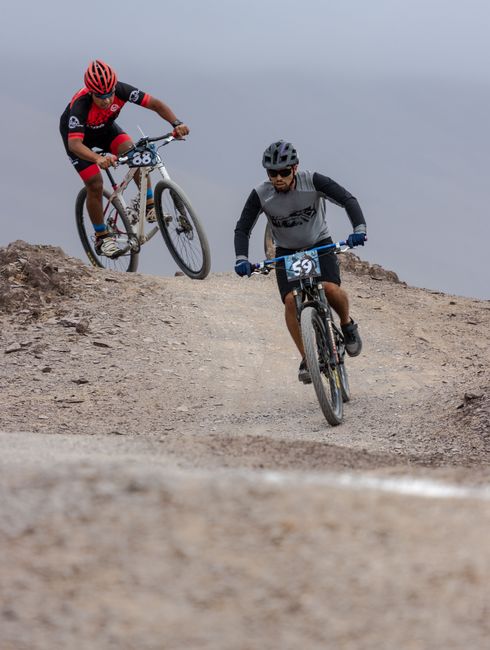
You are standing at the lip of a rock roll you have ridden twice before. Your hands are tight on the grips, your eyes are locked on the one sharp rock you want to miss, and a voice in your head is listing every way this can go wrong. Every rider knows that pause. Mental training for mountain bikers is the practice of using attention, self-talk, routines and planning so that you ride the trail in front of you with more control, whether you are on a Saturday loop, a school team race or a cross-country start line. It does not replace skill or fitness, and it cannot promise a faster run or a safer one.
Quick answer: The mental tools with the best general support in sport are short self-talk cues, a simple pre-performance routine, flexible goals and imagery. Research on all of them is general or comes from lab cycling studies, not from trails, and none guarantees a result. Fear that keeps growing, nerves after a crash that do not ease, or a hit to the head are reasons to see a doctor or licensed mental health professional, not just to try a new cue word.
General information for riders. Back to the mountain biking hub. The skills progression and strength work are on the training page, and fueling, heat and race checklists are on the ride day and race day page.
Fear on technical features: respect it, then build toward it
Fear on a drop, a steep roll-in or a jump is information. Mountain biking has real consequences: a 2025 video analysis of 534 mountain bike crashes (Bonte and colleagues, European Journal of Sport Science) found over-the-bars falls were the most common type and often followed poorly landed jumps. A rider who feels uneasy about a feature may be reading it correctly, and walking it is a legitimate choice. The injuries page covers what those crashes can do.
We did not find a mountain bike study on how riders overcome fear of a particular feature, so the ideas below are common coaching practice, not research findings:
- Build a ladder. Ride a smaller version of the same thing first: a low roll-down before a drop, a tiny tabletop before a bigger jump. The training page lays out a skills progression in order.
- Look, then decide. Walk the feature, check the run-out, pick your line, and then either commit or ride away. Half-committing is when many riders get into trouble, so make the decision at the top, not in the air.
- Let it be a no-go day. If you are tired, hungry or distracted, skip the feature you were saving for today.
Confidence after a crash
Crashes hurt, and sometimes the part that lingers is not physical. A survey of cyclists (Kotler and colleagues, Physical Medicine and Rehabilitation Clinics of North America, 2022) found that fear or anxiety after a crash was associated with being female, a history of depression and a more severe crash. Few of the cyclists received treatment, and most returned to cycling at their previous level, but how long that took varied. In plain words: nerves after a crash are common, there is no standard timetable, and the rider who gets back on slowly is not doing it wrong. The survey covered cyclists in general, not only mountain bikers.
- Get checked first. If you hit your head, or have headache, dizziness, confusion or nausea afterwards, see a doctor before you ride. The injuries page explains the signs and the CDC HEADS UP approach. Easing back belongs on the recovery page.
- Come back in steps. Common coaching practice: start on a trail you know well, ride below the level that caused the crash, then add one challenge at a time. We found no mountain bike study that tests this, so treat it as a sensible habit, not a protocol.
Line choice and focus
Good riders often talk about looking where they want to go, not at the rock they fear. That advice is standard in coaching, and our training page includes it in the skills progression, but we did not find a mountain bike study to cite for it. What research does give us is a general principle: a 2011 meta-analysis of 32 studies (Hatzigeorgiadis and colleagues, Perspectives on Psychological Science) found a moderate positive average effect of self-talk on sport performance, with larger benefits for fine skills and new tasks than for well-learned, gross movements. Line choice and technical features are partly new tasks every time, which is why a short cue may be more useful there than on a long, steady climb.
- Pick one cue per section. “Eyes up” for a rock garden, “smooth” for a corner, “pedal” for the next climb. Practice them on ordinary rides so they are familiar when you are tired.
- Reset after a mistake. A missed line is over the moment it is behind you. A breath and your cue word get you to the next feature.
Self-talk for the hard parts
Two small cycling studies are the nearest evidence for riders. In 2014 (Blanchfield and colleagues, Medicine & Science in Sports & Exercise), 24 people did two weeks of motivational self-talk training and then rode to exhaustion at a fixed hard effort: they lasted an average of 750 seconds, up from 637, with no change in the control group. In 2015 (Barwood and colleagues, International Journal of Sports Physiology and Performance), 14 men rode four 10-km time trials, and the group trained in motivational self-talk got faster while a neutral self-talk group did not. Both were small lab studies, not on dirt, so they say little about a technical descent.
Goals, motivation and imagery
An expert statement for Exercise and Sports Science Australia (Swann and colleagues, Sports Medicine) cautions that goal setting needs awareness of its risks and pitfalls, not only the SMART acronym. On a trail that means holding goals loosely. Weather, mud, a mechanical or a bad day should be able to change the plan.
- Use a goal ladder. A goal (everything clicks), B goal (a solid ride), C goal (finish safe and learn something). A common coaching idea, not a study result.
- Add process goals you control: hold your braking points, eat on the climbs, keep your head up through the rough.
- Use course imagery. Mental imagery means rehearsing the ride in your mind. A 2026 scoping review in Frontiers in Psychology mapped imagery use for stress management in athletes and found it widely used, with the term covering several different things; the evidence is still being sorted out. After a trail walk or practice run, try five minutes picturing the key sections, including what you will do if a line goes wrong.
In a 2018 survey of 1,484 mountain bikers (Roberts and colleagues, Frontiers in Psychology), riders reported many benefits to mental health and well-being from riding. That is what riders say, not proof, but if every ride becomes a test, the part that keeps you coming back can fade. A small pilot study of downhill riders (Hetland and colleagues, 2019) found less visible happiness during a descent than before and after it, which the authors link to how demanding the descent was, so a serious face mid-run does not mean you are not enjoying it.
Race routines and handling pressure
A 2026 position statement from Exercise and Sports Science Australia on performance under pressure (Schweickle and colleagues, Sports Medicine) says pressure can have both helpful and harmful effects on performance, and lists four evidence-based strategies: pre-performance routines, implicit attentional strategies, psychological skills training and mindfulness-based approaches. It is written for sport in general, not for mountain biking, and it does not promise a result. A 2026 scoping review of 17 randomized trials of mindfulness-based programs in athletes (Cherappurath and colleagues, Healthcare) reported beneficial effects on several outcomes, though not uniformly, and called for better trials.
For a mountain bike race the routine is the sequence you can repeat: a breakfast you have practiced, a bike check, the same warm-up, a short walk or ride of the first section, a minute of slow breathing, one cue word at the gate or start line. No mountain bike study on race routines turned up; the value is predictability, not proof. Course practice, warm-up and the bike checklist are on the ride day and race day page.
- Enduro: each stage is its own short race. Use the transition to eat, breathe and reset the cue, and let the last stage go.
- Downhill and gravity racing: the run is short, so most of the mental work happens at the top: line, cue, one breath, go.
Young riders and school teams
A 2025 scoping review of outdoor mountain biking for adolescents aged 10 to 18 (Zarbiv and colleagues, BMJ Open Sport & Exercise Medicine) found only five studies, which associated programs with better self-esteem, resilience, emotional regulation and social connection, and said more research is needed. A 2025 British Journal of Sports Medicine paper (Goddard and colleagues) asks whether goal setting in youth sport may contribute to dropout, so keeping young riders’ goals about skills, effort and fun is sensible. Team and age-group details are on the youth mountain biking page.
Mental performance is not the same as mental health
Cue words, routines and imagery are performance tools. Anxiety, depression, disordered eating, sleep problems and burnout are health matters, and a “toughen up” approach is not the answer for them. The International Olympic Committee consensus statement on mental health in elite athletes (Reardon and colleagues, British Journal of Sports Medicine, 2019) says mental health symptoms and disorders are common among elite athletes, can impair performance, and cannot be separated from physical health.
Signs to take seriously include dread of riding that does not ease, fear that spreads into daily life, restricting food to climb lighter, ongoing low mood or poor sleep, and, for riders who have had a crash, flashbacks or avoiding the trail altogether. Talk to a doctor or a licensed mental health professional. In the United States, you can call or text 988 (Suicide and Crisis Lifeline) any time if you or someone else is in crisis. Outside the US, use your local emergency number or crisis line. A sport psychology professional can help with performance skills, and the Association for Applied Sport Psychology lists resources at appliedsportpsych.org.
Mental training: FAQs
How do I stop being afraid of drops and jumps?
We did not find a mountain bike study that tests a method. Coaches commonly suggest a ladder of smaller versions, deciding at the top, and a clear technical cue, with a lesson if you are stuck. It is fine to walk something that does not feel right today.
Is it normal to be nervous after a crash?
Yes. A survey of cyclists found post-crash fear or anxiety associated with being female, a history of depression and a more severe crash, and the time to return varied (Kotler 2022). If the fear is not easing, or affects sleep or daily life, talk to a doctor or licensed mental health professional.
Does self-talk work for mountain biking?
It can help some riders, but there are no guarantees. A meta-analysis found a moderate average benefit across sports (Hatzigeorgiadis 2011), and two small lab cycling studies found longer time to exhaustion and a faster 10-km time trial after training (Blanchfield 2014; Barwood 2015). None was on a trail.
What should I do the morning of a race?
Follow a routine you have practiced: the same breakfast, bike check, warm-up and one or two cues. Pre-performance routines are among the strategies listed in the 2026 ESSA position statement on performance under pressure. Logistics and fueling are on the race day page.
When is a bad feeling a reason to stop riding?
If it is a health decision: a head knock, dizziness, confusion, chest pain, a sudden sharp pain or signs of heat illness mean stop and get medical help. Ordinary nerves are different, and a goal ladder helps you choose.
Sources
- Bonte et al. Video analysis of 534 mountain bike crashes. Eur J Sport Sci 2025 (PMID 40534393)
- Kotler DH et al. Fear, anxiety, and return to sport after cycling crashes: a survey of cyclists. Phys Med Rehabil Clin N Am 2022 (doi, PMID 34798993)
- Hatzigeorgiadis A et al. Self-talk and sports performance: a meta-analysis. Perspect Psychol Sci 2011 (doi, PMID 26167788)
- Blanchfield AW et al. Talking yourself out of exhaustion. Med Sci Sports Exerc 2014 (doi, PMID 24121242)
- Barwood MJ et al. Improvement of 10-km time-trial cycling with motivational self-talk compared with neutral self-talk. Int J Sports Physiol Perform 2015 (doi, PMID 25010539)
- Swann C et al. Goal setting in exercise and physical activity: an expert statement for Exercise and Sports Science Australia. Sports Med 2026 (doi)
- Zhao L, Wang Y, Anuar N. Mapping the use of mental imagery for stress management in athletes: a scoping review. Front Psychol 2026 (doi)
- Roberts L, Jones G, Brooks R. Why do you ride? A characterization of mountain bikers, their engagement methods, and perceived links to mental health and well-being. Front Psychol 2018 (doi)
- Hetland A et al. The thrill of speedy descents: a pilot study on facially expressed online emotions during a downhill mountain-bike descent. Front Psychol 2019 (doi)
- Schweickle MJ et al. Performance under pressure in sport: a position statement from Exercise and Sports Science Australia. Sports Med 2026 (doi, PMID 42271117)
- Cherappurath N et al. Mindfulness-based interventions and psychological well-being in athletes: a scoping review of randomised controlled trials. Healthcare 2026 (doi)
- Zarbiv G et al. Impact of mountain biking on adolescent well-being: a scoping review. BMJ Open Sport Exerc Med 2025 (doi)
- Goddard SG et al. Goal setting in youth sport: are we unintentionally contributing to dropout? Br J Sports Med 2025 (doi)
- Reardon CL et al. Mental health in elite athletes: IOC consensus statement (2019). Br J Sports Med 2019 (doi, PMID 31097450)
- 988 Suicide and Crisis Lifeline (988lifeline.org)
- Association for Applied Sport Psychology resources (appliedsportpsych.org)
General information for education only, not medical advice. It does not replace a doctor, licensed mental health professional or qualified coach. See our editorial policy for how we research and write.