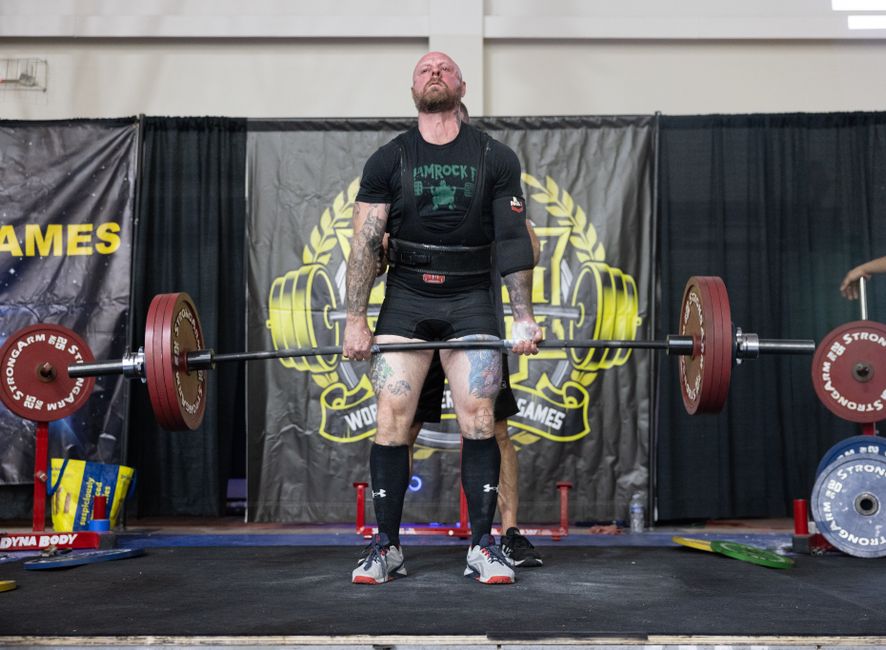
It is the third squat round at a regional meet, and a lifter walks to the bar after the group before her has made a mess of the platform. She doesn’t rush. She checks the rack height, lets the spotter/loaders square up behind the bar, takes her breath and her brace, and waits for the head referee’s “Squat”. Powerlifting injury prevention is the set of habits around a lifter that aim to lower the chance of getting hurt in the squat, bench press and deadlift: coaching, a slow build in load, planned easier weeks, good spotting, honest use of gear, and a sensible approach to body weight. It can lower risk, not remove it.
Quick answer: Powerlifting injury rates are low next to many sports, but low back, shoulder and knee problems are the usual ones, and most come from loading that rose too fast or technique that breaks down when the bar gets heavy. Work with a coach, add load in small steps, schedule easier weeks, use safeties and trained spotter/loaders, and treat belts and sleeves as tools rather than shields. See a sports medicine doctor, physical therapist or athletic trainer if pain lasts, if a joint feels unstable, or straight away for numbness, leg weakness, or a pop with bruising.
General information, not medical advice. This page is about lowering risk. For what each injury looks like and the warning signs, see our powerlifting injuries guide. Back to the powerlifting hub.
What the research says needs preventing
A systematic review of weightlifters and powerlifters put powerlifting at about 1.0 to 4.4 injuries per 1,000 hours of training, with the spine, shoulder and knee hit most often, and called the risk similar to other non-contact sports (Aasa and colleagues, British Journal of Sports Medicine, 2017). In a questionnaire of 104 Swedish sub-elite classic lifters, 70% were injured at the time and 87% had been injured in the past 12 months, mostly in the lumbopelvic region, shoulder and hip, and the authors said load management and technique were likely important (Strömbäck and colleagues, Orthopaedic Journal of Sports Medicine, 2018).
Outside the competition world, a different risk shows up. A study of US emergency department records from 1990 to 2007 found that about two thirds of weight-training injuries involved weights dropping on the person (Kerr and colleagues, American Journal of Sports Medicine, 2010). That is why spotting and safeties get their own section below.
Warm-up: what is and isn’t known
Soccer has the FIFA 11+, a tested warm-up program. We did not find a widely published, tested named warm-up program for powerlifting, so be wary of anyone who says one exists. What lifters actually do is common coaching practice, not a trial result: a few minutes of easy movement, then the lift itself in ramping sets, with the first sets light enough to groove the pattern before the bar gets heavy. Our meet day guide covers warm-ups around your attempts.
Technique and coaching
Technique isn’t only about passing the referees’ lights. The Swedish study above names technique as something that likely matters for injury, and no one sees their own bar path clearly from underneath it. A coach, or a training partner filming from the side, can spot a squat that loses its brace out of the bottom or a deadlift where the back rounds before the bar leaves the floor.
It helps to train the movements the way the platform judges them. In the IPF rulebook, a squat must go to the point where the top of the legs at the hip joint is lower than the top of the knees, a bench needs head, shoulders and buttocks in contact with the bench and the feet flat, and a deadlift ends with the knees locked. Practising those standards with controlled reps, not only maximal singles, gives you more chances to notice a technique problem while the weight is manageable. Our rules page and training guide go deeper on the standards and programming.
Progressive load and deloads
There is no published, proven weekly increase that keeps every lifter safe, so treat any rule you read online with caution. In a 2026 survey of 548 powerlifters, respondents trained an average of 4.25 sessions a week, and nearly all used barbell variations and accessory lifts (Amdi and colleagues, Journal of Strength and Conditioning Research). Reps-in-reserve effort scales are one way lifters keep heavy sets from turning into grinds (Helms and colleagues, 2016).
Deloads, meaning planned lighter weeks, are common. In a survey of 246 strength athletes, all had deloaded, averaging 6.4 days every 5.6 weeks (Rogerson and colleagues, Sports Medicine Open, 2024), and coaches in another study described deloads as typically lasting 5 to 7 days (Bell and colleagues, 2022). Those describe what people do, not proof it prevents injury. A common coaching rule of thumb is to back off when joints feel beaten up and bar speed drops for several sessions.
Peaking is another high-risk time. Surveys of raw lifters found they cut volume sharply before a meet: about 41% to 50% in a step taper starting 7 to 10 days out in one study of 364 lifters (Travis and colleagues, 2021), and about 59% in New Zealand elite lifters (Pritchard and colleagues, 2016). See recovery for habits between sessions.
Low back
The lumbar spine is loaded in both the squat and the deadlift, so back prevention comes down to loading and bracing habits rather than any single trick. Common coaching advice is to stop a set when the back starts to round and not chase one more heavy single when the last rep already looked different. The American Academy of Orthopaedic Surgeons (AAOS) says most low back pain goes away within a few weeks, but it lists leg weakness, numbness or tingling that runs to the foot, loss of bladder or bowel control, and fever with chills or weight loss as signs to get checked promptly.
Shoulder and elbow
The bench press and low-bar squat ask a lot of the shoulder, and the shoulder was among the most common problem areas in both the Swedish and German studies. Lifters often protect it by watching bench volume and including rows and other pulling work in their accessories. AAOS has a guide to shoulder impingement and rotator cuff tendinitis, two overuse problems of the shoulder, and our injuries page covers when to get one checked.
AAOS lists weightlifting among the causes of tennis elbow, which shows up as outer-elbow pain and a weak grip, and says 80% to 95% of cases improve without surgery. In the German survey, upper-limb problems were more frequent in lifters over 40 (Siewe and colleagues, International Journal of Sports Medicine, 2011), so masters lifters may want to watch that load. AAOS notes that tears occur mostly in men aged 30 to 60, often during the lowering phase of a bench press, and lists weightlifting and anabolic steroids as risk factors.
Knee and hip
Knee prevention in the squat is mostly about gradual loading and working within the range you can control. AAOS describes patellofemoral pain as pain around the kneecap, and it notes that tendon injuries can be serious: a patellar tendon tear, with popping, a knee that can’t straighten and a kneecap that rides up, needs prompt medical care, and anabolic steroids are among its listed risk factors.
Spotting, safeties and the platform
In a meet, the IPF rulebook says there must be at least two and no more than five spotter/loaders on the platform at any time. In the gym, National Strength and Conditioning Association (NSCA) guidance treats spotting as a skill. Spotters can matter psychologically too: one study found lifters managed about 4.5 more bench reps with spotters present (Sheridan and colleagues, 2019). That is a performance finding, not proof that spotters prevent injury.
- Set safeties for the squat and bench. Pins or straps sit just below the lowest bar position you’ll reach, and you check them before the first work set. This is common practice, not a sourced figure.
- Practise failing. Many coaches have lifters rehearse a missed squat or bench in a safe setup.
- Train deadlifts with care. A deadlift isn’t spotted the way a squat or bench is, so keep the setup honest and stop a set when the position changes.
- Agree on commands. Settle them with spotters before the set, as a meet crew works from the head referee’s “Start”, “Press” and “Rack”.
Belts, sleeves and other gear: what is known
Gear is where marketing runs ahead of evidence. Verified standards first: IPF rules limit a belt to 10 cm wide and 13 mm thick, and knee sleeves to 7 mm thick and 30 cm long, and your federation decides what is legal on its platform. Details are on our gear page.
What research says about protection is thin. In the German survey, belt users reported more lumbar spine injuries (Siewe and colleagues, 2011), but that was a questionnaire at one point in time, so it can’t show that belts cause back injuries, and no study we found shows that belts prevent them. For knee sleeves, one small study of 15 men found a slightly heavier squat maximum in neoprene sleeves (166 kg against 161 kg without; Machek and colleagues, 2021), which is a performance result, not an injury one. Belts and sleeves are tools, not replacements for bracing, technique or sensible load, and maker claims about “protection” are claims until a study supports them.
Safe weight management
Weight classes make cutting a normal part of the sport, and it carries real risk. A study of the 2018 IPF Classic World Championships found 83% of surveyed lifters cut weight, by an average of 2.9% of body mass, using methods from gradual dieting to fluid restriction, laxatives, sauna and diuretics, and most reported negative psychological changes (Kwan and Helms, Journal of Strength and Conditioning Research, 2022). Because IPF weigh-in is no earlier than two hours before the lifting starts, we advise against water cuts: there’s very little time to recover before a heavy squat. Talk to a coach or registered dietitian about reaching a class through steady changes, or moving up a class instead of dehydrating.
The National Athletic Trainers’ Association (NATA) fluid replacement statement says to drink to thirst when you don’t know your sweat rate, and not to overdrink (McDermott and colleagues, 2017). For teens, see the American Academy of Pediatrics (AAP) report on healthy weight-control practices in young athletes (Carl and colleagues, 2017). See also nutrition and supplements.
Youth lifters
The AAP clinical report on resistance training for children and adolescents (Stricker and colleagues, Pediatrics, 2020) supports supervised, technique-focused programs with two to three sessions a week over at least eight weeks. More in our youth powerlifting guide.
What prevention can’t do
No plan removes risk. Heavy bars, fatigue, bad luck and sudden tendon failures happen to careful lifters,. A simple training log of what hurts and when can show patterns early.
When to see a professional
See a sports medicine doctor, physical therapist or athletic trainer if pain lasts for more than a few weeks, gets worse with training, or leaves a joint feeling unstable. Get care promptly for a pop, tearing or bruising in the chest or knee, leg weakness, numbness or tingling down the leg, or loss of bladder or bowel control. For the details of each injury, go to our injuries page.
Powerlifting injury prevention: FAQs
Does a lifting belt prevent injury?
There is no study we found showing that it does. Belt users reported more lumbar injuries in one German survey, which can’t prove a cause. Learn to brace first, and treat the belt as a tool.
How often should I deload?
There is no proven schedule. In one survey of strength athletes the average was about 6 days every 5.6 weeks (Rogerson and colleagues, 2024). Your coach can tailor it to your training.
Is cutting weight for a meet safe?
It carries risk. Most lifters in the 2018 IPF Worlds study cut weight, and most reported negative psychological changes. We advise against water cuts and suggest talking to a coach or dietitian.
Can I keep training with joint pain?
Mild soreness often allows modified training, but pain that lasts, sharpens or comes with numbness, weakness or instability needs a professional’s advice first.
Sources
- Aasa et al., injuries among weightlifters and powerlifters, systematic review, British Journal of Sports Medicine, 2017
- Siewe et al., injuries and overuse syndromes in powerlifting, International Journal of Sports Medicine, 2011
- Strömbäck et al., prevalence and consequences of injuries in powerlifting, Orthopaedic Journal of Sports Medicine, 2018
- Kerr et al., weight training-related injuries in US emergency departments, 2010
- Amdi et al., survey of powerlifters’ training practices, JSCR, 2026
- Helms et al., RIR-based RPE scale, Strength and Conditioning Journal, 2016
- Rogerson et al., deloading practices of strength athletes, Sports Medicine Open, 2024
- Bell et al., coaches’ perceptions of deloading, 2022
- Travis et al., tapering practices of raw powerlifters, JSCR, 2021
- Pritchard et al., tapering practices of elite raw powerlifters, JSCR, 2016
- Sheridan et al., effect of spotters on bench press repetitions, JSCR, 2019
- NSCA spotting guidance, study-guide summary
- Machek et al., neoprene knee sleeves and squat strength, JSCR, 2021
- Kwan and Helms, weight cutting by world class powerlifters, JSCR, 2022
- AAP clinical report, healthy weight-control practices in young athletes, 2017
- NATA position statement, fluid replacement, 2017
- AAP clinical report, resistance training for children and adolescents, 2020
- IPF Technical Rulebook, effective 1 March 2026
- AAOS OrthoInfo, low back pain
- AAOS OrthoInfo, shoulder impingement and rotator cuff tendinitis
- AAOS OrthoInfo, tennis elbow
- AAOS OrthoInfo, pectoralis tendon tear
- AAOS OrthoInfo, patellofemoral pain syndrome
- AAOS OrthoInfo, patellar tendon tear
General information for education only, not medical advice. It does not replace a visit with a doctor, physical therapist or athletic trainer. See how we write and check our pages in our editorial policy.