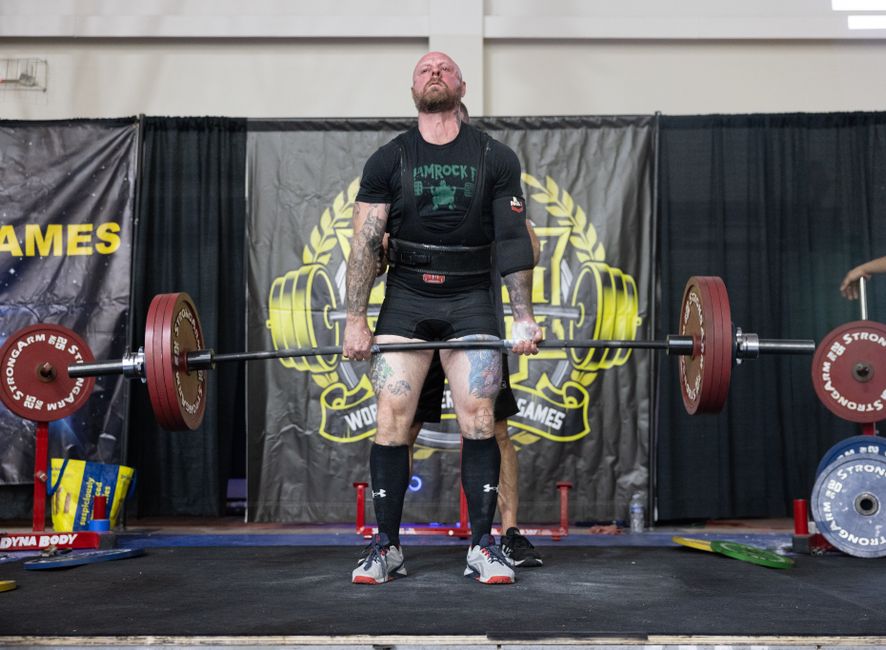
The bar is loaded, the head referee says your name, and the clock starts: one minute to begin. Your third squat is a weight you have only hit once in training, the lifter before you just got three white lights, and your hands are shaking a little. Every lifter knows that moment, from a first local meet to a national platform. Powerlifting mental training means practicing the skills that happen between the chalk and the “Squat” command (choosing attempts with a clear head, settling nerves, getting properly fired up, and shaking off a miss) the way you practice paused bench. This page is about mental performance, which is different from mental health; there is a clear section on that difference below.
Quick answer: Mental skills are trainable habits: attempts planned in advance, a short routine before each lift, arousal you can raise or lower on purpose, and a plan for a red-light attempt. The research on powerlifters is small and mostly observational, and no technique guarantees a heavier total. Fear before a heavy bar is normal, but pain, a bad weight cut or worry that will not let go are health matters, so see a doctor, sports medicine clinician or other qualified professional. In a crisis in the US, call or text 988.
Choosing attempts when the pressure is on
Attempt selection is where nerves and numbers meet. A 2021 analysis of more than 10,000 entries in Australian raw powerlifting competitions (Howells and colleagues, Journal of Sports Medicine and Physical Fitness) found that, on average, lifters opened at about 92% of the best squat they achieved that day, and 93.5% of them improved on that weight later. Winners had opened about 7 kg heavier on squat than non-winners, and about 68% of winners made their third attempt compared with about 64% of non-winners. A related analysis (van den Hoek and colleagues, BMC Sports Science, Medicine and Rehabilitation, 2022) found heavier first attempts among winners on bench and deadlift too. These are associations, not instructions: stronger lifters naturally open heavier, so the data do not show that raising your opener will win you a meet.
What helps under pressure is deciding before the pressure starts. The IPF rules explained on our meet day page give you one minute to hand in the next attempt, so there is little time to think. These steps are common coaching practice, not tested in a trial:
- Write the plan before the meet. Put an opener, a second and a third on paper, with a “feeling good” and a “feeling heavy” option for each, based on your recent training, not on how the warm-up room makes you feel.
- Give your coach or handler the decision. Choosing when you are about to lift is when judgment is worst. Agree in advance who calls the numbers.
How training sets and peaking feed these numbers is covered on our powerlifting training page.
Fear of heavy weights
A new max, a squat that feels like it is sitting on your chest, a bench you once failed: caution under a heavy bar is natural. We did not find a powerlifting study that tests a method for reducing fear of heavy weights, so we will not claim one works. What the evidence can say is narrower. In a 2016 study of 36 collegiate powerlifters on club teams (Judge and colleagues, Journal of Strength and Conditioning Research), higher scores on the Sport Competition Anxiety Test were linked to a lower percentage of their best total achieved on the day, and to lower personal bests in the bench press and deadlift, but not in the squat. It was a small, one-meet study, so it shows a link and not a cause.
Common coaching habits, not proven fixes:
- Rehearse the weight. Heavy singles in training, with commands called and spotters and safeties set up, make the meet weight less of a stranger. Our powerlifting injuries page covers bar safety.
Arousal control before a lift
Powerlifting is unusual because many lifters want to be more activated, not calmer, before a max. A 2026 study of 200 competitive strongmen, strongwomen and powerlifters (Cusimano and colleagues, Journal of Strength and Conditioning Research) had them deadlift twice, once after a free-choice psyching-up strategy and once passively. Average bar speed was about 18.6% higher after psyching up, which the authors converted to an estimated 4.3% increase in predicted one-rep max. No one of the eight strategies beat the others, but lifters tended to pick strategies that matched their personality: those higher in reward sensitivity and trait aggression and lower in anxiety sensitivity leaned toward arousal-raising methods.
It was a single deadlift in a testing setting, not a platform, and bar speed is not a made lift. Lifters differ: copying someone who thrives on loud music may backfire if you get shaky when wound up. Learn your own pattern in training:
- Try a few ways of getting ready on heavy training days (music, a cue word, a short breathing pause, a slap or none) and note which leaves you focused instead of frantic.
- If you feel over-wound, a slow breath and a single cue are common coaching tools. If you feel flat, raise your activation a little. Neither is a cure.
A 2026 Exercise and Sports Science Australia position statement on performance under pressure (Schweickle and colleagues, Sports Medicine) lists pre-performance routines among evidence-based strategies and notes that practicing with some pressure can help. A 2023 systematic review across sports (Reinebo and colleagues, Sports Medicine) found moderate effects for imagery and other psychological skills training, but the effects were not stable once non-randomized trials and subjective outcomes were removed; we found no powerlifting imagery trial. A routine for the platform can be as small as: chalk, breath, one cue, wait for the command. Rehearse it on training days, ideally with a partner calling the commands.
After a failed lift
Red lights happen to everyone: depth, a bar that stalls, a press command missed. You still have your remaining attempts, and the next weight is due within one minute, so there is little time to dwell. We found no study of how powerlifters recover from a miss, so this is general coaching practice:
- Sort the miss. Was it a judging call (depth, a pause) or a strength miss? Your coach can help, because the answer changes your next attempt.
- Lean on the plan. Your “feeling heavy” option exists for this moment. After a miss, the bar stays the same or goes up depending on your plan, and it is easier to follow a plan than to invent one.
- Look after your body first. If anything hurt, take that seriously before talking about attitude; see powerlifting injuries and our recovery page.
Weight-class pressure is a health matter
Weight classes put a number on the scale between you and the platform, and that number can take over your head. In a survey at the 2018 IPF Classic World Championships (Kwan and Helms, Journal of Strength and Conditioning Research, 2022), 83% of lifters had cut weight, losing 2.9% of body mass on average, and most reported negative psychological changes. A survey of 69 British IPF lifters (Campbell and colleagues, Nutrition and Health, 2023) found that 97% had purposely reduced body mass to compete, with an average typical loss of 4.2%. Fluid restriction (86.5%) was the most common method, and about 70% of open-ended comments about the process were negative: fatigue, anxiety, low mood and irritation. The authors cautioned against large rapid cuts.
That is a health question, not a willpower test. We do not recommend water cuts (see our meet day page). Compete in a class you can live in, talk to a sports dietitian about changing classes slowly, and keep young lifters out of weight-cutting (see youth powerlifting and powerlifting nutrition).
Mental performance is not mental health
Everything above is about performing. Anxiety that will not switch off, low mood, disordered eating, compulsive training and burnout are health matters, and they are not fixed by a better routine. A 2025 survey of 267 bodybuilding, powerlifting and strength athletes in Lahore (Tariq and Saad, BMJ Open Sport and Exercise Medicine) linked exercise addiction risk to body image distress, anxiety and stress; as a single-city survey it cannot say how common this is in your gym.
Please talk to a doctor, a licensed therapist or a sports medicine clinician if you notice any of the following for more than a couple of weeks, or if it frightens you: constant dread about meets or the scale, restricting food or fluids, purging or laxative use, training through injury because you feel you must, feeling hopeless, or losing interest in things you enjoy. In the US you can call or text the 988 Suicide and Crisis Lifeline at 988 at any time. The IOC consensus statement on mental health in elite athletes (Reardon and colleagues, 2026) is a reference for coaches and clinicians. If you are a college athlete, check what your athletics department offers.
Getting ready for the meet
The mental work is easier when the logistics are done. Weigh-in times, rounds, warm-up timing and food are on our powerlifting meet day page, so we do not repeat them here. Do a full run-through of your commands and attempt plan beforehand, and write the plan on something you can hand a coach.
Powerlifting mental training: FAQs
Should I psych up before a max attempt?
It may help. In a 2026 study of 200 strength athletes, bar speed on a deadlift was higher after psyching up than after sitting passively, and no single strategy did better than the rest.
How do I choose my third attempt?
Plan it before the meet with a “feeling good” and a “feeling heavy” number, and agree with your coach who decides. You have one minute to hand it in under IPF rules. No study tells you the best weight.
Does competition anxiety lower a powerlifting total?
In a small 2016 study of 36 collegiate lifters, higher competition anxiety scores went with lower best totals, but a link is not a proof. Ongoing worry that disrupts your life deserves a professional.
I missed my opener. What now?
Under IPF rules you still have your remaining attempts, and you must hand in your next weight within one minute or the bar stays the same after a miss. Ask your coach whether it was strength or a judging standard, then stick to your plan.
Is stress about making weight a mental health problem?
Stress over the scale is common: surveys of IPF lifters report anxiety, low mood and irritation during weight cuts. If it becomes constant, leads to restricting food or fluids or you feel unable to stop, treat it as a health matter and speak to a doctor or dietitian.
Sources
- Howells RJ and colleagues, 2021, impacts of squat attempt weight selection and success on powerlifting performance, J Sports Med Phys Fitness: PubMed
- van den Hoek DJ and colleagues, 2022, identifying factors related to competitive success in powerlifting, BMC Sports Sci Med Rehabil: PubMed
- Judge LW and colleagues, 2016, competitive trait anxiety and collegiate powerlifting performance, J Strength Cond Res: PubMed
- Cusimano K and colleagues, 2026, effects of psyching-up on deadlift performance, J Strength Cond Res: PubMed
- Kwan K, Helms E, 2022, weight cutting by world class powerlifters, J Strength Cond Res: PubMed
- Campbell P and colleagues, 2023, rapid weight loss practices in international, national and regional powerlifters, Nutr Health: PubMed
- Tariq A, Saad A, 2025, exercise addiction risk among athletes, BMJ Open Sport Exerc Med: PubMed
- Schweickle M and colleagues, 2026, Exercise and Sports Science Australia position statement on performance under pressure: PubMed
- Reinebo G and colleagues, 2023, psychological skills training review, Sports Med: PubMed
- Reardon CL and colleagues, 2026, IOC consensus statement on mental health in elite athletes: PubMed
- IPF Technical Rulebook, effective 1 March 2026: powerlifting.sport
- 988 Suicide and Crisis Lifeline: 988lifeline.org
General information for education only, not medical advice. Talk with a doctor, sports medicine clinician or licensed mental health professional about your own situation. See our editorial policy for how we research and write.