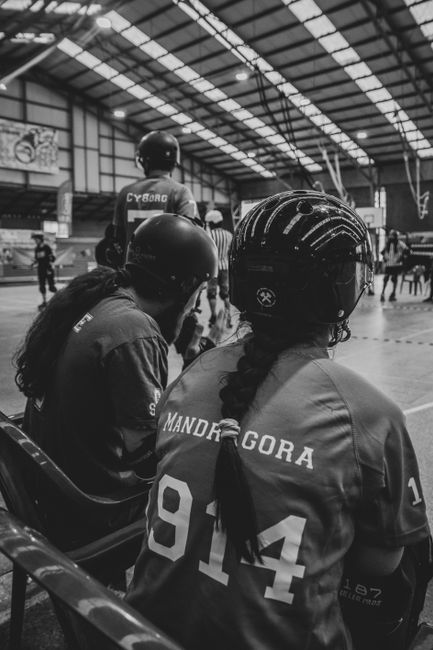
Third jam of the second period, and the score is tied. You are the pivot, your heart is pounding, and you have 30 seconds to line up. Your captain is talking fast, the pack is forming, and somewhere in the back of your head is the hit from two bouts ago that put you on the floor. Or it is the Tuesday after a bad fall, and you are standing at the edge of the track wondering whether to lace up. Roller derby mental training means practicing the skills between your ears (a clear plan for each jam, short calls to your wall, a calm reset after a hit, a routine for bout-day nerves) the way you practice your plow stops. This page is for skaters of any level. It is about mental performance and team skills, which is different from mental health; a section below explains the difference.
Quick answer: Derby gives you 30 seconds between jams, so use them: one breath, one job for the next jam, and one short call to your teammates. Practice falling and hitting in coached drills until they are routine, tell your coach honestly how you feel after an injury before you go back, and keep a simple routine for bout day. Research on these tools in derby skaters is thin, and none of them guarantees a better result or a safer bout. See a doctor, licensed psychologist or other qualified professional if worry, low mood or trouble eating or sleeping lasts more than a couple of weeks or gets in the way of daily life. In a crisis in the US, call or text 988.
What the research says (and does not say) about derby minds
Roller derby is young and under-studied. We found no trial that tests a mental training program on derby skaters, so most of the tools below come from sport psychology research in other sports, and from common coaching practice. We say which is which. One derby-specific study is worth knowing: Moore and colleagues (2019) asked 1,813 roller derby players, mostly women, to read nine stressful situations (including an injury and not being selected) and say whether each felt more like a challenge or a threat. The biggest share of the difference (about 52%) came from the mix of person and situation: the same stress lands differently on different skaters, so what calms a teammate may not calm you.
Strategy and the 30 seconds between jams
Under the WFTDA rules, jams last up to two minutes and no more than 30 seconds may pass before the next one starts. That short window is where much of derby’s mental game happens. Each team puts up to five skaters on the track, the jammer is the only one who can score, and only the lead jammer can end a jam early by putting her hands on her hips. The pack is the largest group of blockers within 10 feet of each other, so a lot of strategy is about controlling its speed and shape. See our rules guide.
A simple way to use the lineup window, built on those rules (it is a coaching framework, not a tested intervention):
- Breathe first. A 2018 systematic review of slow breathing (fewer than 10 breaths a minute) in healthy people, in Frontiers in Human Neuroscience, found links to more relaxation and alertness and less anxiety and anger. It was not done in athletes, so treat it as a reasonable tool to try, not a proven derby fix.
- Pick one job. “Hold the inside line,” “slow the pack,” “get my jammer out.” One task is easier to keep in mind than five.
- Agree on one plan. Who is the pivot, who is the wall, will the jammer try for a star pass? Decide it in the 30 seconds, not in the pack.
- Keep the call short. The rules say all communication between skaters, staff and officials must be respectful, and only the Captain or Alternate can call a team timeout or an official review (each team gets three 60-second timeouts).
We found no study of communication or calling systems in roller derby. Short, agreed words for “wall up,” “hold,” “release” or “jammer behind” are common coaching practice; teams build their own and rehearse them at practice. For the physical side, see roller derby training.
Focus, self-talk and confidence
A 2011 meta-analysis of 32 studies on self-talk and sports performance (Hatzigeorgiadis and colleagues, Perspectives on Psychological Science) found a moderate positive effect overall. It found that instructional self-talk (short cues about what to do) worked better for fine, precise tasks, and that the effect was larger for new skills than well-learned ones. For a newer skater, a cue like “knees bent, eyes up” may help with a skill she is still learning. This is research in many sports, not derby, and an average effect promises nothing for one skater.
Confidence in derby usually comes from reps you can point to: a clean fall, a held wall, a surviving jam. Goals tied to a skill (a clean star pass) are easier to control than goals tied to the scoreboard; this is coaching practice, not a tested method.
Handling hits and falls
Fear of hits and falls is a normal reaction, not a flaw. We found no study on how skaters build or lose their nerve with hits, so this is general coaching practice. Many coaches build comfort in steps: learn to fall small and get up fast in a no-contact drill, then add light contact with a partner, then pack work, and only then full-speed hits. Junior leagues using JRDA levels allow no contact until skaters pass skills assessments; see our youth roller derby guide.
Two facts from skaters themselves are useful here. In a focus-group study of female skaters (Cathorall and Punches, 2017, BMJ Open Sport & Exercise Medicine), skaters named “knowing one’s body” and internal pressure related to “not letting the team down” as leading personal risk factors, and they named unmatched skill levels as a leading outside risk. A practical reading: say “I’m not ready for that hit yet,” and expect teammates to listen. Skating within your skill level is a safety habit, not a lack of courage. The injury patterns and the protective gear rules are on our roller derby injuries page.
After a hard fall, a quick body check comes before any mental reset. A head hit needs the concussion steps on the injuries page: tell someone, stop for the day, and return only through a trained professional. Hiding symptoms is not mental toughness.
Confidence after an injury
Coming back from an injury is physical and mental. The 2016 consensus statement on return to sport from the First World Congress in Sports Physical Therapy (Ardern and colleagues, British Journal of Sports Medicine) says return to sport is a continuum alongside rehabilitation, not a single decision at the end, and suggests a biopsychosocial view of the athlete. It also says the evidence is scarce. An earlier study of 187 athletes after ACL reconstruction (Ardern and colleagues, 2013, American Journal of Sports Medicine) found that psychological readiness, fear of reinjury and the athlete’s own expectations before surgery and in early recovery were linked to whether she was back at her old level of sport by 12 months, and only 31% were. That was knee surgery in mixed sports, not derby, and it does not show that a mental program changes the outcome, but it is a reason to take fear of reinjury seriously.
Common sense, not a prescription: ask your doctor, physical therapist or athletic trainer what you are cleared to do, return in steps (skating alone, non-contact drills, then contact), and tell your coach what scares you. See our roller derby recovery guide for rest and return steps. Return-to-play decisions belong to a clinician.
Bout-day nerves and routines
Bout nerves are normal. A 2026 position statement from Exercise and Sports Science Australia on performance under pressure (Schweickle and colleagues, Sports Medicine) lists pre-performance routines, psychological skills training and mindfulness-based approaches among strategies for pressure. A 2023 review and meta-analysis of psychological interventions across sports (Reinebo and colleagues, Sports Medicine) found moderate effects for imagery, multimodal psychological skills training and mindfulness-based approaches, but the effects were no longer significant when weaker studies were removed. These tools are worth trying, not guaranteed.
A simple routine to practice at every scrimmage: finish your warm-up, check your gear, take three slow breaths, name your first-jam job, and walk to the line. Imagery of one or two key moments works for some skaters. The food, drink, warm-up and gear checklist for the day itself is on roller derby bout day; if nerves take your appetite, the nutrition guide has everyday fueling ideas. After a bad jam, many coaches teach a quick reset: one breath, one lesson (“I was late to the wall”), and back to the next job.
Team culture
Derby leagues are usually skater-run, and the culture of a team shapes how safe and welcoming practice feels. A 2024 meta-analysis of 15 team-building studies in sport (Kwon, Frontiers in Psychology) found that team-building was most effective for teams of 15 to 20 year olds, at collegiate level, and in programs lasting more than two weeks, and that it mostly helped a member’s attraction to the group’s task. It was not about derby, and the evidence is small.
Team culture can be worked on, but we found no derby trial of any one method. Common-sense habits are clear roles for new skaters, a buddy for fresh meat, and a coach who asks “How are you feeling about contact today?” League setups are on our leagues and associations page.
Mental performance is not the same as mental health
Everything above is about performance and teamwork skills. Anxiety disorders, depression, disordered eating and burnout are health matters, not mindset problems, and a better routine does not fix them. The 2026 International Olympic Committee consensus statement on mental health in elite athletes (Reardon and colleagues, British Journal of Sports Medicine) says mental health symptoms and disorders are common among elite athletes and can affect performance, and recommends screening and monitoring with validated tools. It covers elite athletes; we found no derby-specific figure.
Signs worth taking seriously include worry or low mood lasting weeks, panic before a bout or practice, big changes in eating or sleep, or dreading a sport you used to love. Start with your doctor, a licensed psychologist or another qualified mental health professional. In the US, you can call or text 988 (Suicide & Crisis Lifeline) at any time. If food and weight are involved, a clinician should lead care.
Roller derby mental training: FAQs
How do I stop being scared of hitting and falling?
Go in small steps with a coach: fall small and get up in a no-contact drill, then light contact with a partner, then pack work. There is no derby trial on the best method, so this is coaching practice.
What should I do in the 30 seconds between jams?
Take a slow breath, pick one job, and agree on the plan with your teammates. It is a coaching framework built on the WFTDA lineup window, not a tested program.
How do I get my confidence back after an injury?
Get clearance from your doctor, physical therapist or athletic trainer, return in steps, and talk about fear of reinjury with them and your coach. A study after ACL surgery linked fear of reinjury to later return to sport, though not in derby.
When is it a mental health problem and not a mindset problem?
When anxiety, low mood, panic, disordered eating or burnout lasts weeks or gets in the way of daily life. See a doctor or licensed mental health professional, and in the US call or text 988 in a crisis.
Sources
- WFTDA, The Rules of Flat Track Roller Derby (jams, lineup time, timeouts, communication): rules.wftda.com
- Moore and colleagues, 2019, Frontiers in Psychology, challenge and threat evaluations in 1,813 roller derby players: PubMed 31428027
- Cathorall and Punches, 2017, BMJ Open Sport & Exercise Medicine, skaters’ beliefs about injury risk factors: PubMed 29081986
- Hatzigeorgiadis and colleagues, 2011, Perspectives on Psychological Science, self-talk meta-analysis: PubMed 26167788
- Zaccaro and colleagues, 2018, Frontiers in Human Neuroscience, slow breathing systematic review: PubMed 30245619
- Ardern and colleagues, 2016, British Journal of Sports Medicine, consensus statement on return to sport: PubMed 27226389
- Ardern and colleagues, 2013, American Journal of Sports Medicine, psychological responses and return to sport after ACL reconstruction: PubMed 23733635
- Reinebo and colleagues, 2023, Sports Medicine, psychological interventions meta-analysis: PubMed 37812334
- Schweickle and colleagues, 2026, Sports Medicine, ESSA position statement on performance under pressure: PubMed 42271117
- Kwon, 2024, Frontiers in Psychology, team-building and cohesion meta-analysis: PubMed 38558775
- Reardon and colleagues, 2026, British Journal of Sports Medicine, IOC consensus statement on mental health in elite athletes: PubMed 42580854
- 988 Suicide & Crisis Lifeline: 988lifeline.org
General information for education only, not medical advice. It does not replace a doctor, psychologist, qualified coach or other qualified professional, and roller derby has real risks. See how we work in our editorial policy. Back to the roller derby hub.