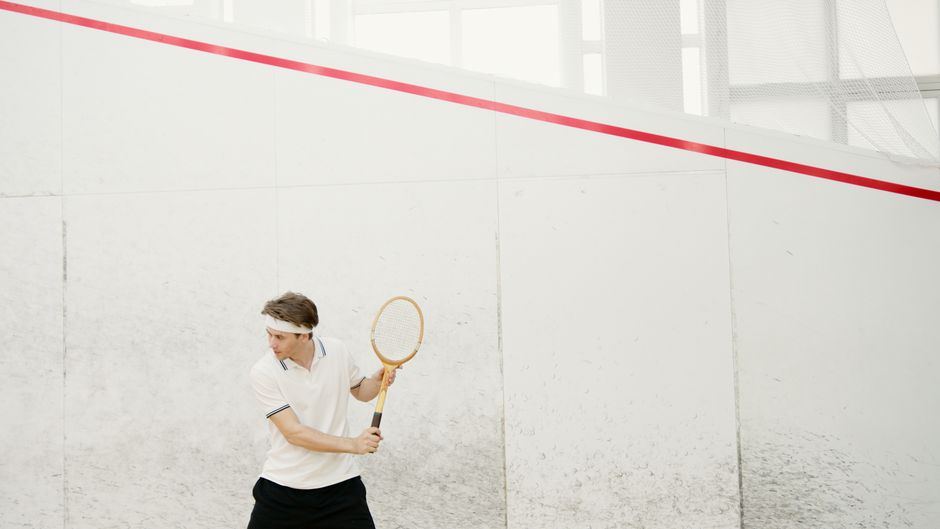
It is 10-all in the fifth game. You have just run a long rally that left your legs shaking, your opponent is stepping back to the T, and the referee has not yet called the score. Every squash player knows how loud your own head can get in that gap. Squash mental training means practicing the skills between your ears (focus, routines, tactical thinking, composure when you are tired or frustrated) the way you practice your drives and ghosting. This page is for players, parents and coaches. It is about mental performance, which is different from mental health; there is a clear section on that difference below.
Quick answer: Mental skills are trainable habits: a short routine between rallies, a simple plan for how you will play under fatigue, small goals you control, and a plan for the next rally after a mistake. Research on these tools is promising but not settled, and none of them guarantees a win. See a doctor, licensed psychologist or other qualified professional if worry, low mood or trouble eating or sleeping lasts more than a couple of weeks or gets in the way of daily life, and in a crisis call or text 988 (US).
What makes squash mentally different
Squash gives you very little time to think and almost no time to leave the court. In the simulated-match study of elite players that we use on our squash training page (Girard and colleagues, 2007), rallies averaged 18.6 seconds, the ball was in play about 70% of the time, and players spent about 69% of the match above 90% of their maximum heart rate. That means decisions arrive while you are breathing hard, and the pauses are short. Under the World Squash singles rules (2025 edition), coaching is allowed only in the up-to-2-minute intervals between games, so most thinking during a game is your own.
Confidence: built from evidence, not slogans
Sport psychologists often describe confidence as self-efficacy: your belief that you can do a specific thing, such as keep a tight length when your legs are heavy. It grows mostly from evidence you can point to, like completed ghosting sessions, won practice games and a pattern that worked last week. One coaching habit: jot down two things that went well after every match, even a loss.
Focus: one rally at a time
A 2024 systematic review of attentional focus in racket sports, including squash (Starzak and colleagues, PLoS One), concluded that an external focus (on the ball, a target or the effect of the shot) tended to benefit learning and performance more than an internal focus on body movements, particularly for novice or lower-skilled players. So in practice, thinking “hit the nick” or “length to the back corner” may serve you better than “bend my wrist” in the middle of a rally. The squash-specific evidence inside the review is thin, so treat it as a starting point.
A second focus tool is simply staying in the present point. A 2024 interview study of ten amateur squash players (published in Psychology of Sport and Exercise) found that their ability to read their own and their opponent’s thoughts and feelings (called mentalizing) helped them focus, regulate themselves and enjoy playing, while a temporary loss of it hurt their enjoyment, their relationships with opponents and their concentration under pressure. It is a small qualitative study that describes experiences rather than proving what works.
Between-rally routines
The gap between rallies is short but real. A pre-performance routine is a short, fixed sequence that gets you ready and shuts out noise. A 2026 position statement from Exercise and Sports Science Australia on performance under pressure (Schweickle and colleagues, Sports Medicine) lists pre-performance routines among the evidence-based strategies, along with psychological skills training and mindfulness-based approaches. No squash trial of a specific routine was found, so the steps below are common coaching practice, not tested prescriptions.
- After the rally: walk back to the T and let the last point go with one slow breath. Wipe your hands or grip if you need to.
- Before the serve: pick your serve and the first shot of the next rally in advance, then use one cue word (“length”, “low”, “patient”).
- Between games: breathe, drink, and keep to one or two tactical points from your coach or yourself. The interval length and the other rules are in our squash rules guide, and the 2-minute routine with drinks and grips is on our match day page.
- Practice it: use the same routine in every practice match, not only in tournaments, so it is automatic when the score is tight.
Tactics and decisions when you are tired
Squash tactics are decisions made at speed: drive or drop, straight or cross-court, defend or attack. A 2018 study of 80 players at four levels of expertise (Catalan-Eslava and colleagues, Journal of Human Kinetics) found that reading the context of the game improved with level of expertise, and that correct decision-making was linked to better quality of execution for the return and the drop shot. A 2017 analysis of elite matches (Murray and colleagues, Journal of Sports Sciences) described situation awareness in squash, from defensive shots played under pressure to attempted winners with the opponent out of position.
What changes when you are exhausted? We did not find a squash-specific study of decision-making under fatigue, so we will not claim numbers for it. In badminton, a 2026 laboratory study of national-level players reported that combined physical and mental fatigue reduced smash speed and accuracy, which is one reason coaches there recommend practicing key shots when tired. That is unproven for squash, but a few practical ideas follow.
- Decide your default pattern before the match (for example, hold length until you have a loose ball), so you are not inventing tactics when your legs are gone.
- Use conditioned practice games late in a hard session, when decisions are hardest. Our training page explains the fitness side.
Goals and motivation
Players stay motivated through long seasons of drills and early practices when the goals feel like their own. A common approach splits goals into outcome (win the club ladder), performance (win most of my rallies that go past ten shots in practice games) and process (split step on every opponent hit, back to the T after every shot). Process goals are fully in your control. A 2015 systematic review of young racquet sport players, covering tennis, table tennis, badminton and squash (Faber and colleagues, Journal of Sports Sciences), found moderate evidence that assessments of mental and goal management skills predicted later performance, while stressing that long-term studies were lacking.
Visualization and imagery
Imagery means rehearsing play in your mind with as many senses as you can: the sound of the ball off the wall, the feel of the split step, the sight of the boast landing in the nick. A 2023 systematic review and meta-analysis of psychological interventions across sports (Reinebo and colleagues, Sports Medicine) found moderate effects for imagery, multimodal psychological skills training and mindfulness-based approaches compared with controls. But the authors report that the effects were not stable: when non-randomized trials and subjective outcomes were removed, they were no longer significant. So imagery is a low-cost add-on to real court time, not a replacement. Try 3 to 5 minutes before bed, rehearsing hard moments too: a long rally, a lost lead, your calm response.
Pressure at game balls
Nerves before a match, and at 9-9 or 10-10, are normal. A game goes to 11, with a two-point margin needed from 10-all (World Squash singles rules, 2025), so a single loose rally can decide a game. The ESSA position statement above says pressure can have both helpful and harmful effects on performance, and that training environments that add some pressure can help prepare athletes. On court that might mean starting practice games at 8-8 or playing with friends watching. Keep it fair and safe, so it builds readiness rather than fear.
Handling frustration and setbacks
Frustration is common in a sport with close contact, tight calls and no hiding place. The squash mentalizing study above suggests that losing sight of the opponent’s perspective, or your own, can hurt both your play and your enjoyment. For doubles racquet sports (which include squash doubles), a 2020 randomized vignette study of 103 players (Deck and colleagues, Research Quarterly for Exercise and Sport) found higher anger and anxiety when a partner was described as playing poorly, so what you say to a partner matters. Many coaches teach three steps after a bad rally or a lost game: acknowledge it with a slow breath, take one lesson (“I kept lifting the ball to the front”), and move to the next job (the next serve). Review lessons rather than blame, ideally a day later when you are calmer.
Preparing for competition
Put the mental pieces into the week before a tournament: one or two imagery sessions, a rehearsed between-rally routine, one or two process goals and enough sleep. Physical preparation is in our training guide, logistics, meals and fluids are on the match day page, and rest afterward is in our recovery guide. If an injury is part of why you feel anxious about playing, read our squash injuries guide and talk to a sports medicine doctor, physical therapist or athletic trainer.
Young players
Keep it light for juniors: fun routines, effort goals and praise for trying. Age-based guidance for juniors, including levels and structure, is on our youth squash guide.
Mental performance is not the same as mental health
Everything above is about performance skills. Anxiety disorders, depression, disordered eating and burnout are health matters, not mindset problems, and they are not fixed by a better routine. The 2026 International Olympic Committee consensus statement on mental health in elite athletes (Reardon and colleagues, British Journal of Sports Medicine) treats them as medical and psychological care issues.
Signs to take seriously include worry or low mood lasting weeks, panic before matches, withdrawing from friends or the club, big changes in eating or sleep, or dreading play you used to enjoy. Start with your doctor, a licensed psychologist or another qualified mental health professional. In the US, you can call or text 988 (Suicide & Crisis Lifeline) at any time. A clinician should lead care for a health concern.
Frequently asked questions
Does visualization help squash players?
A 2023 review across sports found moderate benefits for imagery, but the effects were not stable once weaker studies were removed. It works best alongside real court time.
How do I stop dwelling on a lost rally in squash?
Pick a reset routine, such as a slow breath on the walk back to the T and a cue word, and rehearse it in practice matches. Then take one lesson from the rally and turn to the next serve.
Is it normal to be nervous at game ball?
Some nerves are common, and the ESSA statement says pressure can have helpful as well as harmful effects. If worry is constant, causes panic or disrupts sleep or eating, talk to a doctor or licensed mental health professional.
How do I make good decisions when I am exhausted?
Decide your default pattern before the match and practice playing it when tired. A study of elite play describes how situation awareness drives shot choice, but we found no squash study of decisions under fatigue, so this is practical advice, not a proven result.
Should my child see a sport psychologist?
Most kids need fun, supportive coaching, not a specialist. If a child shows lasting distress, start with their pediatrician or a licensed mental health professional.
Sources
- Girard O et al. Physiological and metabolic responses to simulated squash matches. J Strength Cond Res, 2007. PMID 17685699
- Starzak M et al. Attentional focus strategies in racket sports: a systematic review. PLoS One, 2024. PMID 38181000
- How squash players’ mentalizing abilities affect their experiences of playing squash (interpretative phenomenological analysis). Psychology of Sport and Exercise, 2024. PMID 39672526
- Catalan-Eslava M et al. Analysis of tactical, decisional and executional behaviour according to the level of expertise in squash. J Hum Kinet, 2018. PMID 29599875
- Murray S et al. Using a situation awareness approach to determine decision-making behaviour in squash. J Sports Sci, 2017. PMID 28990852
- Faber IR et al. Assessing personal talent determinants in young racquet sport players: a systematic review. J Sports Sci, 2015. PMID 26109450
- Deck S et al. The impact of partner performance on emotions in doubles racquet sports. Res Q Exerc Sport, 2020. PMID 32142397
- Reinebo G et al. Effects of psychological interventions to enhance athletic performance: a systematic review and meta-analysis. Sports Medicine, 2023. PMID 37812334
- Schweickle MJ et al. Performance under pressure in sport: a position statement from Exercise and Sports Science Australia. Sports Medicine, 2026. PMID 42271117
- Reardon CL et al. Mental health in elite athletes: International Olympic Committee consensus statement (2026). Br J Sports Med. PMID 42580854
- Wang B et al. Synergistic effects of physical-mental mixed fatigue on badminton forehand smash performance. PLoS One, 2026. PMID 41739866
- World Squash. Rules of Singles Squash 2025 (V1.2). PDF
- 988 Suicide & Crisis Lifeline
General information for education only, not medical advice. It does not replace a doctor, psychologist or other qualified professional. See how we work in our editorial policy. Back to the squash hub.