This article contains affiliate links: if you buy through them we may earn a commission, at no extra cost to you. Read our affiliate disclosure.
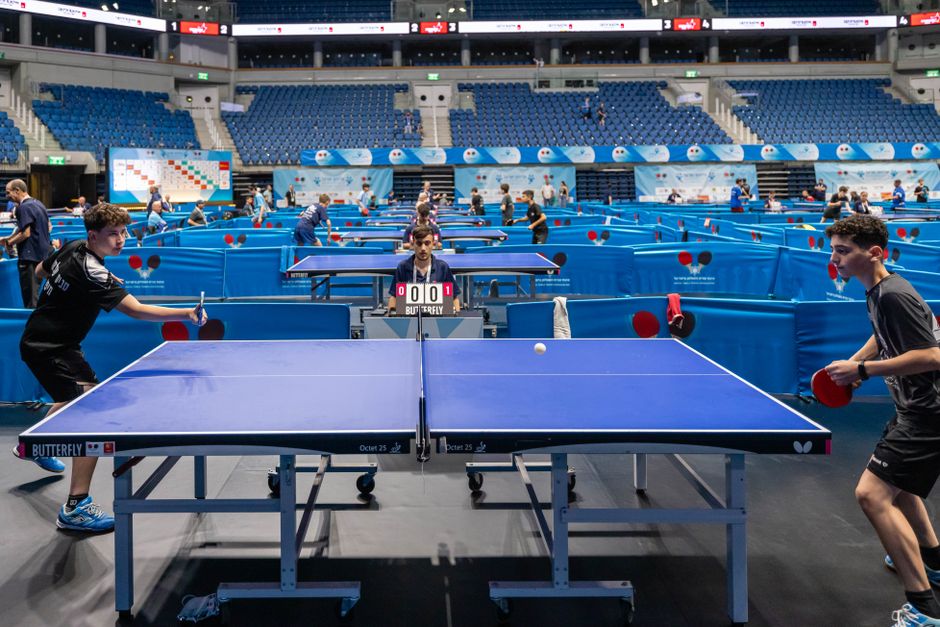
Seventh match of a long Saturday in a school gym. The tables are in rows, a ball has rolled under the barrier, and a player who has been sitting for forty minutes steps wide to his forehand on a cold start and feels the knee complain. Table tennis injury prevention is the set of habits around a player, a real warm-up, sensible hours, leg and shoulder strength, good shoes and a few safety checks around the tables, that aim to lower the chance of getting hurt. Table tennis is a low-risk sport, with no contact and a ball under 3 grams, so this is about small habits that protect tendons and joints over years of rallies. They lower the odds. They cannot promise anything.
Quick answer: Injury risk in table tennis is low, and most injuries that do happen are overuse problems in the shoulder, back, knees and feet. The steps with the most support are warming up properly before you hit, building weekly hours up gradually with rest days, strength work for legs, trunk and shoulder, and grippy court shoes. No table tennis trial has yet shown that a prevention program works, so treat all of this as sensible practice, not proof. See a sports medicine doctor, physical therapist or athletic trainer if pain keeps building, and get to an eye doctor the same day after a blow to the eye.
General information, not medical advice. This page is about lowering risk. What each injury looks like is on our table tennis injuries guide, so we do not repeat it here. For the sport as a whole, start at the table tennis hub.
How big is the risk, honestly?
Small. At the Beijing 2008 Olympics 5.2% of table tennis players reported an injury, and at London 2012 it was 6.3%, according to the 2022 scoping review of 42 studies (Medicina). In a study of 139 national-level French juniors the rate was 1.2 injuries per 1,000 hours of play, and 82.6% were overuse injuries (Bonhomme et al., 2026). That is the key to prevention here: you are guarding against slow, repeated loading, not against crashes. Most of the review’s studies had a moderate or high risk of bias, so every number is rough.
Warm up before the first rally
The scoping review lists poor warm-up and stretching among the risk factors. We found no table tennis trial of a structured warm-up program, and the review itself calls for prevention programs to be tested. The rules give you only up to 2 minutes of practice at the match table (ITTF Statutes 2026), which is a sighting session, not a warm-up. Do the real one before you get there: a few minutes of easy movement, side steps, hip and shoulder circles and shadow strokes, then hit. If you have been sitting between matches, re-warm before the next one.
Shoulder, elbow and wrist: the playing arm
The forehand loop turns the playing arm through a big, fast arc thousands of times a week. Rotator cuff problems were the most common diagnosis in one study in the scoping review, and shoulder tendinopathy made up 11.6% of injuries in the French juniors. In 19 elite male players, a fatiguing protocol dulled shoulder position sense in both arms and made forehand placement less accurate (Chen et al., 2025). That is a reason to stop a heavy drill when strokes go sloppy. For the shoulder and elbow, the American Academy of Orthopaedic Surgeons (AAOS) describes impingement as pain and stiffness lifting the arm, often worse at night, and lateral epicondylitis, “tennis elbow”, as an overuse problem linked to racket sports. We found no table tennis wrist injury rate.
What prevention can reasonably mean here: strengthening the rotator cuff and shoulder blade with a physical therapist (PT) or coach, forearm work, and keeping weekly hitting hours from jumping. Our training page lists the strength work players use.
Back and knees: the low stance
Table tennis is played bent forward, turning to one side. Chronic low back pain was 8.4% of the French juniors’ injuries and knees were the largest group at 30.5%. The AAOS says most low back pain settles within weeks, but leg weakness, loss of bladder or bowel control, fever or pain that lasts beyond a few weeks needs a doctor. We found no study showing how low or upright a stance prevents back pain, so we make no such claim. One reasonable step is trunk work: 12 weeks of periodized core training in 18 college players improved muscular endurance, balance and agility (Dong et al., 2025).
Footwork and ankles
A 2025 motion-lab study of 18 elite male players (Yang et al., J Sports Sci Med) found that the chassé (side shuffle) step loaded the knee more, while the one-step loaded the hip more. The practical takeaway is to mix step types in practice instead of drilling one step for hours, which is what our training page suggests too. It is a lab finding, not a trial of fewer injuries. A multiball study measured balance dropping as the session went on (Gu et al., 2019), so short sets with breaks are safer.
For ankles, the National Athletic Trainers’ Association (NATA) says the most consistent risk factor for a sprain is a previous sprain, and recommends taping or a brace plus balance training for athletes with a past sprain. A brace is not rehab, and your PT or athletic trainer (AT) can say what suits you.
Build hours up gradually
Load means all the stress on a player: practice, multiball, matches, lifting and travel. The scoping review lists long training histories (more than 5 years or more than 20 hours a week), overtraining, poorly planned programs and too little rest after an injury as risk factors. We found no table tennis number for how fast to ramp up weekly hours, so we will not invent a percentage. The sensible rule is to avoid big jumps: a return after a break, a new club night added to the week, or a tournament weekend deserve a slower build than your usual week. Match-day fuel and rests are on our tournament day guide.
Young players
In the French junior study, 40% of injuries were growth-related, led by Osgood-Schlatter disease at the knee (15.8%), Sever’s disease at the heel (13.7%) and Sinding-Larsen-Johansson at the kneecap (9.5%). The AAOS says Osgood-Schlatter usually fades when the growth spurt ends. The American Academy of Pediatrics (AAP) recommends at least 1 to 2 days off a week from a single sport and time off across the year. A limp or a sore knee or heel after play is worth a visit. More on our youth table tennis page.
Older players
Older age appears in the scoping review as a risk factor, but we found no table tennis study of players over 50, no age-specific warm-up and no injury rates for veteran players. Those are gaps, not reassurance. If you are returning after years away or starting late, build gradually and tell your doctor about any heart, joint or balance concerns.
Floors, shoes and the hall
Footwork is quick and sideways, so the floor and your shoes matter. We found no table tennis study that links a particular floor or shoe to fewer injuries, so what follows is common sense. A stray plastic ball underfoot is the classic slip hazard: clear loose balls from around the table between rallies and pick up balls that have rolled into the next court. Rubber-soled shoes are the advice in US coach Larry Hodges’ first-tournament guide; thin, grippy court shoes are general footwear advice, not a tested standard. Our table tennis gear page covers rackets, rubbers and shoes.
Heat and fluids. Halls are usually indoors and more controlled than outdoor sports, but a day of back-to-back matches still sweats you out. NATA says to know your sweat rate and not to gain body weight while drinking, and that early signs of heat illness are headache, nausea and dizziness. A 2026 Frontiers in Nutrition paper notes a 1% body-weight water deficit can harm attention. Confusion, slurred speech or collapse needs 911.
Barriers and head knocks. Players do slip, dive for wide balls or collide with barriers and doubles partners. The CDC’s HEADS UP rule is to remove a player you suspect has a concussion from play that day until a health care provider clears them.
Eye safety around the ball
Eye injury from the ball is rare: the scoping review found table tennis behind just 1 of 118, 2 of 63 and 1 of 45 sports eye injuries in three hospital case series. The American Academy of Ophthalmology (AAO) and the AAP do not list table tennis in their risk table for protective eyewear, but say athletes who are functionally one-eyed should wear protection in all sports. So routine eye protection is not standard advice for table tennis, and we do not claim a standard for it. What we can say: use even, bright light. The ITTF asks for at least 1,800 to 2,000 lux at world and major events and at least 1,000 lux over practice tables. If your eyes are consistently red, blurry, watery, light-sensitive or painful, the AAO says see an eye doctor, and get seen the same day after a hit to the eye with pain or vision change.
Gear can help at the margins, but none of it is treatment. Examples, not endorsements:

Mizuno Wave Medal 7 Table Tennis Shoes
- Built for table tennis
- Low, grippy court sole
- Several sizes
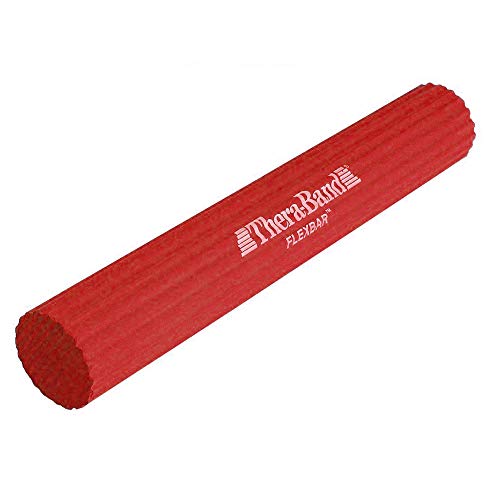
TheraBand FlexBar (Red)
- 12 in rubber bar
- 1.5 in diameter
- About 10 lb to bend into a U

ASO EVO Ankle Stabilizer
- Lace-up with figure-8 straps
- Fits left or right foot
- Low profile
What prevention cannot do
No warm-up, brace or program removes the risk, and the scoping review found no prevention trial in table tennis to lean on. A tendon can still flare in a player who does everything right.
When to see a professional
Right away: a concussion danger sign, an eye injury with pain or blurred vision, a possible broken bone, or back pain with leg weakness or loss of bladder or bowel control. Soon: shoulder pain at night, elbow or wrist pain that weakens your grip, back or hip pain lasting more than a few weeks, or a child limping or rubbing a knee or heel after play. A sports medicine doctor diagnoses and a PT guides rehab and the return to footwork. For the injuries themselves, read the injuries page, and for the days after hard sessions, see table tennis recovery.
Table tennis injury prevention: FAQs
Is table tennis a safe sport?
It is a low-risk sport. About 5% to 6% of players reported an injury at the 2008 and 2012 Olympics, and the main problems are overuse.
Does warming up really prevent table tennis injuries?
Poor warm-up is a listed risk factor in the scoping review, but we found no table tennis trial of a warm-up program. It is sensible, but the 2 minutes at the match table is not enough.
How can I protect my shoulder and elbow?
Keep weekly hitting hours from jumping, stop heavy drills when strokes go sloppy, and ask a PT about rotator cuff and forearm strengthening. No table tennis trial shows these prevent injury; night pain or a weaker grip is a reason to be seen.
Do table tennis players need eye protection?
Most do not wear it, and ball-related eye injuries are rare. The AAO and AAP say functionally one-eyed athletes should wear protection in all sports. See an eye doctor after any blow to the eye with pain or vision change.
I am over 50. Is there special advice?
Older age is a listed risk factor in the scoping review, but we found no table tennis study of older players. Build up gradually, ask your doctor about any health concerns, and ask a PT about leg strength and balance.
Sources
- Scoping review of injuries in table tennis, Medicina 2022
- Bonhomme et al., injuries in national-level French junior players, Ann Med Surg 2026
- Chen et al., fatigue and shoulder proprioception in elite players, 2025
- Yang et al., footwork steps and joint loading in elite players, J Sports Sci Med 2025
- Gu et al., balance across a multiball session, 2019
- Dong et al., periodized core training in college players, PLoS One 2025
- ITTF Statutes 2026 (practice time, lighting, bleeding rule)
- AAOS OrthoInfo, Shoulder Impingement/Rotator Cuff Tendinitis
- AAOS OrthoInfo, Tennis Elbow
- AAOS OrthoInfo, Low Back Pain
- AAOS OrthoInfo, Osgood-Schlatter Disease
- NATA position statement, ankle sprains, 2013
- AAP clinical report, Sports Specialization and Intensive Training in Young Athletes, 2016
- AAP, Resistance Training for Children and Adolescents, 2020
- NATA position statement, fluid replacement, 2017
- NATA position statement, exertional heat illnesses, 2015
- Wang et al., nutrition and hydration in table tennis, Front Nutr 2026
- CDC HEADS UP, concussion response
- AAO and AAP, Protective Eyewear for Young Athletes
- AAO, Computers, Digital Devices and Eye Strain
- Larry Hodges, Everything You Ever Wanted To Know About Playing In Your First Tournament
General information for education only, not medical advice. It does not replace a visit with a doctor, physical therapist or athletic trainer. See how we write and check our pages in our editorial policy.