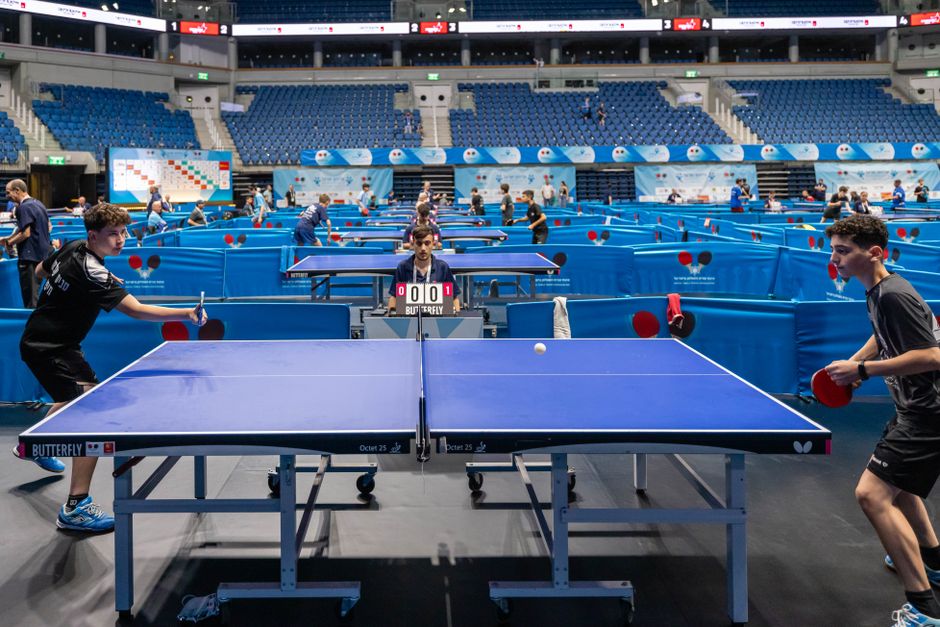
It’s 10-10 in the fifth game of the league final. You’ve just lost three points in a row, your opponent is bouncing the ball on the table before serving, and the whole room has gone quiet. Nobody can hit a better backhand in the next ten seconds than they could a minute ago, so what can change is how you handle the moment. That’s what table tennis mental training is about: the routines, focus and tactical habits that help a player use what they already have, from a Tuesday club night to a national event.
Quick answer: Pick one short routine for the gap between rallies and use it every point, in practice as well as in matches. Give each serve and each return one clear job, and practice under mild pressure before a big match. Research on table tennis players shows that pressure and mental tiredness change how players move and decide, but no mental technique guarantees a win. If worry, low mood, sleep or eating changes, or loss of enjoyment last more than a couple of weeks, see a doctor or licensed mental health professional.
What the research does and doesn’t say
Most table tennis studies are small and use college or squad players, and many test attention or reaction, not whether a routine wins matches. We name the study where a point comes from one, and label general coaching practice as our suggestion.
Between-point routines
Rallies are short, so a match is a series of tiny resets. The rules give some built-in pauses (see our rules page): a towel break after every 6 points, up to 1 minute between games, and one time-out of up to 1 minute per match, asked for with a “T” sign between rallies.
The ESSA position statement on performance under pressure (Sports Medicine, 2026) lists pre-performance routines among the strategies with an evidence base, together with implicit attentional strategies, psychological skills training and mindfulness approaches. It isn’t about table tennis in particular, so the steps below are a common coaching template, not a tested table tennis formula:
- Close the last point: a small, fixed gesture, such as wiping the racket, a look at the floor or a quiet “next.”
- Breathe out: one slow breath while you walk back or pick up the ball. Drop your shoulders.
- One job: a single plan for the next rally, for example “short serve, then be ready for the push” or “get my feet set before the return.”
- Same ritual to start: your usual stance and serve or receive setup, then play.
Keep it short and the same every time, and use it in practice games and in the 2 minutes of table practice before a match.
Serve and receive: where the focus goes
The serve and the return start every rally, so they’re where focus is tested first. A few findings from table tennis studies, each with limits:
- Reading the serve: in a 2026 study, 32 table tennis athletes and 42 non-athletes watched serve clips and predicted where the ball would land. The athletes were more accurate and were less thrown by misleading cues, especially when more of the server’s movement was visible. It is a lab video task, not a real return.
- A steady last look: “quiet eye” is the final fixation on the ball before you hit. In a simulated competition of 10 athletes, it was longer before winners than before errors (Vincze, 2023), and in 11 elite youth players it dropped under fatigue (Vincze, 2022). Both are tiny studies and show association, not that holding your gaze longer will win you points.
For your own serve, a common coaching habit is to decide spin and placement before you pick up the ball. It still has to be clearly legal (see the serve rules on our rules page).
Handling pressure at deuce
Under the laws, a game goes to 11 and you must win by 2, so from 10-all it’s deuce territory, and the serve changes after every point. That’s often where games are decided, and it’s where research suggests pressure shows up:
- A 2026 analysis of top-level international competition (Acta Psychologica) concluded that the eleven-point system makes tactics more aggressive but adds risk at critical points, and suggested more psychological training for high-pressure moments. This is a modelling study on elite match data, not a trial of any mental technique.
- In a forehand experiment with 30 novice players (Sekiya and Tanaka, 2019), adding mild pressure, with money at stake, raised anxiety and heart rate. Players shortened their swings, hit slower and, in the authors’ words, used a risk-averse strategy that hurt accuracy. Novices with a small reward are not finalists, but tight arms and a “just get it on” swing will sound familiar.
What to do with that, as coaching suggestions: practice deuce on purpose. Start training games at 8-8 or 10-10, give the loser a small chore, or play the last game of a drill session with a spectator. Choose the shot you trust with a clear target instead of an easier-looking swing that slows down. And keep your routine on, because at deuce it’s the first thing to disappear.
Tactics and decisions in a match
Match analysis studies describe what top players do, and they aren’t recipes for club players. One note:
- A 2026 study of 40 training matches and 40 international matches among Chinese national youth team U15 girls found that training matches differed from competition: training stressed control of short balls, while international matches used more backhand long-area attacks to start offense, and later strokes mattered more. The authors suggest training should include more competition-like simulation. So practice games should look like real matches, not only drills.
For you, that translates into habits: have a plan A for your serve and receive, notice which of your opponent’s serves or placements you struggle with, and change one thing at a time. Use the between-game minute and the single time-out for one adjustment, not a list. Under the rules, only one named adviser can coach you in individual events, so decide before the match what you want them to say to you.
In doubles, the hitting order is strict (server, receiver, server’s partner, receiver’s partner). Agree beforehand who covers what and what you’ll say after an error. We found no table tennis study on partner talk.
After an error or a lost game
Everyone shanks a return into the net. The reset is the same as your routine, just longer: close the point, breathe, one job. After a lost game, use the 1-minute break to drink, towel off and choose one adjustment. Our game day page has the full list of breaks and how to use them.
Mental tiredness matters here too. In a 2026 study of 24 collegiate players, 45 minutes of a draining computer task before a reactive footwork test lengthened the time before movement started and was followed by stiffer landings and higher loads through the lower body (Li, Frontiers in Psychology). A 2026 meta-analysis also links mental fatigue to slower reactions and poorer decisions in sport, so hours of phone scrolling between matches isn’t neutral.The 2026 meta-analysis we cite on the game day page found mental fatigue is linked to slower reactions and poorer decisions in sport. Both suggest that scrolling a phone for hours between matches isn’t neutral, and that a stiff, rushed body late in a long day may be partly a tired head. See our injuries page for pain and overuse, and our recovery page for sleep and rest.
Confidence, goals, imagery and mindfulness
Confidence is your belief that you can do a specific thing, like open with a forehand loop or return a short serve. It grows from honest evidence: well-run practice, matches against players at the right level, and a habit of noting what worked. Coaches often split goals into outcome (win the division), performance (get 8 of 10 serves in practice where I want them) and process (use my routine every point). Process goals are the ones you control on a bad day. That split is standard coaching practice, not a table tennis study result.
Some table tennis evidence exists, with caveats:
- Mindfulness: in a 2026 randomized trial, 90 college table tennis athletes did 8 minutes of mindfulness after training, 4 times a week for 16 weeks. The mindfulness group scored better on attention tests and reported better mood and less mental fatigue than the control group. It was one study in one setting and did not measure match results.
- Self-talk, imagery and routines: a small 2018 study of three Korean Paralympic table tennis athletes with spinal cord injuries tried eight sessions of psychological skills training, including self-talk, imagery and routines, before the 2012 Games. Their mental skills scores improved, but only one athlete fully carried that use into competition. Three people can’t prove anything, but it shows the skills take practice to use under pressure.
Getting ready for a tournament
Mental preparation starts before the first match. Write two or three process goals on a card in your bag, know your draw and schedule, and plan what you’ll do in the waiting. For arrival times, fuel, hydration and the order of the day, use our game day page instead of repeating it here. For events and levels, see leagues and associations.
Young players
One French study followed 159 elite youth table tennis players (average age about 14) in intensive training centers. Players who were still playing six years later had reported less amotivation and less “sport devaluation,” meaning losing the sense that the sport matters, six years earlier (Martinent, 2018). A companion 2022 study found that better recovery was linked to a lower sense of reduced accomplishment. These are correlations in a group of elite youth players, not proof that anything causes dropout. For ages, stages and specialization, see our youth table tennis page.
Mental performance is not the same as mental health
Routines, self-talk and imagery are performance skills. Anxiety disorders, depression, disordered eating, burnout and thoughts of self-harm are health matters, and a routine won’t treat them. The International Olympic Committee’s 2026 consensus statement on mental health in elite athletes (British Journal of Sports Medicine) describes mental health conditions as common in athletes, able to affect performance, and treatable, with many athletes continuing to compete.
Talk to a doctor or a licensed mental health professional if you notice persistent low mood or worry, dread before matches, changes in sleep or eating, losing interest in a game you loved, or exhaustion that rest doesn’t fix. In the United States, you can call or text 988 (or chat at 988lifeline.org) for the free, confidential 988 Suicide & Crisis Lifeline, 24 hours a day. If you are in immediate danger, call your local emergency number. Outside the US, use your country’s crisis line.
FAQs
What should I do at deuce in table tennis?
From 10-all the serve changes every point, and you must win by 2. In the one pressure experiment we found with novices, swings got shorter and slower. So keep your routine, pick a clear target, and commit to a shot you trust. This is coaching advice built on that research; no study tested a specific deuce plan.
How do I reset after a few bad points?
Shrink the goal to the next rally: close the point, one slow breath, one job. If you need more, use the towel break after every 6 points or your one time-out of up to 1 minute, asked for between rallies with a “T” sign.
Does visualization help table tennis players?
We found only a very small table tennis study (three Paralympic athletes) that included imagery among other skills, so we can’t say how much it helps on its own. Many athletes try short imagery sessions alongside real practice; it costs nothing.
When is nervousness a health problem?
When worry, low mood or dread lasts for weeks, disrupts sleep or eating, or takes the fun out of playing, talk to a doctor or licensed mental health professional. In the US, call or text 988 if you are in crisis.
Sources
- Schweickle MJ et al., ESSA position statement, Performance Under Pressure in Sport, Sports Medicine, 2026.
- Reardon CL et al., IOC consensus statement on mental health in elite athletes, British Journal of Sports Medicine, 2026.
- 988 Suicide & Crisis Lifeline.
- Sekiya H, Tanaka Y, Movement modifications related to psychological pressure in a table tennis forehand task, Perceptual and Motor Skills, 2019.
- Lin Y, Chen M, Iterative changes in table tennis rules and the technical and tactical system, Acta Psychologica, 2026.
- Li Q et al., How mental fatigue alters reactive step biomechanics and joint loading in table tennis players, Frontiers in Psychology, 2026.
- Lu et al., Mental fatigue and sport performance, meta-analysis, 2026.
- Qian L et al., Mindfulness intervention in table tennis college athletes: a randomized controlled trial, 2026.
- Lim TH et al., Psychological skills training for Paralympic table tennis athletes, Journal of Exercise Rehabilitation, 2018.
- Kinematic information availability and prior weighting in action prediction (table tennis serve clips), Behavioural Brain Research, 2026.
- Vincze A et al., Quiet Eye supports winner shots in a simulated table tennis competition, Scandinavian Journal of Medicine and Science in Sports, 2023; Vincze A, Jurchis R, Quiet Eye under fatigue and complexity, Journal of Motor Behavior, 2022.
- Wang S, Zhang H, Training matches versus international competitions in elite Chinese U15 female players, Journal of Sports Science and Medicine, 2026.
- Martinent G et al., Psychological factors and participation and success in table tennis, Journal of Sports Sciences, 2018; Martinent G et al., Stress, recovery and coping and burnout symptoms of young elite table-tennis players, Frontiers in Psychology, 2022.
- ITTF Laws of Table Tennis and ITTF Statutes 2026, as summarized on our rules page.
General information for education only, not medical advice. It does not replace care from a doctor or licensed mental health professional. See our editorial policy for how we choose and check sources. Back to the table tennis hub.