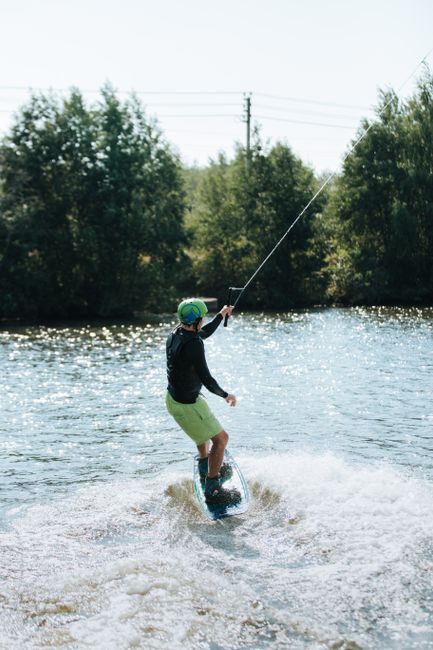
You have been circling the same wake for three sets. Your friends on the boat have seen you almost go for the new invert twice, and each time you let the handle pull you flat at the last second. Or you are the rider who landed it once, caught an edge on the next try, and now your legs feel different at the wake. Or you are in the pack for your first contest, watching the rider before you, with ninety seconds to go. Wakeboarding mental training means practicing the skills between your ears (a calm approach to a new trick, a reset after a crash, focus on the pass, a routine for contest day) the way you practice your edge. This page is for lake riders, cable-park regulars and contest riders. It is about mental performance, which is different from mental health; a section below explains the difference.
Quick answer: Riders can train a calm approach: build a new trick in small steps you can already land, use a short routine before each set, take one lesson from a crash and move on, and rehearse your contest passes before the day. Research on these tools in wakeboarders is very thin, and reviews across sports find effects that are not stable, so none of this guarantees a better ride or fewer falls. See a doctor if a crash left you with a headache, confusion or pain, and see a doctor, licensed psychologist or other qualified professional if worry, low mood or trouble eating or sleeping lasts more than a couple of weeks. In a crisis in the US, call or text 988.
Fear of a new trick, and building up to it
Hesitating before a trick you have not landed is a normal reaction, not a flaw. Wakeboarding does carry real risk: a 2005 study of US emergency-department visits (Hostetler and colleagues, American Journal of Sports Medicine) found that head injuries were the largest share of wakeboarding injuries, at 28.8%, and described rapid boat acceleration, little protective gear and waterway obstacles as risk factors. We found no published trial on how wakeboarders overcome fear of a trick, so what follows is common coaching practice, not tested treatment.
Many coaches and riders build up in steps instead of forcing the full trick:
- Break the trick into parts. Edge, pop, rotation and landing are separate pieces. Get each one comfortable at the size you can already control.
- Go up one step at a time. A smaller wake, a slower speed or a shorter rope can make the next step less of a leap. Pick the change together with your driver or coach.
- Practice the landing and the fall. Knowing how you will land, and how you will fall if it goes wrong, makes the attempt less scary. Our wakeboard training page covers leg strength, landing practice and balance.
- Set up for safety first. A Coast Guard approved life jacket, a helmet if you hit features, a spotter who watches you, and a clear course. See the rules and safety page.
- Know when to say no today. Tired legs, fading grip, cold water or choppy conditions are good reasons to wait. Stopping the set is a decision, not a failure.
Confidence after a crash
A hard fall can shake your trust in a trick you used to land. First, deal with the body. If you hit your head or feel dizzy, confused, nauseous or have a headache, stop riding and get checked by a medical professional before you ride again; our wakeboarding injuries guide covers concussion and the common knee and shoulder injuries.
Fear after a bad crash is common in sport. Studies of athletes coming back from surgery for a torn ACL or shoulder instability, injuries wakeboarders do get, point the same way. A 2025 systematic review in Sports Health found that kinesiophobia (fear of movement) and fear of reinjury are seen commonly after ACL reconstruction. A 2023 systematic review in the Orthopaedic Journal of Sports Medicine of shoulder instability surgery found that of patients who did not return to sport, 85% cited psychological reasons, and fear of reinjury was the most common one (42.8%). Those are patients after surgery, not riders after an ordinary wipeout, so the numbers do not transfer directly. The point is that fear after a crash is real, and that when it blocks you from riding at all, you can ask your doctor, physical therapist or a sport psychology professional for help.
For everyday falls, many coaches teach a simple reset: take one breath, name one lesson (“I stood up too early on the landing”), and go back to the last step you were comfortable with before trying again. This is coaching practice, not a tested method. The recovery page covers the physical side of coming back.
Focus on the pass
A pass or a set is short, and attention wanders. Many riders find it helps to pick one thing per set: where the wake meets your edge, a look to the landing, or the line you want across the course. We found no wakeboarding study of attention cues, so treat them as things to try. The 2026 position statement from Exercise and Sports Science Australia on performance under pressure (Schweickle and colleagues, Sports Medicine) lists implicit attentional strategies among strategies used when performing under pressure; it does not test them in wakeboarding.
Tiredness hurts focus and landings. Our lake day and contest day page notes that sloppy landings are a sign to end the set. Eating, drinking and shade between sets help you keep attention for the next one.
Imagery and routines
Imagery means picturing a run in detail before you ride it: the approach, the edge, the pop, the landing. A 2023 systematic review and meta-analysis of psychological interventions in competitive athletes (Reinebo and colleagues, Sports Medicine; 111 studies, 25 of them combined) found moderate effects for psychological skills training (g = 0.83), mindfulness- and acceptance-based approaches (g = 0.67) and imagery (g = 0.75). But the authors say the effects are not stable: when non-randomized trials and subjective performance measures were removed, the estimates were no longer significant. Imagery is worth trying as an add-on to real riding, not a replacement for it, and it comes with no guarantee.
A pre-ride routine is a short, repeatable sequence that takes you from the dock to the handle: check your gear, take a slow breath, run your one cue (“edge, pop, land”) and give your driver the signal. The ESSA statement lists pre-performance routines among its strategies for pressure. The exact steps are your own. Practice the same sequence on regular lake days, so it feels normal on contest day.
Contest nerves and competition preparation
Nerves before a contest are normal. The ESSA position statement says pressure can have both facilitative and debilitative effects on performance and notes that training environments with pressure can prepare athletes to perform under it. For a wakeboarder, that can mean practicing the whole pass in order, the way you will ride it, instead of only repeating single tricks.
Some facts from the World Wake Association rules, as described on our lake day and contest day page, can help you plan your run mentally:
- It is a two-pass, judged run. You choose your tricks and their order, and three judges score difficulty, risk, intensity, variety and execution. Only landed tricks count.
- Two wake falls end the run. Knowing this ahead of time lets you decide your plan: which tricks you open with, and which you save for the moment you want to risk.
- You tell the driver your speed and rope length. Decide these in training, not at the dock.
- Use the whole course. Know where the course and the fall buoys are before you ride.
Writing out your two passes, rehearsing them in your head and in practice, and having a fallback plan if you fall early are coaching practices we found no wakeboard study for. Sign-in times, warm-up, food and sun are in the lake day and contest day guide, and divisions and events are on the leagues and associations page.
Young riders
We found no wakeboarding-specific research on mental skills in kids. In general, the American Academy of Pediatrics (cited on our training page) recommends at least one to two days off a week from organized sport and time away from one sport across the year. For young riders, keep it fun, let them set the pace on new tricks, praise effort and trying, and make sure a qualified adult is in the boat. More on the youth page.
Mental performance is not the same as mental health
Everything above is about performance skills. Anxiety disorders, depression, disordered eating and burnout are health matters, not mindset problems, and a better routine does not fix them. The 2026 International Olympic Committee consensus statement on mental health in elite athletes (Reardon and colleagues, British Journal of Sports Medicine) covers mental health in athletes as a medical topic, separate from performance coaching.
Signs worth taking seriously include worry or low mood lasting weeks, panic before getting on the boat, big changes in eating or sleep, or dreading a sport you used to love. Start with your doctor, a licensed psychologist or another qualified mental health professional. In the US, you can call or text 988 (Suicide & Crisis Lifeline) at any time. If food and weight are involved, a clinician should lead care; our nutrition and supplements guide is background only.
Wakeboarding mental training: FAQs
How do I get over my fear of a new trick?
Build up in small steps you can already land, and practice the landing and the fall. Riders often work with a coach or an experienced rider and change one thing at a time, such as wake size or speed. No published trial tells us the best method, so this is common coaching practice.
How do I get my confidence back after a bad crash?
Get any head injury or pain checked first. Then go back to a step you were comfortable with and build up again. Studies after knee and shoulder surgery show fear of reinjury is common; if it keeps you off the water, talk to your doctor, physical therapist or a sport psychology professional.
Does visualizing a trick help?
Many riders do it, but we found no study in wakeboarding. A 2023 review across sports found moderate effects for imagery that were not stable once weaker studies were removed. Treat it as an add-on to real practice.
How do I handle nerves before a contest?
Expect them. Know the format (two passes, two wake falls end the run), practice your whole pass in order, and use a short routine you have used before. The ESSA position statement lists routines, attention strategies, psychological skills training and mindfulness-based approaches as tools, with no guarantee.
When is it a mental health problem and not a mindset problem?
When anxiety, low mood, panic, disordered eating or burnout lasts weeks or gets in the way of daily life. See a doctor or licensed mental health professional, and in the US call or text 988 in a crisis.
Sources
- Hostetler and colleagues, 2005, American Journal of Sports Medicine, water skiing and wakeboarding injuries in US emergency departments: PubMed 15888722
- Sports Health, 2025, systematic review of psychological factors after ACL reconstruction: PubMed 39041333
- Orthopaedic Journal of Sports Medicine, 2023, psychological factors in return to sport after shoulder instability surgery: PubMed 38035214
- Reinebo and colleagues, 2023, Sports Medicine, psychological interventions meta-analysis: PubMed 37812334
- Schweickle and colleagues, 2026, Sports Medicine, ESSA position statement on performance under pressure: PubMed 42271117
- Reardon and colleagues, 2026, British Journal of Sports Medicine, IOC consensus statement on mental health in elite athletes: PubMed 42580854
- World Wake Association rule book (two-pass run, DRIVE judging, two wake falls, speed and rope length): thewwa.com
- 988 Suicide & Crisis Lifeline: 988lifeline.org
General information for education only, not medical advice. It does not replace a doctor, psychologist, coach or other qualified professional, and wakeboarding has real risks. See how we work in our editorial policy. Back to the wakeboarding hub.