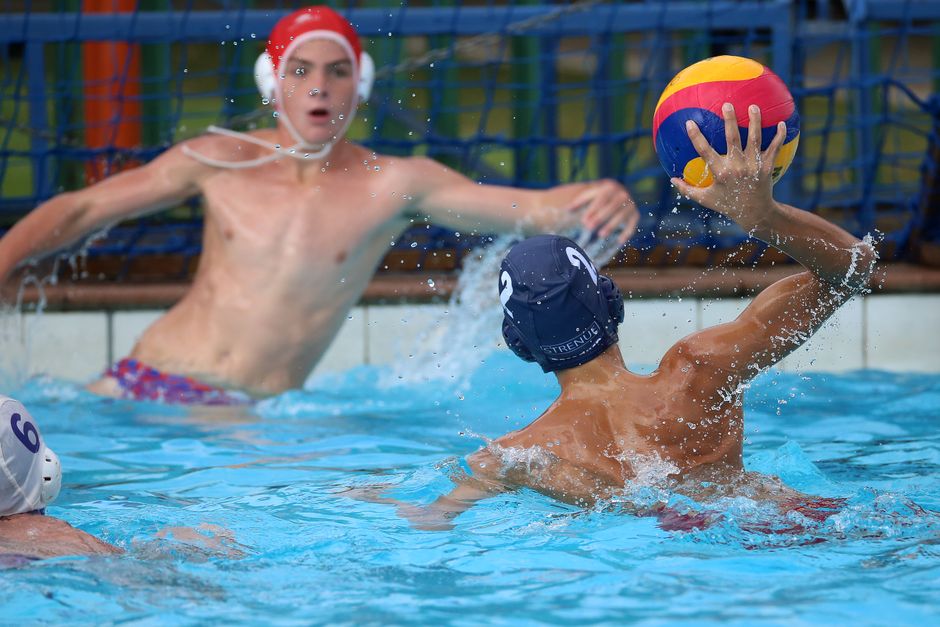
A junior-varsity team is lined up along the wall before a Saturday tournament. The coach walks the row and does what she does every match day: tugs each cap strap to make sure the ear guards sit snug, checks fingernails, asks the goalkeeper how her shoulder feels, and sends everyone into the water for an easy swim before anyone touches a ball. Nobody calls it exciting, but it is what water polo injury prevention looks like: the small, repeatable habits that lower the chance of a torn-up shoulder, a ruptured eardrum, a concussion that gets played through or a scary moment in deep water.
Quick answer: Warm up in the water, build shoulder and leg strength gradually, wear a cap with its ear guards in good shape, and take any player who may have a concussion out for the rest of the day (the CDC’s “when in doubt, sit them out”). Never do breath-holding drills or contests, and never train alone in deep water. See a doctor, physical therapist or athletic trainer for a shoulder that slipped out, pain that lasts more than a week or two, ear drainage or hearing loss after a hit, any change in vision after a blow to the eye, or any concussion sign.
General information, not medical advice. This page is about lowering risk. For what each water polo injury looks like and what to do after one, see our water polo injuries guide. Back to the water polo hub.
Why prevention in this sport looks different
World Aquatics’ own rules describe water polo as a contact sport with the highest incidence of traumatic injuries of its aquatic sports. A 2021 systematic review of 41 studies found that sudden injuries mostly hit the hands and head, from unexpected contact with the ball or an opponent, while injuries that build up in training mainly affect the shoulder. So prevention has two halves: protect against sudden contact, and manage load on the throwing shoulder.
Warm up in the water
We found no published water polo injury-prevention warm-up program comparable to FIFA 11+ for soccer, so this page does not claim one. What the research does show is about performance. In a 2026 study of 10 international-level players, an in-water warm-up, or a dryland plus in-water warm-up, led to better results on a water polo sprint test than a dryland-only warm-up, and adding dryland to the in-water routine added nothing. Whether it lowers injury risk has not been shown in the sources we reviewed.
The throwing shoulder
In a group of 80 sub-elite players, the shoulder was the most frequently injured site and caused about a quarter of lost training days; two-thirds of those shoulder injuries were overuse, and players waited an average of 10 days before telling the physio. The habits that follow from the research:
- Tell someone early. The 10-day delay above is the easiest thing for a team to fix.
- Strengthen the braking muscles. In a small study of 18 players, those with a past shoulder injury shot about 6% faster but had weaker outward-rotation strength relative to inward rotation. Balanced rotator cuff work is the usual response.
- Use a structured band program. In a 2026 trial, 46 young players who did the Thrower’s Ten band and dumbbell routine three times a week for 10 weeks improved shoulder stability and flexibility.
- Add new load slowly. In a 2023 in-season study, shoulder pain rose from the first to the last week in every group that added strength or power training. Heavier lifting needs a plan around the shooting volume, not on top of it.
- Take instability seriously. In one clinic’s 20-year series of 92 players with shoulder problems, 58% had at least one instability episode (a dislocation or partial dislocation). A shoulder that has slipped out should be assessed before the next game.
The exercises and weekly layout are on our water polo training page.
Eggbeater legs, hips and knees
The eggbeater is the engine of the sport, and most players tread water for the whole game. We did not find a source in our research that quantifies eggbeater knee injuries or lays out a knee-prevention program, so we leave that out rather than guess. What we can say: in Pac-12 college records (729 injuries over five seasons), about half of the 26 surgeries were for groin and hip problems, nine of them for hip impingement (FAI), so recurring hip or groin pain is worth taking to a professional rather than swimming through. In a 2026 study of 22 university players, differences in lift came mainly from the timing and angle of the foot, not its speed, so have a coach watch your kick before adding load.
Training load, fatigue and tournament weekends
The American Academy of Pediatrics (AAP) recommends 1 to 2 days off a week and time away from any single sport each year; Jayanthi and colleagues linked weekly training hours greater than a child’s age with more serious overuse injury. In elite players, morning heart rate variability dipped when preseason load jumped 60 to 70% and improved once in-season load came down by 30%, and heart rate recovery was slower after two heavy days. These are small-group monitoring findings, not rules to copy.
Tournaments stack load quickly. In 14 Italian under-16 club players who played 12 matches in 7 days, harder matches went with more fatigue and poorer perceived recovery, and morning matches were linked with better perceived recovery. Between games: water polo game day and recovery cover them in detail.
Concussion: recognize and remove
In a survey of more than 1,500 USA Water Polo members, 36% reported a concussion, and goalkeepers reported significantly more. In Pac-12 college records, concussion was the most common single diagnosis (11.4% of injuries) and 82% happened outside of competition, in practice. A later Pac-12 study found goalkeepers’ concussions came mostly from the ball and field players’ from contact with another player.
- Recognize. The CDC’s HEADS UP signs include looking dazed, slow answers, clumsiness, headache, dizziness, nausea, blurry vision and feeling foggy.
- Remove. CDC: if you think someone may have a concussion, take them out for the rest of the day until a health care provider clears them. Under the rules, a substitute can enter.
- Stay with them. In deep water a dazed player can slip under, so a teammate or lifeguard should stay with them until they are on the deck.
- Call 911 for the CDC’s danger signs: one pupil larger than the other, a worsening headache that won’t go away, slurred speech, weakness or numbness, repeated vomiting, seizures, growing confusion or loss of consciousness.
- No same-day return after a diagnosed concussion, according to the American Medical Society for Sports Medicine (AMSSM); return is gradual and cleared by a clinician.
Ears, eyes, face and teeth
Caps and ear guards. World Aquatics requires caps fastened under the chin and fitted with malleable ear protectors. NFHS (high school) and NCAA rules say each player, in the water or on the bench, must wear a cap with protective ear guards at all times. A 2017 sports medicine review lists ruptured eardrums among water polo’s traumatic injuries. Check that guards are present and not cracked, and the strap is fastened. Our water polo gear page covers caps in more detail. If you think you have burst an eardrum, MedlinePlus says to keep the ear dry and stay out of the water until a doctor has seen it.
Eyes. Goggles are not allowed in games. The NCAA says ordinary swim goggles are not acceptable, and NFHS allows contact-sport goggles, face masks or nose guards only with state authorization. After a blow to the eye, the American Academy of Ophthalmology says not to press on it, and to contact an ophthalmologist or go to the emergency room right away for a black eye, pain or any change in vision, even after a light hit.
Fingernails, jewelry and cuts. World Aquatics requires players to remove articles likely to cause injury and to have fingernails properly cut. A bleeding player is ordered out of the water at once and may return only as a substitute after the bleeding stops.
Teeth. In a 2023 survey of 114 Croatian first-league players, 27.2% reported a dental injury from water polo, mostly upper front teeth from contact with another player, yet only 7% wore a mouthguard. A 2018 study of 347 players found 57.9% had at least one orofacial injury in a season, mostly lacerations, with 1.2% using a mouthguard habitually. NFHS and NCAA rules need no special approval for mouthguards, but those studies did not test whether they prevent these injuries.
Deep water, fatigue and hypoxic blackout
World Aquatics requires at least 1.80 meters of water over the field of play, so nobody stands. It also asks event lifeguards and medical teams to train in deep-water extraction and to practice reaching players across the lane ropes.
- No hyperventilating, breath-hold drills or contests. The American Red Cross, YMCA of the USA and USA Swimming call hyperventilating before underwater swimming and extended breath-holding dangerous and potentially deadly, because a swimmer can lose consciousness underwater without warning. The condition is called hypoxic blackout; those groups prefer that term to “shallow water blackout”.
- Never train alone in deep water. The CDC and the AAOS both stress never swimming alone and having a lifeguard or coach watching.
- Know what a problem looks like. The CDC says drowning can be silent. A player who goes under and does not come straight back up needs help immediately: stop play, get them out, and call 911 if they are unconscious or not breathing normally.
- Lightning. NATA says pools, indoor ones included, are unsafe when you hear thunder; wait 30 minutes after the last lightning or thunder.
Youth players
The AAP supports supervised strength training for children, about 2 to 3 times a week for 20 to 30 minutes, starting without weights and focusing on form, with no maximal lifts until the body has finished growing. For age groups and splashball see water polo for youth, and for the rules water polo rules. We did not find a water polo-specific injury-prevention program for children.
What prevention can’t do
None of the habits above guarantees that nobody gets hurt. A hand or ball to the face is part of the game, and no cap has been shown to prevent concussion. The maker of one padded cap says its padding is designed to absorb impact, but that is a maker claim, and we have not confirmed that padded caps are allowed in every league, so check with your league or referee. The aim is fewer and milder injuries, caught earlier.
When to see a professional
Right away: a player pulled from the water unconscious or not breathing normally (call 911 and start CPR if trained), any concussion danger sign, an eye injury with pain or changed vision. Within a day or two: a suspected concussion, ear pain with drainage or muffled hearing, a shoulder that slipped out, a finger that is deformed or will not straighten, or a cut that may need stitches. Soon: shoulder pain lasting more than a week or two, pain that changes your shot, or hip or groin pain that keeps coming back.
Water polo injury prevention: FAQs
How do you prevent shoulder injuries in water polo?
The research points to balanced rotator cuff and shoulder-blade strength, managing throwing volume, adding new load slowly and reporting pain early. No study we reviewed proves any routine prevents injury.
Do water polo caps prevent concussions?
Standard caps are required mainly for ear guards, not head protection. No cap has been shown to prevent concussion, so the CDC’s recognize-and-remove steps apply in full.
Why do players have to wear ear guards on the bench?
NFHS and NCAA rules say each player, in the water or on the bench, must wear a cap with protective ear guards at all times.
Are breath-hold drills safe for water polo players?
The Red Cross, YMCA of the USA and USA Swimming call hyperventilation and extended breath-holding dangerous and potentially deadly because of hypoxic blackout.
Does a mouthguard help in water polo?
Dental and facial injuries are common in the surveys above and few players wear one, but those studies did not test whether mouthguards prevent them. Ask a dentist or sports medicine professional about fit.
How many days off should a young player take?
The AAP recommends 1 to 2 days off per week and time away from any single sport each year.
Sources
- World Aquatics Water Polo Rules, Competition Regulations Part Six (July 2023)
- NFHS Water Polo Uniform Rules, 2024-26
- NCAA Water Polo Rules, 2026-28
- NCAA protective equipment interpretation (January 2025)
- Prevalence and mechanisms of injuries in water polo: a systematic review, BMJ Open Sport and Exercise Medicine, 2021
- Injuries affecting intercollegiate water polo athletes, Orthopaedic Journal of Sports Medicine, 2022
- Epidemiology of shoulder injury in sub-elite water polo players, Physical Therapy in Sport, 2019
- The epidemiology of shoulder injuries in water polo players, Journal of Clinical Medicine, 2024
- Shoulder rotation strength and overhead shooting speed and prior shoulder injury, Sports Biomechanics, 2024
- Thrower’s Ten program in water polo athletes, Shoulder and Elbow, 2026
- Strength training and shoulder pain in male and female water polo players, Journal of Exercise Rehabilitation, 2023
- Foot kinematic and kinetic differences in eggbeater kick technique, Frontiers in Sports and Active Living, 2026
- Effects of different warm-up strategies in high-level water polo players, Journal of Functional Morphology and Kinesiology, 2026
- Heart rate recovery after acute training load changes in top-class water polo players, European Journal of Sport Science, 2021
- Supercompensation in elite water polo: heart rate variability and perceived recovery, Sports Medicine International Open, 2021
- Congested match schedule in U16 youth water polo players, Sports, 2025
- Blumenfeld and colleagues, sports-related head injury and concussion in water polo, Frontiers in Neurology, 2016
- Concussion in collegiate water polo goalkeepers, Clinical Journal of Sport Medicine, 2026
- Care of water polo players, Current Sports Medicine Reports, 2017
- Dental injuries in Croatian professional water polo players, Sports, 2023
- Zamora-Olave and colleagues, orofacial injuries and mouthguard use in water polo, Dental Traumatology, 2018
- CDC HEADS UP, concussion signs and symptoms
- American Medical Society for Sports Medicine, concussion position statement (2019)
- American Academy of Ophthalmology, recognizing and treating eye injuries
- MedlinePlus, ruptured eardrum
- CDC, drowning prevention
- AAOS OrthoInfo, swimming injury prevention
- American Red Cross, YMCA of the USA and USA Swimming joint statement on hypoxic blackout
- NATA position statement, lightning safety (Walsh and colleagues, 2013)
- Brenner, sports specialization and intensive training in young athletes, Pediatrics, 2016
- Jayanthi and colleagues, training volume and serious overuse injury in young athletes, 2015
- American Academy of Pediatrics, strength training by children and adolescents (2020)
- USA Water Polo, splashball programs
General information for education only, not medical advice. It does not replace a visit with a doctor, physical therapist or athletic trainer. See how we write and check our pages in our editorial policy.