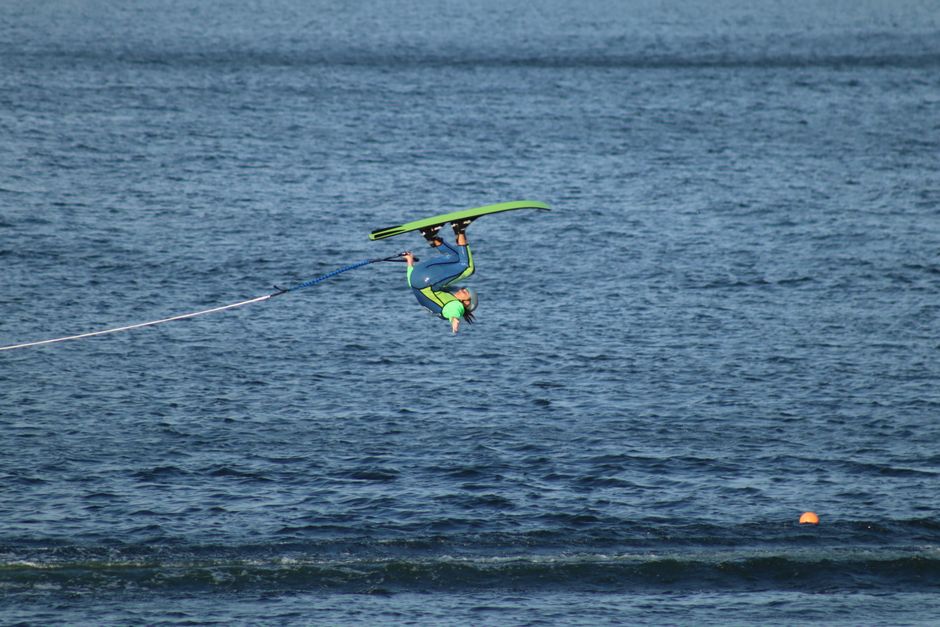
You are in the water at the dock, rope in hand, the boat idling in front of you. Today is the day you shorten the rope, or take the jump ramp up a notch, and your stomach knows it. The handle is the same handle. What has changed is the voice in your head. Mental training for water skiers is the practice of using attention, self-talk, routines and planning so that you ski the pass in front of you with more control, whether you are working on a first slalom course, a jump at the lake or a tournament set. It does not replace skill, fitness or a good boat driver, and it cannot promise a longer run or a farther jump.
Quick answer: The mental tools with the best general support in sport are short self-talk cues, a simple pre-performance routine, imagery and training under pressure. We found no study of them on water skiers specifically, so this page uses sport-wide research plus common coaching practice, and none of it guarantees a result. Fear that keeps growing, nerves that do not ease after a fall, or a hit to the head are reasons to see a doctor or licensed mental health professional, not just to try a new cue word.
General information for skiers. Back to the water skiing hub. Strength, grip and balance work are on the training page, and registration, weather and food for the day are on the tournament day page.
Fear and progression: slalom and jump
Fear at the dock is information. Water skiing carries real consequences: a survey of 96 college skiers (Jung and colleagues, 2021) found the ankle and foot, knee, and head and neck were the most injured areas, and a review of tournament skiing found a high rate of lower-back injuries in the jump event. A skier who feels uneasy about a step may be reading it correctly, and holding at the current step for another weekend is a legitimate choice. The injuries page covers what those falls can do.
We did not find a study on how skiers work through fear of a shorter rope or a bigger ramp, so the ideas below are common coaching practice, not research findings:
- Change one thing at a time. The slalom ladder is already built in: the boat speeds up pass by pass until your division maximum, then the rope shortens in set steps, per the USA Water Ski & Wake Sports rules summarized on our rules page. In practice, make the next set a little faster or a little shorter, not both.
- Jump: decide before the pass. Choose the speed and the ramp height on the dock, not on the approach. Most divisions jump a 5-foot ramp, and the boat speed is the skier’s choice up to the division maximum, so you control how big a step you take. Half-committing at the ramp is when many skiers get into trouble.
- Let it be a no-go day. If your legs are cooked, your back is sore or you are distracted, skip the step you were saving for today. College skiers in the Jung survey were mostly hurt by losing control, and tired legs lose control.
Composure through a pass
A slalom pass is a string of six turns, and each one asks for the same calm. An Exercise and Sports Science Australia position statement on performing under pressure (2026) lists four strategy types with support: pre-performance routines, implicit attentional strategies, psychological skills training and mindfulness-based approaches. It also notes that pressure can help or hurt performance. Those are sport-wide findings, not water ski findings. Skiers commonly use them like this:
- One cue per buoy. A single short word such as “stack”, “stand tall” or “smooth” rather than a lecture. A meta-analysis of self-talk in sport (Hatzigeorgiadis and colleagues, 2011) found a moderate positive effect on performance, with instructional self-talk working better on fine motor tasks and on new tasks than on well-learned ones.
- Look where the next turn starts. Many coaches teach skiers to keep their eyes on the next buoy or the end of the course rather than the wake. This is coaching practice; we did not find a study of it in skiers.
- Reset after a bad turn. A late turn at the 2 ball is gone once you round it. Many skiers pick a cue for the next buoy and leave the last one behind.
Confidence after a fall
Falls at speed hurt, and sometimes the part that lingers is not physical. A survey of cyclists (Kotler and colleagues, 2021) found that fear or anxiety after a crash was associated with being female, a history of depression and a more severe crash. Few cyclists received treatment and most returned to their previous level, but how long it took varied. We found no matching survey of water skiers, so read it as a hint: nerves after a hard fall are common, there is no standard timetable, and the skier who gets back on slowly is not doing it wrong.
- Get checked first. If you hit your head, or have a headache, dizziness, confusion or nausea afterwards, stop and see a doctor before you ski again. The injuries page explains the signs, and easing back in belongs on the recovery page.
- Return in steps, with a doctor or physical therapist’s go-ahead if you were hurt. A common sequence is easy two-ski or wide-rope sets first, then your usual rope, then the step that threw you.
Tournament nerves
A tournament puts a crowd on the bank and one pass at a time on the line. In slalom your score is the buoys you round before you miss or fall; in jump you get three passes; in tricks, two 20-second passes. The ESSA position statement describes both helpful and harmful effects of pressure, and says training under some pressure can prepare athletes for it. For skiers that can mean:
- Practice with an audience. Run a pass in front of friends or ski a mock tournament with a score, so competition is not the first time you feel watched. This is our reading of the pressure-training idea, not a water ski study.
- Use a pre-pass routine. The same steps each time: gear check, breath, one cue, the signal. A routine gives your attention something to do besides the crowd.
- Pick goals you control. “Hold my stance through the 1 ball” is yours to control; “beat the skier next to me” is not. This is common coaching advice, not a finding from our sources.
Imagery and routines
Imagery means rehearsing a pass in your head: the deep-water start, the first turn, the cut to the ramp. A 2026 scoping review of imagery for stress management in athletes (Zhao and colleagues) found it is widely used and often part of larger psychological-skills programs, and cautioned that results usually cannot be credited to imagery alone and that evidence for a single imagery method is not settled. Try it as an extra, not a substitute for time on the water.
Setbacks and goals
A missed pass, a lost buoy or a bad jump day happens to every skier. For goals, favor small steps over one big result. An editorial in the British Journal of Sports Medicine (Goddard and colleagues, 2025) raises the question of whether goal setting in youth sport can unintentionally contribute to dropout; for kids on skis, keep the focus on fun and effort, and let the youth page guide the physical side.
When it is a health matter, not a performance matter
Mental performance skills are not a treatment. The International Olympic Committee’s 2019 consensus statement on mental health in elite athletes says mental health symptoms and disorders are common among elite athletes, can impair performance and cannot be separated from physical health. Persistent anxiety, low mood, loss of interest in skiing, changes in eating or sleep, panic around the boat, or exhaustion that does not lift with rest are health matters. Take them to a doctor or a licensed mental health professional.
- In the United States, call or text 988 (the 988 Suicide and Crisis Lifeline) if you or someone you know is in crisis, or call 911 in an emergency.
- The Association for Applied Sport Psychology lists resources on finding a sport psychology professional.
- If you are in college, your athletics department or campus counseling center is a first stop.
Water ski mental training: FAQs
How do I get over my fear of the jump?
There is no published method for skiers, so this is common coaching practice. Go up in small steps, decide ramp height and speed on the dock, never half-commit on the approach, and ski with a coach or experienced driver. If fear is growing or you have a recent head or back injury, see a doctor or physical therapist before you keep going.
How do I stop getting tense when the rope gets shorter?
Change one thing at a time, stay on a rope length until it feels boring, and give yourself one short cue per buoy. A meta-analysis of self-talk in sport found a moderate positive effect, with instructional cues working better on new, fine-motor tasks. Tension that comes with pain or a recent injury is a reason to stop and be checked.
Is it normal to be nervous after a bad fall?
Yes. A survey of cyclists found fear or anxiety after crashes was common and that return timelines varied. If you hit your head, get checked before you ski. If the fear does not ease or keeps you off the water, talk to a doctor or licensed mental health professional.
Does visualization work for water skiing?
Imagery is widely used in sport, but a 2026 scoping review found the evidence is mixed and often based on programs with several parts. Try it as an extra, not a replacement for practice.
How do I handle tournament nerves?
Practice under a little pressure, use the same pre-pass routine each time, set goals you control, and plan the waiting time. Nerves are normal; they only become a health matter when they are severe, constant or get in the way of daily life.
Are mental skills the same as mental health care?
No. Skills such as self-talk and routines support performance. Anxiety, depression, disordered eating and burnout are health conditions that a qualified professional should assess.
Sources
- Hatzigeorgiadis A et al. Self-talk and sports performance: a meta-analysis. Perspect Psychol Sci 2011 (doi, PMID 26167788)
- Schweickle MJ et al. Performance under pressure in sport: a position statement from Exercise and Sports Science Australia. Sports Med 2026 (doi, PMID 42271117)
- Zhao L, Wang Y, Anuar N. Mapping the use of mental imagery for stress management in athletes: a scoping review. Front Psychol 2026 (doi, PMID 42846045)
- Kotler DH et al. Fear, anxiety, and return to sport after cycling crashes: a survey of cyclists. Phys Med Rehabil Clin N Am 2021 (doi, PMID 34798993)
- Goddard SG et al. Goal setting in youth sport: are we unintentionally contributing to dropout? (editorial) Br J Sports Med 2025 (doi, PMID 40930570)
- Jung et al. Water ski injuries and chronic pain in collegiate athletes. Int J Environ Res Public Health 2021 (PMID 33918591)
- Roberts and Roberts. Tournament water skiing trauma. Br J Sports Med 1996 (PMID 8799590)
- Reardon CL et al. Mental health in elite athletes: IOC consensus statement (2019). Br J Sports Med 2019 (doi, PMID 31097450)
- USA Water Ski & Wake Sports, AWSA Official Tournament Rules 2025 (usawaterski.org/AWSA)
- 988 Suicide and Crisis Lifeline (988lifeline.org)
- Association for Applied Sport Psychology resources (appliedsportpsych.org)
General information for education only, not medical advice. It does not replace a doctor, licensed mental health professional or qualified coach. See our editorial policy for how we research and write.