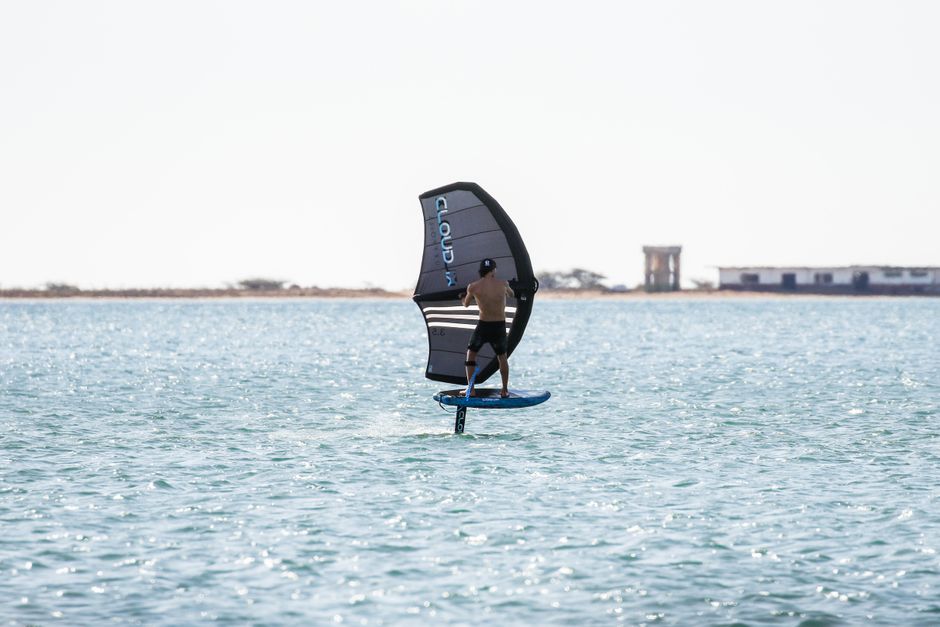
The bay is full of whitecaps and the app shows 24 knots with gusts a lot higher. Three riders are already pumping up their wings, and your own wing is still in its bag. You flew beautifully last weekend, until the foil dropped out from under you and the board hit your shoulder on the way down, and you have not forgotten it. Every wingfoiler knows this moment, and the quieter one that follows: the second hour, arms burning, when everything feels fine and your judgment is slipping. Wing foiling mental training is the practice of the skills between your ears (calling a session on or off, staying calm after a crash, noticing tiredness, and moving up at a pace your skills can carry) the same way you practice a tack. It is for riders of every level. It is about mental performance, which is different from mental health; a section below explains the difference.
Quick answer: Good judgment on the water is a habit you can train. Set your go/no-go limits on the beach before the wind tempts you, treat fatigue as a reason to come in (in the largest wingfoil survey, most injuries happened in the second hour and were put down to tired riding errors), rebuild confidence after a crash in small steps, and change one thing at a time as you progress. None of these tools guarantees safety or better results. See a doctor, licensed psychologist or other qualified professional if fear, low mood or trouble sleeping lasts more than a couple of weeks or affects daily life, and in a crisis call or text 988 (US).
Fear and risk: respect the foil, not the panic
A wing is handheld and has no lines, which makes wing foiling feel gentle compared with kiting. The foil is another matter: it sits well below the board, and a fall can bring the mast, front wing and board close to you. We found no published trials of fear management specific to wing foiling, so the habits on this page are general coaching practice, not proven treatment. What the wingfoil research does show is useful for your risk judgment. In the largest survey so far (Gangl and colleagues, Open Access Journal of Sports Medicine, 2023; 415 riders), 31% reported at least one traumatic injury in the previous year, beginners were injured most often, and the authors note that beginners should not overestimate themselves. Respecting that is not timidity; it is part of the sport.
Go or no-go: the decision you make on the sand
The wind, gust, direction, depth and storm facts live in our wing foiling Session Day guide. This section is about the mind that makes the call. The National Weather Service defines a gust as a variation of 10 knots or more between peaks and lulls, so a big gap between average and gust speed is worth writing into your limits.
- Write your limits down in advance. A maximum average wind for your wing and level, a maximum gust gap, and the situations that always mean no: a building storm, offshore wind without a boat nearby, no buddy, water too shallow for your mast. A rule made calmly on Tuesday is easier to follow at 4 p.m.
- Beware the crowd effect. Seeing other riders out feels reassuring, but their wing size, weight, foil and skill are not yours.
- Ask the three questions. Can I get back to the beach if the wind drops or my wing fails? Does someone know where I am? Am I rested, fed and warm? A no to any of them is a reason to wait.
Confidence after a crash with the foil
A hard fall with the foil, a catapult, or a mast strike in shallow water can leave a rider tense for weeks: gripping the handles too hard, avoiding the foil, or riding well below their level. The Gangl survey found that the most injured body parts were the feet and toes, lower legs and knees, and that serious injuries were mainly to the ribs. Fear after an injury is not something to push through. There is little wing-specific research on confidence, so the steps below are common coaching practice.
- Get hurt things checked first. See our wing foiling injuries guide, and let a doctor or physical therapist tell you when you can return. Shoulder dislocations and rotator cuff tears were among the injuries that lasted longest in the survey.
- Work out what happened. Was it gear, a gust, a lull, tired legs, or a move that was too big? A clear cause turns a frightening event into something you can fix.
- Go back to something easy. A bigger board, a lighter wind, flat water and a short session are a fair first step. VDWS, the German association of water-sports schools, teaches wingfoiling in seven levels, starting with controlling the wing on a big, stable board before the foil, so stepping back a level is normal, not failure.
- Change one thing at a time. Wind, foil size, distance from shore and the new move are four dials; turn one, not all four.
- Rebuild in small pieces. Practice getting up and falling safely in easy conditions, and use the balance and strength work in wing foiling training to feel steadier on the board.
Fatigue and error awareness
Fatigue is where the mental side of wing foiling meets the numbers. In the Gangl survey, 24% of injuries happened in the first hour on the water and 55% in the second hour, and riders put 77.5% of injuries down to individual riding errors caused by tiredness. The authors suggest taking a break. It is a survey of riders’ own reports, so it shows a pattern, not an exact cause.
- Set a check-in, not a finish line. Agree with your buddy to come in after about an hour to drink, eat and shake out your arms. Then decide whether to go back.
- Know your own tired signs. Sloppy pumping, late reactions to gusts, sagging posture, a loosening grip, or “just one more run” thinking. Any of them means land.
- Do not judge by the wind alone. Cold, hunger and thirst reduce attention too. Hydration, fuel and cold-water facts are in the Session Day guide and the nutrition page.
Progression: moving up without rushing
In the Gangl survey, 85% of riders were self-taught, and beginners had the highest injury rate. A kitesurfing review of 3,138 riders found skill level was the most important risk factor there, which is a related sport and not proof for wingfoiling.
- Use a ladder. The VDWS levels run from wing control on a big board, to the first 50 meters on the foil, to foiling in different directions, the foiling jibe, the foiling tack and finally jumps. You do not need a certificate to use that order as a plan.
- Set process goals. “Keep my front arm long through the lull”, “pump twice before I stand” or “land three clean touchdowns” are things you control. “Beat Sam on the downwinder” is not.
- Take lessons at the next level. An instructor sees what you cannot.
Focus, imagery and pre-session routines
Imagery means rehearsing a move in your mind: the pump, the stand-up, the weight shift as the foil lifts, and a soft touchdown. A 2023 systematic review and meta-analysis of psychological interventions for athletes (Reinebo and colleagues, Sports Medicine) found moderate effects for psychological skills training, mindfulness-based approaches and imagery. The effects were no longer significant when non-randomized trials and subjective outcomes were removed, so treat imagery as a low-cost addition to real practice, not a replacement.
A short routine before every session helps you start in the right frame of mind: read the water, check the leashes and foil screws, agree your signals, take one slow breath before launching. A 2026 position statement from Exercise and Sports Science Australia (Schweickle and colleagues, Sports Medicine) lists pre-performance routines, psychological skills training and mindfulness-based approaches among evidence-based strategies for performance under pressure,.
Competition: race starts, heats and waiting for wind
Wingfoil racing, freestyle and wave events bring pressure that a weekend session does not: starts, crowded marks, heats and long waits for wind. The same tools apply. Build a start routine, set one or two process goals per heat, and plan a short reset between races (a drink, a breath, one thing you will do differently). Helmets are mandatory at Wingfoil World Tour race events, and every wing must be leashed to the rider, so your pre-race check is also a calming ritual. Logistics for event days are in the Session Day guide, formats in wing foiling rules and leagues and associations, and rest between heavy days in wing foiling recovery.
Young riders
The wingfoil survey included riders as young as nine, but it was mostly adults (mean age 43.5, 14% women), so it says little about children. Young riders learn best with fun, an instructor who sets the conditions and an adult who is happy to cancel. See our youth wing foiling guide.
Mental performance is not the same as mental health
Everything above is about performance skills. Anxiety disorders, depression, disordered eating and burnout are health matters, not mindset problems, and a better routine does not fix them. The 2026 International Olympic Committee consensus statement on mental health in elite athletes (Reardon and colleagues, British Journal of Sports Medicine) says mental health symptoms and disorders are common among elite athletes, can have sport-related causes and can affect performance, and recommends screening and monitoring. Worry or low mood lasting weeks, panic before sessions, big changes in eating or sleep, or losing interest in riding and in friends are worth taking seriously.
Start with your doctor, a licensed psychologist or another qualified mental health professional. In the US, you can call or text 988 (Suicide & Crisis Lifeline) at any time.
Wing foiling mental training: FAQs
How do I decide whether it is too windy to wing foil?
Set limits on the beach before you rig: average wind, gust gap, direction, storms and your own level. A gust is a swing of 10 knots or more between peaks and lulls, according to the National Weather Service. If you are unsure, the answer is no. See the Session Day guide.
How do I get my confidence back after a bad crash?
Get injuries checked first, go back to an easier level, change one thing at a time and work out what actually happened. If fear lasts for weeks or spills into daily life, talk to a doctor or a licensed mental health professional.
Why do I crash more when I am tired?
Tired arms and legs slow your reactions. In the largest wingfoil survey, 55% of injuries came in the second hour and riders blamed tired riding errors for 77.5%. It is a self-reported survey, but the advice to take a break is simple.
Does visualization help wingfoilers?
A 2023 review across sports found moderate effects for imagery, but they were not stable once weaker studies were removed. No wingfoil-specific trial exists that we found. Use it alongside real practice.
When should I move up to stronger wind or a smaller foil?
When your current level feels easy and repeatable, and you can say what you will change. Raise one thing at a time and take a lesson. No study gives an exact timetable.
Sources
- Gangl and colleagues, 2023, Open Access Journal of Sports Medicine, sports injuries while wingfoiling: PubMed 37916042
- Reinebo and colleagues, 2023, Sports Medicine, psychological interventions meta-analysis: PubMed 37812334
- Schweickle and colleagues, 2026, Sports Medicine, ESSA position statement on performance under pressure: PubMed 42271117
- Reardon and colleagues, 2026, British Journal of Sports Medicine, IOC consensus statement on mental health in elite athletes: PubMed 42580854
- Offerhaus and colleagues, 2026, BMC Sports Science, Medicine and Rehabilitation, kitesurfing injuries (related sport): PubMed 41620742
- National Weather Service, glossary: gust: weather.gov
- Wingfoil World Tour, race class equipment rules: wingfoilworldtour.com
- VDWS, wingfoiling courses: vdws.de
- 988 Suicide & Crisis Lifeline: 988lifeline.org
General information for education only, not medical advice. It does not replace a doctor, psychologist or other qualified professional, or a certified wing foiling instructor. See how we work in our editorial policy. Back to the wing foiling hub.