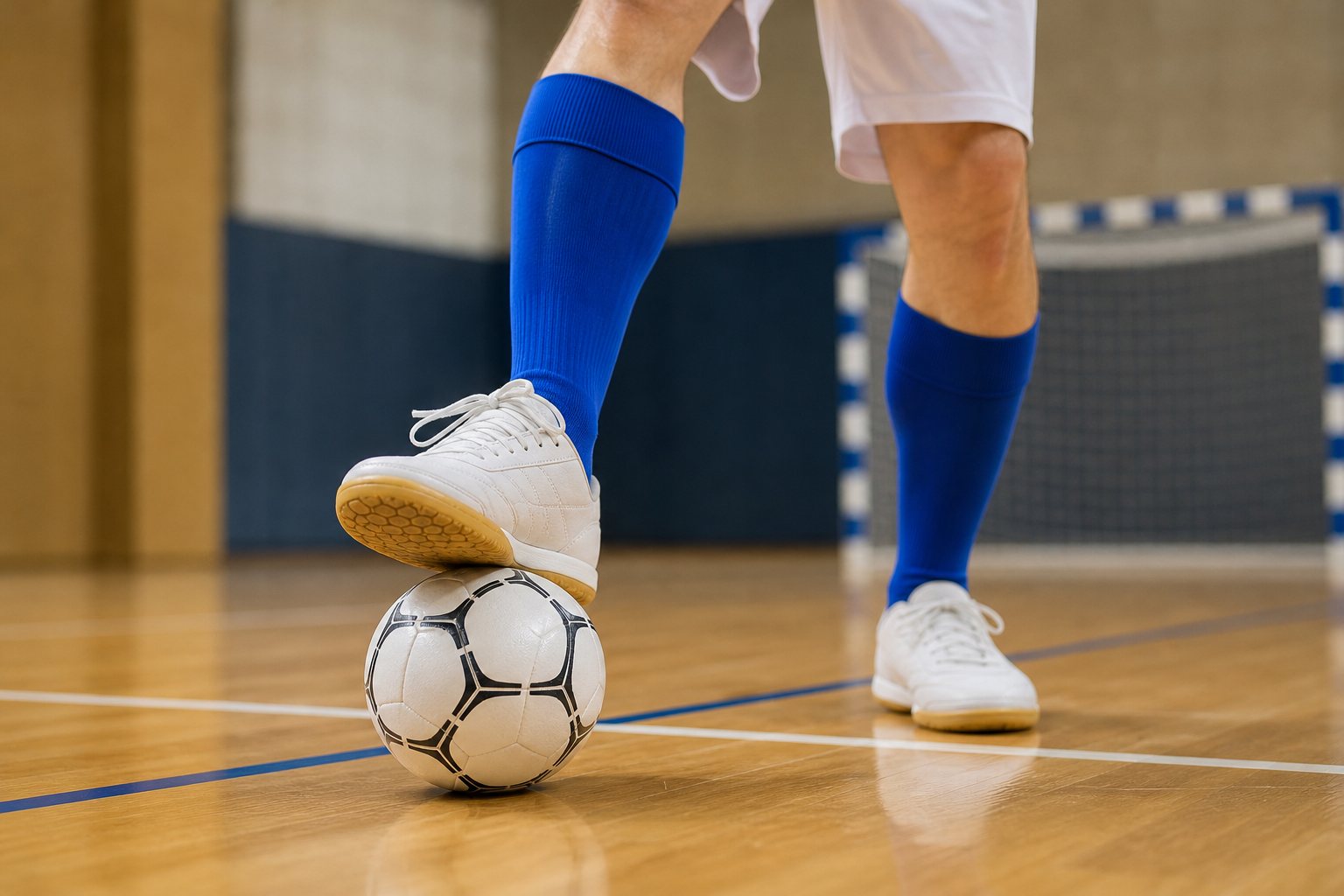
Four seconds on the clock for a kick-in, a coach shouting from the bench, and the player with the ball has just given the ball away twice. What she does in the next breath, take the pass, hide, or reset, is mostly mental. Mental training in futsal means practising the skills of attention, confidence, routine and recovery from mistakes in the same way you practise passing. It is separate from mental health care, which has its own section below. We describe what research and common sport-psychology practice say, and we make no promises that any technique improves results.
Quick answer: Many players use goal setting, short routines, imagery and a quick reset after errors. Research on soccer players gives modest support for imagery, but most studies are small, and none we found was in futsal. Anxiety, depression, disordered eating or burnout are health matters: talk to a qualified professional. In the US you can call or text 988 at any time.
Why futsal asks a lot of the mind
The Futsal Laws put clocks on restarts: kick-ins, goal clearances and free kicks have a four-second limit once the team is ready. Substitutions are unlimited, and a match is two periods of 20 minutes, so a bench player must switch from sitting to full intensity. A 2026 study of ten first-league futsal players (Monteiro and colleagues, Vision) measured a mean reaction time of 0.63 seconds on a visual task, which hints at how little time there is to decide. These facts describe the setting, not a mental program. Our rules page explains the restarts.
Confidence, focus and goal setting
Confidence is built from preparation more than pep talks. Many coaches have players set three kinds of goals: a result goal (win), a performance goal (complete most passes) and a process goal (scan before receiving, call the pass early). That three-goal split is common sport-psychology practice, not something we could tie to a futsal study. For focus, simple cues work: one word for the next action, a look at the shoes before a restart, a breath before the kick-in. Keep it short; with four seconds, long routines do not fit.
Imagery and visualization
A 2026 study in JSAMS Plus (Joseph-Jacques and colleagues) of 20 youth soccer players, mean age 16.4, found that internal visual and kinesthetic imagery improved goals scored and accuracy compared with a control group. A 2011 study (Wood and Wilson, Cognitive Processing) of 20 university players found quiet-eye training improved accuracy at first but the gain did not hold under shootout pressure, the authors concluded partial support. A 2024 survey of 266 soccer players (Shi and colleagues, Frontiers in Psychology) linked mindfulness, confidence, anxiety control and attention, but it shows association, not cause. These studies are small and not about futsal. Imagery is cheap, so a few minutes of picturing a clean first touch and a calm restart is a reasonable add-on.
Pre-game routines and handling pressure
Routines make the nervous moments familiar: pack the bag the night before, eat your usual meal, warm up in the same order, and run through the first two minutes in your head. Research on penalty shootouts (Jordet, Journal of Sports Sciences, 2009, 200 penalties in World Cup and European finals) found that higher-status teams spent less time preparing and scored less, a reminder that rushing under pressure costs accuracy. It is soccer, not futsal, but futsal’s own penalty and free-kick moments are similar. The Spanish under-19 data on our injuries page shows that matches carry more risk than training, so stay alert, not frantic.
Mistakes and setbacks
Futsal gives few seconds between a mistake and the next play. A widely used sport-psychology habit is a short reset: one breath, a word like “next,” a small physical cue such as touching the shirt, and back to the ball. After the game, review one or two things you can control rather than replaying every error. We did not find a futsal study of reset routines; treat this as common practice.
Teamwork and decisions
Small teams make communication easy to see. A 2026 study of 169 adults (Cammarata and colleagues, Frontiers in Psychology) found that cohesion and closeness predicted a sense of belonging, with rugby ahead of soccer and basketball. A 2026 study of 40 male soccer players (Ivosevic and Stockel, Frontiers in Psychology) tested peripheral vision in pass decisions. Short calls, clear roles and a habit of looking up before receiving are standard coaching advice. In futsal, with no offside and constant rotation, communication about who covers whom matters in every phase.
Competition day
There is no futsal game-day page in this section, so here is the short version: arrive early enough for a full warm-up, have your shin guards and indoor shoes checked, eat your usual pre-match meal (see nutrition), and know your team’s substitution rotation. Our training page and recovery page cover preparation and the day after. We found no youth-specific futsal mental-skills source, so we give no age rules; coaches should keep expectations realistic for children and teens.
Mental performance is not mental health
Practising focus does not treat anxiety, depression, disordered eating or burnout. Those are health matters, and a doctor, psychologist or counsellor is the right person. The IOC consensus statement on mental health in elite athletes (Reardon and colleagues, 2026) addresses screening and care in sport. A 2026 study of Australian A-League players (Mifsud and colleagues) found sport-related distress in 43% of men and 66% of women, which shows how common stress can be among football players. If you or someone you know is struggling, the 988 Suicide and Crisis Lifeline offers free, confidential support by call or text at 988 in the US, 24 hours a day. Outside the US, use your local emergency number or crisis line.
Futsal mental training FAQs
What is mental training in futsal?
Practising attention, confidence, routines and quick resets so you can play well under pressure. It complements, and does not replace, physical practice.
Does visualization really help soccer or futsal players?
A 2026 study of 20 youth soccer players found imagery helped with goals and accuracy compared with a control group. It was small and not futsal-specific, so think of it as a useful extra.
How do I handle mistakes in a fast game?
Many players use a one-breath reset and a one-word cue, then go back to the next play. This is common practice rather than a tested futsal program.
Is pre-game anxiety normal?
Some nerves are common. If worry is constant, affects sleep or eating, or keeps you from playing, talk to a doctor or counsellor. In the US you can call or text 988.
What if my child is stressed about futsal?
Listen, keep the focus on effort and fun, and talk to a pediatrician or mental health professional if stress persists or affects daily life.
Sources
- Monteiro et al. 2026: Visual discrimination in first-league futsal players (PMID 42201151)
- Joseph-Jacques et al. 2026: Imagery in youth soccer players (PMID 42238611)
- Wood and Wilson 2011: Quiet-eye training (PMID 21318734)
- Shi et al. 2024: Mindfulness, confidence, anxiety in soccer players (PMID 39328817)
- Jordet 2009: Penalty shootouts (PMID 19058088)
- Ivosevic and Stockel 2026: Peripheral vision and pass decisions (PMID 42865354)
- Cammarata et al. 2026: Cohesion and belonging (PMID 42839933)
- IOC consensus statement on mental health in elite athletes, 2026 (PMID 42580854)
- Mifsud et al. 2026: Distress in A-League players (PMID 41888960)
- 988 Suicide & Crisis Lifeline
- FIFA Futsal Laws of the Game 2025/26
General information for education only, not medical advice. It does not replace a sports medicine doctor, physical therapist, athletic trainer or dietitian who knows you. See how we write and check our pages in our editorial policy. Back to the futsal hub.