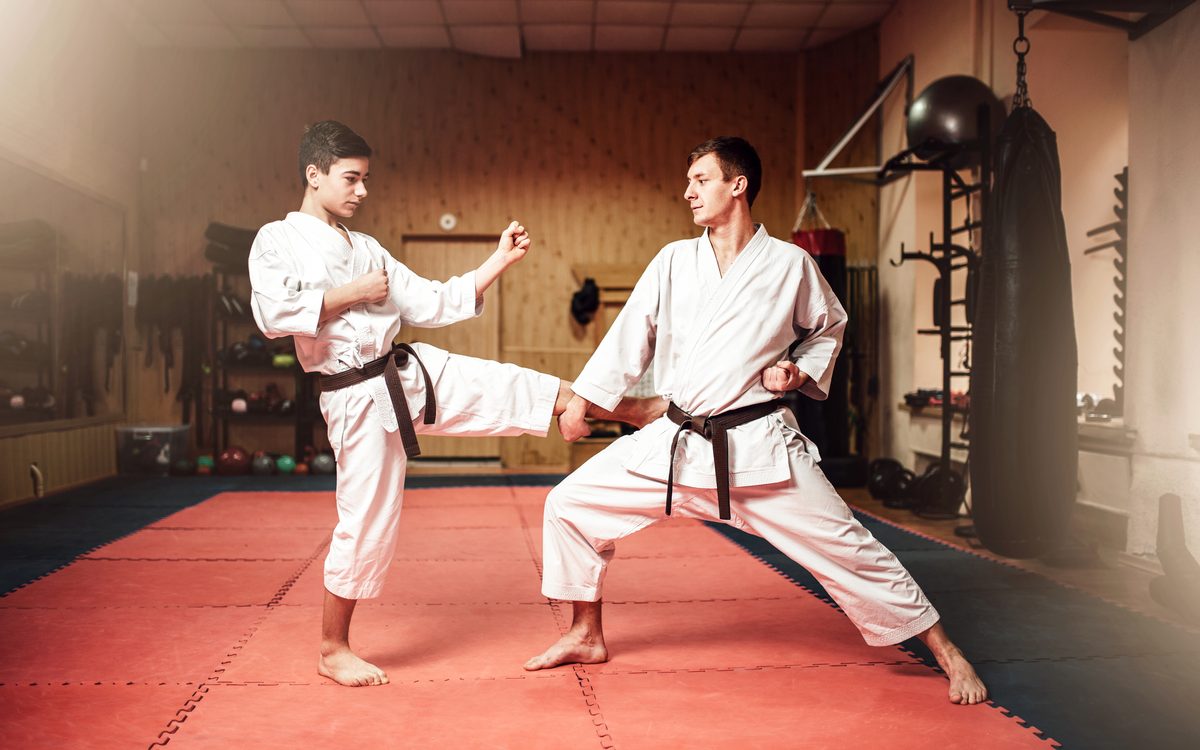
Two minutes into a kumite bout the fighter’s breathing is loud, the legs feel heavy, and the next scoring chance lasts less than a second. Karate training is the mix of skill practice, conditioning and rest that prepares a body for that sequence of short bursts, and the same mix lets a beginner hold a low stance for a whole class. This page covers what the sport demands, a sample week and the limits that research and pediatric guidance put on training load.
Quick answer: Published studies describe karate as a high-power, intermittent sport in which a good aerobic base helps athletes recover between bursts and between bouts. Kumite costs more energy than kata. A sensible week has skill practice, two short strength sessions, mobility work and rest days, and rises slowly. For children the American Academy of Pediatrics (AAP) says there is some evidence that training more than three hours a week raises injury risk. If pain stays in one spot, see a sports medicine doctor, physical therapist or athletic trainer.
What the sport demands
A review of the physical and physiological profile of elite karate athletes (Chaabene and colleagues, Sports Medicine, 2012) concluded that top performers need a high fitness level. It reports that aerobic capacity plays a major role by limiting fatigue and speeding recovery between bouts, that muscular explosive power is central to the decisive actions, and that karate performance leans on power at lower loads more than at heavy ones. It also notes that studies of women are scarcer than those of men.
An earlier laboratory study of world champions (Doria and colleagues, European Journal of Applied Physiology, 2009) measured simulated competition in six kata and six kumite athletes. Kumite required much higher metabolic power than kata, the aerobic share of the energy cost was the largest, and heart rates ranged from 174 to 187 beats per minute during the simulated bouts. The numbers matter less than the picture: kumite is sustained intermittent effort, kata is shorter and more about control and power in each move.
A 2026 study of 28 international-level karate athletes found sex differences in the lower body: men had longer flight times in jump tests, while women showed greater hip abduction range of motion in a wall split test. The authors suggest this supports individualized conditioning. A 2026 exploratory study of 27 elite traditional kumite athletes looked at strength, jumping and reaction measures; after correcting for the many comparisons, none of the associations held up, so it is a reminder not to over-read single numbers.
The parts of a training week
- Skills. Basics, kata, partner drills and, for competitors, sparring. This is the largest block for most students. Short, focused repetitions with feedback usually beat long unfocused ones.
- Aerobic base. Easy running, cycling or swimming, or long steady rounds of shadow work, to support recovery between bursts. Intensity should be mostly easy.
- Power. Jumps, bounds, medicine-ball throws, kicks against a pad. Keep sets short and sharp, and stop when speed drops.
- Strength. Squats and lunge patterns for the stances, hip hinges, rows, presses and trunk work for rotation and posture. The AAP supports supervised resistance training for children and teens, typically two to three sessions a week for at least eight weeks, led by someone qualified.
- Mobility. The ACSM position stand recommends flexibility work for each major muscle-tendon group, with about 60 seconds of total stretch time per exercise and at least two days a week. High kicks and deep stances ask a lot of hips and hamstrings.
- Rest. At least one or two full days off a week is a common recommendation; see our recovery page.
A sample week for a recreational adult
This is an example, not a prescription from any source.
- Monday: class (basics and kata) plus 15 minutes of mobility.
- Tuesday: strength session, 30 to 40 minutes, then an easy walk.
- Wednesday: class with partner drills.
- Thursday: easy aerobic work, 20 to 30 minutes.
- Friday: class, with light sparring if your dojo offers it and you have the control for it.
- Saturday: optional strength or power session.
- Sunday: rest.
Competitors add more sparring and speed work and cut volume before an event. The weekly total should rise gradually; the International Olympic Committee (IOC) consensus on load in sport (Soligard and colleagues, 2016) says that sudden jumps in training load and poorly managed load are linked to injury and illness, and that athletes should not make rapid increases. We found no source that gives a safe weekly number of hours for adults.
Periodisation in plain words
Periodisation means planning the year in phases: a general base with lower intensity and more strength, a build that adds sparring and speed, a short sharpening phase before a competition, and a break afterward. The IOC consensus supports planned progression and recovery rather than a fixed formula. For kata athletes the emphasis shifts toward stance strength, balance and precision; for kumite athletes toward speed, timing and repeated effort. Use your instructor’s calendar of gradings and tournaments as the frame.
Youth and training load
The AAP martial arts clinical report says qualified instructors matter, advises delaying contact until a child has the maturity and skill, and states there is some evidence that training more than three hours a week increases injury risk, while noting that more study is needed. Young athletes who also play other sports should count all hours together.
What a review says about long-term karate
A 2025 review of 21st-century karate research found only 14 papers strictly on karate. It reports that greater skill goes with greater fitness, that kumite takes more metabolic power than kata, and that individualized forms of training matter. With so few studies, treat the findings as suggestive.
Karate training FAQs
Is karate good cardio? It can be. The Doria study found the aerobic system supplied the largest share of energy in simulated competition, and kumite cost much more energy than kata. A typical beginner class is lighter than that.
Do I need to lift weights for karate? Not to begin. Two short strength sessions a week can help with stances and power, and the AAP supports supervised strength training for young people. Start light and learn the movements first.
Should I stretch before class? Many instructors use an active warm-up first and save longer stretching for after. The ACSM flexibility guidance (60 seconds per exercise, at least two days a week) is about regular practice, not one stretch before a kick.
How many days a week should I train? There is no single number. Many adults do two to four classes a week plus extra work. For children, the AAP notes some evidence that more than three hours a week raises injury risk. Build up slowly and take rest days.
Do kata and kumite athletes train differently? Yes, in emphasis. Kumite needs repeated bursts and recovery; kata needs control, balance and strength in stances. Both rely on power and a base of fitness.
Sources
- Chaabene et al., Physical and physiological profile of elite karate athletes, Sports Med 2012 (PubMed 22901041)
- Doria et al., Energetics of karate (kata and kumite), Eur J Appl Physiol 2009 (PubMed 19711097)
- Sex-specific differences in elite karate athletes, 2026 (PubMed 42197970)
- Strength, jump and psychomotor associations in elite kumite athletes, Front Sports Act Living 2026 (PubMed 43022009)
- The Health Effects of Karate Training: A Review, Healthcare 2025 (PubMed 39857145)
- AAP: Youth Participation and Injury Risk in Martial Arts (2016)
- AAP: Resistance Training for Children and Adolescents (2020)
- ACSM position stand, Garber et al. 2011 (PubMed 21694556)
- IOC consensus statement on load in sport, Soligard et al. 2016 (PubMed 27535989)
General information for education only, not medical advice. It does not replace a visit with a doctor, physical therapist or athletic trainer. See how we write and check our pages in our editorial policy.