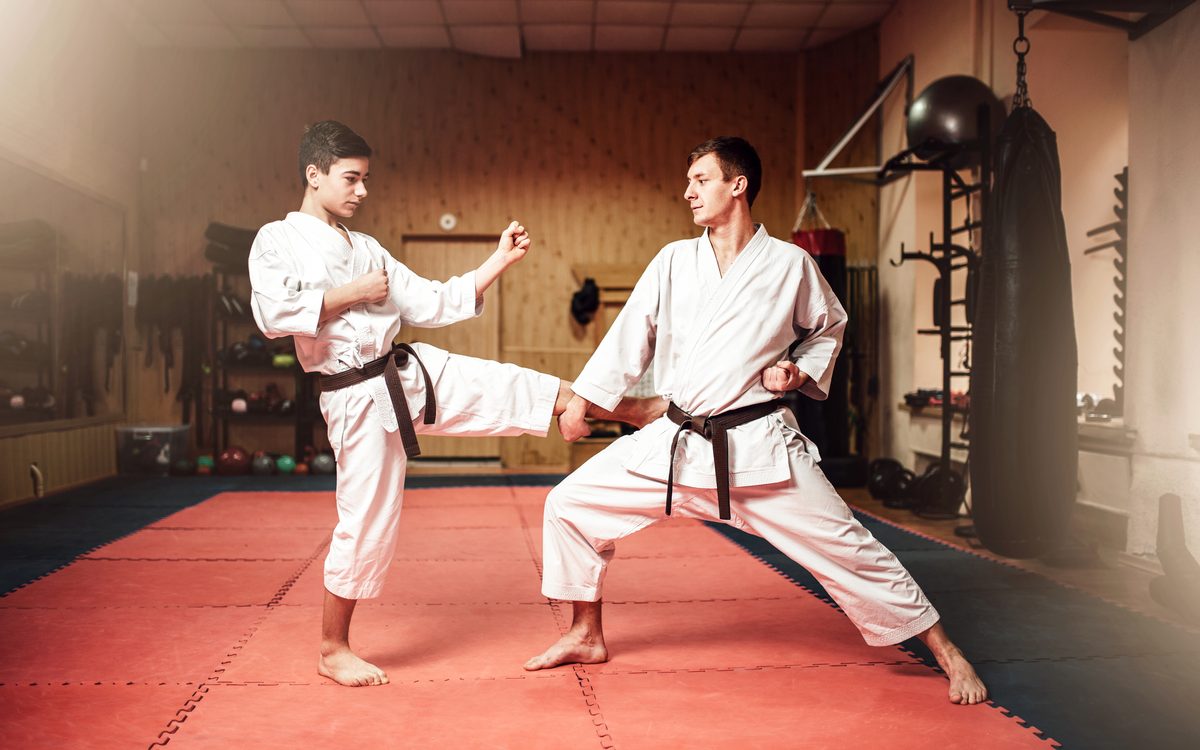
The class ended an hour ago and the thighs are already stiff from a long run of low stances. Tomorrow is another class, and on the weekend there is a grading. Karate recovery is what happens between sessions: sleep, food and fluid, rest days, gentle movement and a plan that stops fatigue from piling up. This page covers what the research supports, where the evidence is thin and how to tell ordinary soreness from an injury.
Quick answer: The best-supported recovery tools are the unglamorous ones: enough sleep, a week with real rest days, a load that rises gradually, and food and fluid after hard sessions. Massage has some evidence for soreness; cold-water immersion may blunt strength gains if used after strength training; stretching and cooling down mostly help comfort, not next-day performance. Soreness in broad muscle groups after a hard class is common. Pain that is sharp, stays in one spot or changes how you move deserves a visit with a sports medicine doctor, physical therapist or athletic trainer.
What a hard session does to the body
Kumite is demanding. In a laboratory study of world-class karate athletes (Doria and colleagues, 2009), simulated kumite cost much more energy than kata, with heart rates between 174 and 187 beats per minute. A different combat sport study of simulated MMA sparring (three rounds of five minutes, Coswig and colleagues, 2016) found creatine kinase, a marker of muscle stress, was still higher 48 hours later than before the session. We found no karate study with the same measurement, so we use the MMA result only as a reminder that the effects of a hard sparring session can last a couple of days. Allow a day or two before the next hard session when you can.
Sleep
Sleep is the base of every recovery plan. The American Academy of Sleep Medicine (AASM) consensus recommends 9 to 12 hours for ages 6 to 12 and 8 to 10 for teens, and the AASM and Sleep Research Society consensus recommends at least 7 hours for adults. A 2026 study of 176 young Tunisian karate athletes (Medicine, Baltimore) found that anxiety about a competition was linked to sleep disturbances in the week before it, which is why a calm routine and a consistent wake time matter before tournaments. Sports medicine reviews of sleep in athletes (Nedelec and colleagues, 2015) point to consistent timing, a dark and cool room and limiting screens late in the evening.
The first hour after class
- Fluids and food. The American College of Sports Medicine, Academy of Nutrition and Dietetics and Dietitians of Canada (ACSM/AND/DC) position suggests about 1.25 to 1.5 litres of fluid for each kilogram of body mass lost, and 0.25 to 0.3 grams of protein per kilogram in the first period after exercise. See our nutrition page.
- Cooling down. A 2018 review (Van Hooren and Peake, Sports Medicine) found a cool-down is largely ineffective for same-day or next-day performance and mostly does not reduce soreness. A short walk and some easy breathing is fine for comfort.
- Hygiene. The National Athletic Trainers’ Association (NATA) says to shower after practice, not share towels or soap, and launder uniforms after each use, because mats spread skin infections.
Load management across the week
The International Olympic Committee consensus on load (Soligard and colleagues, 2016) supports gradual progression and recovery rather than sudden jumps. The American Academy of Pediatrics (AAP, Brenner 2016) advises at least one to two days off per week for young athletes, and its martial arts report notes some evidence that more than three hours a week raises injury risk in children. For adults, no source gives a universal rule; use the signals below.
Signs you may need more rest: resting heart rate higher than usual, persistent heavy legs, slower reactions, poor sleep, falling motivation or small pains that do not clear. A wearable can show trends but not diagnose anything.
Mobility and flexibility
Karate asks a lot of hips, hamstrings and ankles. The ACSM position stand recommends flexibility exercises for each major muscle-tendon group, a total of about 60 seconds per exercise, at least two days a week. Many students do their mobility work after class when muscles are warm. A 2026 study found female elite karate athletes had greater hip abduction range than male athletes, so ranges differ between people; copy a coach’s plan, not another athlete’s range. Pain in a stretch is a signal to back off.
Recovery methods, honestly graded
- Massage and foam rolling. A 2018 review of 99 studies (Dupuy and colleagues, Frontiers in Physiology) found massage was the most effective method for soreness and perceived fatigue. A foam roller or massage gun is a comfort tool, not a treatment.
- Compression. A 2017 review (Brown and colleagues, Sports Medicine) found small benefits, mainly for strength recovery.
- Cold-water immersion. A 2015 study (Roberts and colleagues, Journal of Physiology) found that in 12 weeks of strength training, immersion after sessions reduced strength and muscle gains. Use it sparingly in training blocks, and check with a doctor if you have heart or circulation problems.
- Stretching and cooling down. See above; helpful for range and comfort, limited for performance.
- Mindfulness and yoga nidra. A 2024 report of one male and one female elite karate athlete (Heliyon) tested yoga nidra, a guided relaxation, for recovery and stress; two people is too few to draw conclusions.
Soreness or injury?
Delayed muscle soreness is dull, spread across a muscle, peaks a day or two after unfamiliar work and eases with movement. Injury pain is more often sharp, local, present at rest or at night, comes with swelling, or changes how you move. This distinction is general guidance and not a diagnosis; if you are unsure, ask a professional. After a head injury, follow the CDC HEADS UP steps and do not return until a healthcare provider says so. See our injuries page.
Tournament days
On a multi-bout day eat easily digested food, sip fluids, keep warm between bouts and rest in a quiet space. After the event, expect to feel tired for a day or two; keep the first session after a tournament light.
Karate recovery FAQs
How many rest days do I need? The AAP advises one to two days off per week for young athletes. Adults vary. Take a rest day when sleep, mood and heavy legs suggest it.
Should I ice or use cold water after class? Evidence is mixed. One study found cold-water immersion after strength sessions reduced gains over 12 weeks. For soreness alone, massage had stronger evidence in a large review.
Is stretching after class worth it? It helps range of motion when done regularly. The ACSM suggests at least two days a week. It does not reliably prevent next-day soreness.
Are massage guns worth buying? They can feel good, but the strongest evidence is for massage in general, not for any device. Treat one as comfort, not treatment.
How much sleep does a teen karate student need? The AASM consensus is 8 to 10 hours for teens.
Sources
- Doria et al., Energetics of karate, Eur J Appl Physiol 2009 (PubMed 19711097)
- Coswig et al., simulated MMA sparring, J Strength Cond Res 2016 (PubMed 26817739)
- Competitive anxiety, mood and sleep in young Tunisian karate athletes, 2026 (PubMed 42065146)
- AASM pediatric sleep duration consensus (PubMed 27456512)
- AASM and SRS adult sleep consensus, 2015 (PubMed 25979105)
- Nedelec et al., sleep hygiene and recovery strategies, Sports Med 2015 (PubMed 26275673)
- Van Hooren and Peake, Do we need a cool-down after exercise?, 2018 (PubMed 29663142)
- ACSM, AND and DC position on nutrition and athletic performance, 2016 (PubMed 26891166)
- NATA position statement on skin diseases (PDF)
- IOC consensus statement on load in sport, 2016 (PubMed 27535989)
- AAP: Youth Participation and Injury Risk in Martial Arts (2016)
- ACSM position stand, Garber et al. 2011 (PubMed 21694556)
- Dupuy et al., recovery methods review, Front Physiol 2018 (PubMed 29755363)
- Brown et al., compression garments, Sports Med 2017 (PubMed 28434152)
- Roberts et al., cold-water immersion and training adaptations, J Physiol 2015 (PubMed 26174323)
- Yoga nidra in two elite karate athletes, Heliyon 2024 (PubMed 38268574)
- CDC HEADS UP: response
General information for education only, not medical advice. It does not replace a visit with a doctor, physical therapist or athletic trainer. See how we write and check our pages in our editorial policy.