This article contains affiliate links: if you buy through them we may earn a commission, at no extra cost to you. Read our affiliate disclosure.
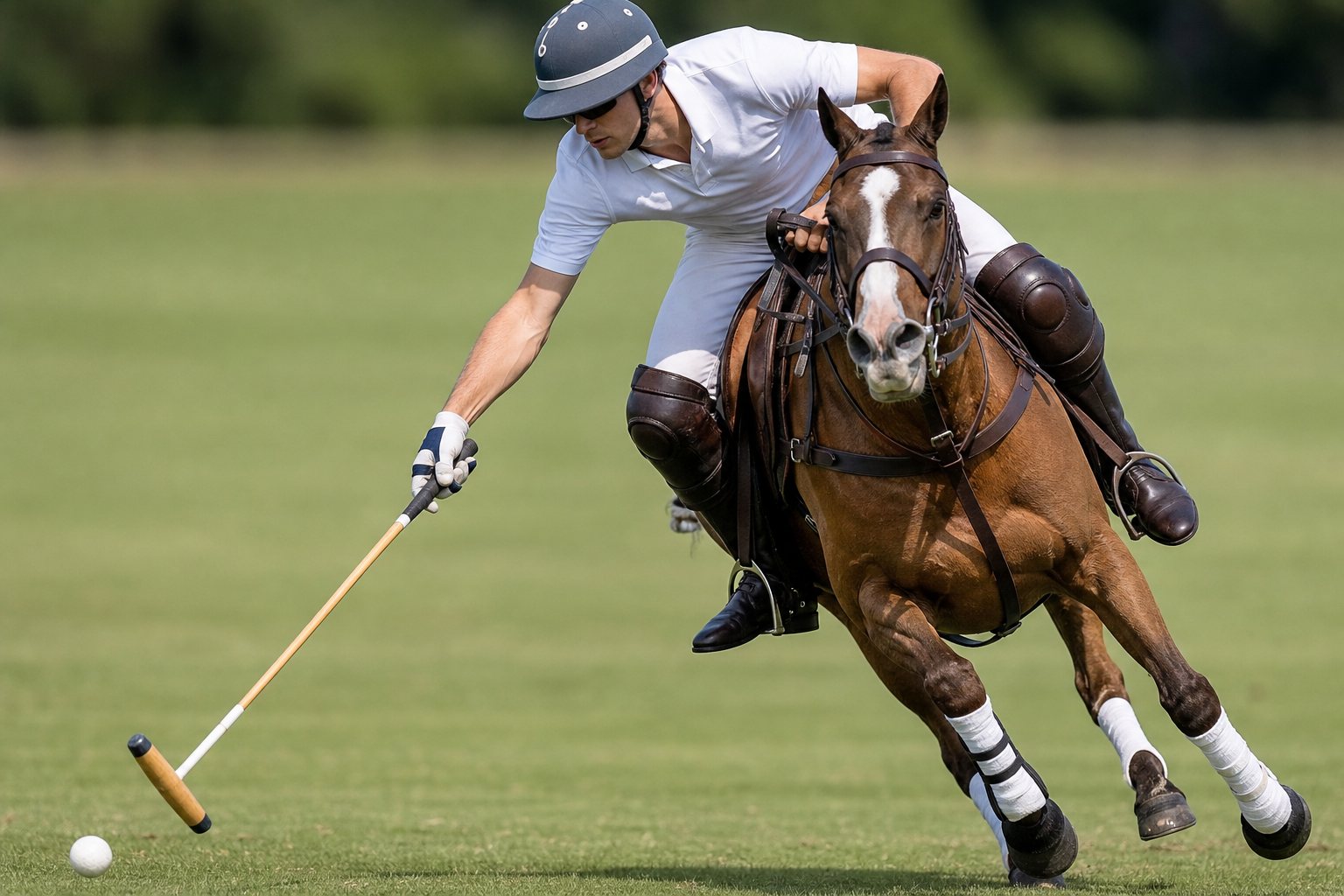
The grooms have the ponies tacked up, the sideboards are freshly painted, and a player is pulling a helmet on, adjusting the chin strap until it will not rock, and checking the goggles sit clear. Polo gear is a short list of items that matter a great deal: the helmet that meets the standard, eye protection, kneepads, boots, gloves, mallet and a sun-and-heat kit. This page explains what to look for, how to check fit and condition, and where standards end and maker claims begin.
Quick answer: The most important item is a helmet certified to NOCSAE ND050, the polo standard that the USPA requires for member play since May 1, 2021, fitted in person. Eye protection is advised by the 2026 English injury study, and a separate NOCSAE standard (ND055) covers helmet-mounted polo eye protection. Kneepads, boots and gloves complete the kit. Maker claims are not certifications: look for the standard name. If you are unsure, ask your club.
General information, not medical advice. Product cards are examples, not endorsements; we have no verified polo helmet or eye-protection product to show, so ask a polo coach, your club and a qualified fitter. Back to the polo hub. Safety habits are on the injury prevention page.
Helmet
The USPA says that, since May 1, 2021, helmets in actual outdoor and arena games at USPA member clubs must be certified to NOCSAE ND050, the Standard Performance Specification for Newly Manufactured Polo Helmets, with a chin strap; some variances exist, and practice games are excluded in the summary we saw. Check the current USPA or your national association’s rule book. The USPA’s rule followed a review by the Virginia Tech helmet lab, according to a USPA news summary.
- What a standard means. A certification means the model passed a defined test; it does not mean it prevents every injury. A 2025 laboratory study (Stark and colleagues, Annals of Biomedical Engineering) tested ten polo helmets in three test systems and found a substantial range in head acceleration between models, so models differ even among those on the market.
- Fit. Helmets should sit level, snug, with the chin strap secured so it does not rock when you shake your head. Try several sizes in person. In the UK survey of 112 players (Sports Medicine Open 2015), 49.4 percent said they chose their helmet for appearance, so choose on certification and fit first, style second.
- Inspection (general advice). Check for cracks, dents, loose padding and a worn strap before each ride. Follow the maker’s guidance about replacing a helmet after a significant impact or fall, and do not buy used helmets with an unknown history.
Eye protection
The 2026 English study of 236 injured players found eye injuries were the most common reason for hospital treatment, and advised requiring sports glasses, goggles or face guards in addition to helmets. NOCSAE lists ND055 for helmet-mounted polo eye protection (search summary). Ask your club and an eye doctor what is approved with your helmet, because a facemask may need to be an authorised accessory from the helmet maker.
Kneepads and boots
The museum says kneepads protect the knees during ride-offs and bumps. Boots are tall riding boots with a small heel that stops the foot slipping through the stirrup; fit matters because your feet are your connection to the stirrups. Ask your club what they recommend. We could not find a polo-specific safety standard for boots or kneepads.
Gloves
Gloves help you hold the reins and the mallet grip, and reduce blisters. They are comfort and grip aids, not injury-proof protection.
Mallets
The museum says the mallet (stick) is 48 to 54 inches long, with a bamboo shaft and a head of bamboo root or a hard wood such as maple; it is far more flexible than a golf club or hockey stick. Beginners are usually shown the length by a coach or the club; we found no sourced rule for choosing length and do not give one. Inspect shafts for cracks, which can break during a swing.
Balls and tack
The museum says the ball is plastic, 3 1/2 inches across and 4 1/2 ounces. Saddles, bridles, bits and leg protection for horses are a veterinary and trainer matter and are beyond this page.
Sun and heat kit
Many polo days are long and hot. The CDC recommends hydration, shade and breaks for outdoor activity in heat. A water bottle, a cooling towel and a broad-spectrum sunscreen are practical extras for a tournament day. Reapply sunscreen as its label directs.

SSG Digital Riding Gloves
- Digital grip palm
- Grips when wet
- Machine washable

MISSION Max Plus Cooling Towel
- Microfiber, soak and wring
- UPF 50 (listing)
$22.99 at Amazon, as of Nov 17, 2026 01:07 UTC
Check price on Amazon
Blue Lizard Sport Mineral SPF 50
- Zinc oxide + titanium dioxide
- 80 minutes water resistant
- Fragrance-free
$8.97 at Amazon, as of Nov 17, 2026 01:07 UTC
Check price on Amazon
Nalgene Sustain 32 oz Bottle
- 32 oz, wide mouth
- BPA-free
- Easy to refill
Standards versus maker claims
Look for the standard name (for example NOCSAE ND050 for helmets) on the product or on the maker’s list of certified models, check it against your association’s rules, and treat words such as “advanced,” “impact-absorbing” or “pro-level” as marketing unless a standard is named. The listing details in the cards above come from the Amazon listings, not our own testing.
Polo gear FAQs
Do I need a special polo helmet?
For USPA member play, the USPA says the helmet must be certified to NOCSAE ND050. Riding helmets sold for general riding may not meet it, so check.
Do I need goggles?
The English authors advise eye protection for players. Ask your club about approved options.
What should a beginner buy first?
Ask the club first, since many provide horses and some gear for lessons. A fitted helmet is the first priority.
How do I know a helmet fits?
It sits level, feels snug, and does not move when you shake your head with the strap fastened. Have a qualified fitter check.
Can I use a second-hand helmet?
We do not recommend it: you cannot know its impact history. Follow the maker’s replacement guidance.
Sources
- USPA: helmets that pass NOCSAE ND050
- NOCSAE ND050 polo helmet standard
- Virginia Tech Helmet Lab: polo helmets
- Stark NE et al. Polo helmet test systems (Ann Biomed Eng 2025, PMID 40246778)
- Ken-Dror G et al. (Postgrad Med J 2026, PMID 41263769)
- Falls and injuries to polo players (Sports Med Open 2015, PMID 27747839)
- Museum of Polo and Hall of Fame, FAQs
- CDC: Heat and athletes
General information for education only, not medical advice. It does not diagnose, treat or clear anyone to play. For your own situation, see a sports medicine doctor, physical therapist or athletic trainer. How we write and check our pages is in our editorial policy.