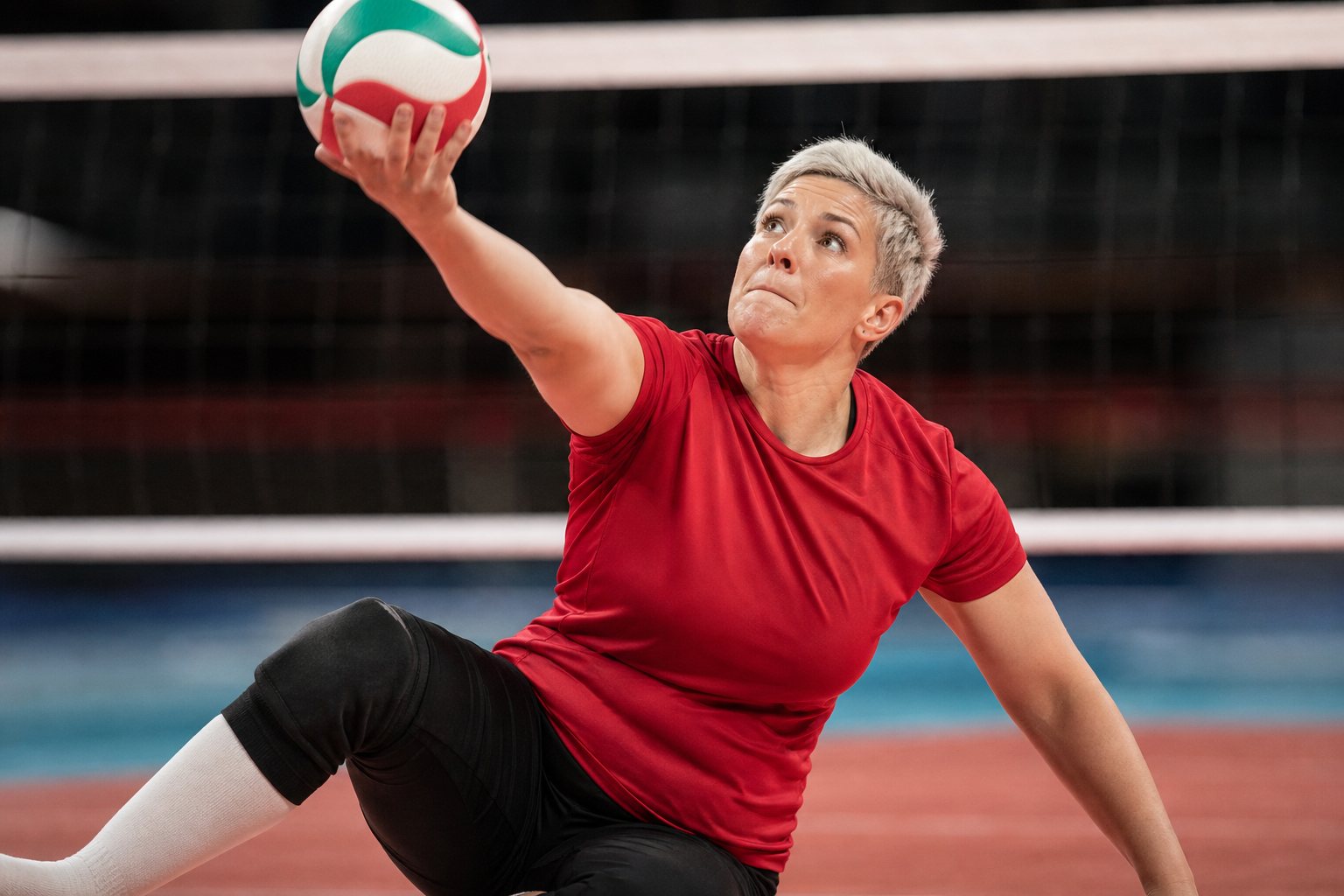
A hard serve skids off a defender’s outstretched fingertips and she shakes the hand out, then goes back to the floor for the next rally. In sitting volleyball the hands and shoulders do the work that legs do in the standing game, and they take the knocks. Sitting volleyball injuries are mostly overload problems of the shoulder, hand and fingers, neck and back, with some acute knocks from the ball, the floor and other players. This page summarises what the surveillance numbers and small studies say, and the general principles of rehabilitation.
Quick answer: In the Paris 2024 Paralympic Games, sitting volleyball had an injury incidence of 19.9 per 1,000 athlete days, against 8.6 for the Games overall. Studies in teams point to the shoulder, fingers and wrist, neck and lower back. Most reports are small or retrospective. Rehabilitation is individual: see a sports medicine doctor, physical therapist or athletic trainer who works with para athletes. Seek emergency care after a head injury with danger signs.
General information, not medical advice and not a diagnosis. Ways to lower risk are on our injury prevention page, and recovery between sessions is on our recovery page.
What Paralympic surveillance shows
At the Paris 2024 Paralympic Games, 4,450 athletes were monitored over 62,300 athlete days. There were 535 injuries (10.9% of athletes injured), an incidence of 8.6 per 1,000 athlete days (95% CI 7.9 to 9.4). Taekwondo (27.3), football 5-a-side (22.3) and sitting volleyball (19.9, 95% CI 14.8 to 26.7) had higher incidence than other sports (Derman and colleagues, British Journal of Sports Medicine 2026). Incidence counts every reported injury, including minor ones, and the authors reported that 19.1% of injuries across all sports caused time lost from training or competition. At Tokyo 2020, football 5-a-side, taekwondo, judo and badminton had the highest incidence, sitting volleyball was not among them in the abstract, and the shoulder (0.7 per 1,000 athlete days) and the hand and fingers (0.6) were the most common sites across all sports (Derman and colleagues, 2022).
Patterns in teams and leagues
- Iran Sitting Volleyball Super League, 2023-24. Of 56 athletes from 6 teams, 30 (53.6%) had an injury, 80 injuries in all, at 16.2 per 1,000 athlete days. Incidence was 33.5 in the competition period and 14.5 before it, most injuries were re-injuries, and the fingers, wrist and shoulder were the most affected areas (Mahmoudkhani and colleagues, Physician and Sportsmedicine 2025).
- Systematic review. Injuries mainly affected the upper limbs, especially the shoulder, mostly by overload and in training, with time lost from sport (Moraes and colleagues, Motriz 2025).
- Pain surveys. In 35 elite Polish para athletes (21 sitting volleyball players, 14 para swimmers), the most common pain was in the neck (37%) and lower back (34%) (Zwierzchowska and colleagues, Medicine 2022). In 75 elite volleyball players, the shoulder and knee joints were the most common sites of pain or injury in all groups, followed by the lower back, and lower limb amputation seemed to affect how often complaints occurred (Zwierzchowska and colleagues, Scientific Reports 2023). In 12 elite Polish players, the lower back, upper back and neck were the most painful areas.
Taken together, the shoulder is the clearest pattern, with hands, fingers, neck and back close behind. The numbers come from different designs, countries and definitions, so they are not directly comparable.
Shoulder overload
The American Academy of Orthopaedic Surgeons’ OrthoInfo says shoulder warning signs include pain at rest and at night, pain lifting or lowering the arm, weakness and a crackling feeling, that continuing to use a painful shoulder can make a problem worse, and that early treatment can prevent symptoms from worsening. That is a general description of rotator cuff problems, not a diagnosis of any player. OrthoInfo also says most people improve with nonsurgical care, which includes resting and limiting overhead activity, medicines such as anti-inflammatories if a doctor agrees, and physical therapy for strengthening and stretching, and that overhead sport is one reason a doctor may discuss surgery. Only a clinician can say what applies to you.
Hands, fingers and wrists
Jamming a finger when trying to catch a ball is a classic way to injure it. OrthoInfo’s finger fracture page says to see a doctor right away after a suspected finger fracture, and notes that fingers can stiffen while immobilised, which is why a hand therapist may guide exercises afterwards. Signs it lists include swelling, tenderness, bruising, trouble moving the finger and a finger that looks short, angled or overlapping its neighbour. Do not tape over a finger that cannot straighten and keep playing.
Neck and back
In the Polish team studies, fat mass and upper-body strength were linked to spine curves and pain locations in small samples (Zwierzchowska and colleagues, Journal of Human Kinetics 2022). These are associations in 12 players and do not show cause. Persistent neck or back pain, or any numbness or weakness, needs a clinician.
Concussion
The Concussion in Para Sport position statement (Weiler and colleagues, British Journal of Sports Medicine 2021) says para athletes need case-by-case decisions about returning to sport after concussion. The CDC’s HEADS UP guidance lists danger signs, including a worsening headache, repeated vomiting, seizures, increasing confusion and one pupil larger than the other; call 911 or go to an emergency department. Take the player out of play, and a health care provider decides when to return.
General rehabilitation principles
- Rehabilitation is planned around the injury and the athlete’s impairment; there is no universal timetable, and we do not give one.
- Common elements, per OrthoInfo for the conditions above: relative rest from the painful activity, a clinician-guided strengthening and range-of-movement program, and a staged return to play decided with the treating clinician.
- Re-injury is a concern in this sport. In the Iran league, most injuries were re-injuries, which supports finishing rehabilitation before returning, as advised.
When to see a professional
See a doctor promptly for a deformed finger, joint instability, an inability to bear weight or use the arm normally, numbness or weakness, or head injury danger signs. See a sports medicine doctor, physical therapist or athletic trainer soon for pain at rest or at night, shoulder pain that comes back each session, persistent neck or back pain, or any injury that has not improved. Return-to-play clearance is the treating clinician’s decision.
Sitting volleyball injuries: FAQs
What are the most common sitting volleyball injuries?
Studies point to the shoulder, fingers and wrist, with neck and low back pain also common. A systematic review found most injuries affect the upper limbs, mainly through overload in training.
Is sitting volleyball dangerous?
At Paris 2024 its injury incidence (19.9 per 1,000 athlete days) was higher than the Games overall (8.6), but incidence counts all injuries, minor ones included. Most research is small.
Can I keep playing with shoulder pain?
A clinician should decide. OrthoInfo notes that using a painful shoulder can worsen some problems. See a sports medicine doctor or physical therapist.
How long do sitting volleyball injuries take to heal?
It depends on the injury and the person, and no universal time exists. Your treating clinician can give an estimate and decide when to return.
Does concussion happen in sitting volleyball?
Concussion is reported in para sport generally, but we found no sitting volleyball figures. Use the CDC danger signs and remove a player with suspected concussion from play.
Sources
- Derman et al., injury and illness at Paris 2024, Br J Sports Med 2026
- Derman et al., injury at Tokyo 2020 Paralympics, Br J Sports Med 2022
- Mahmoudkhani et al., Iran Sitting Volleyball Super League injuries, Phys Sportsmed 2025
- Moraes et al., sports injuries in sitting volleyball: systematic review, Motriz 2025
- Zwierzchowska et al., musculoskeletal pain in elite Para athletes, Medicine 2022
- Zwierzchowska et al., injuries and pain in Olympic and Paralympic volleyball players, Sci Rep 2023
- Zwierzchowska et al., compensatory mechanisms and pain in Polish sitting volleyball players, J Hum Kinet 2022
- AAOS OrthoInfo: Rotator cuff tears
- AAOS OrthoInfo: Finger fractures
- Weiler et al., Concussion in Para Sport position statement, Br J Sports Med 2021
- CDC HEADS UP: signs and symptoms
General information for education only, not medical advice. It does not replace a visit with a doctor, physical therapist or athletic trainer. See how we write and check our pages in our editorial policy.