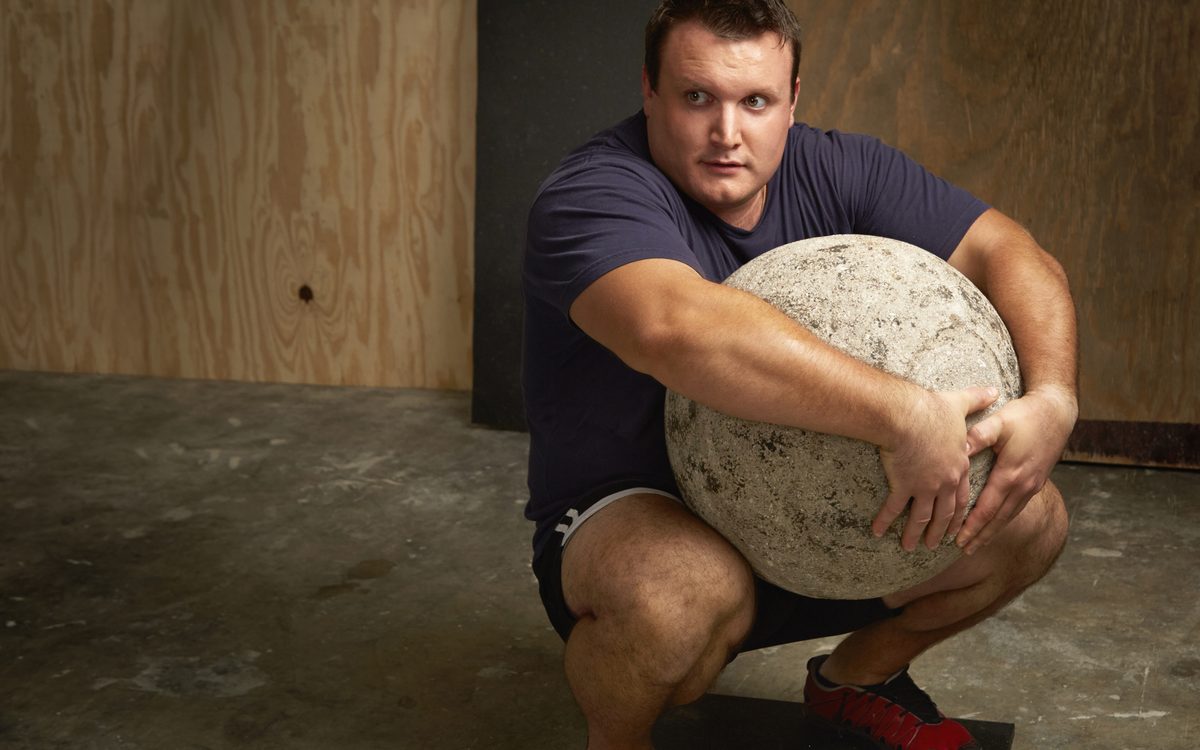
A heavy stone slips down the athlete’s thighs, the bar-side hand lets go and a sharp pull shoots through the inside of the elbow. It is a familiar picture in strength sports, and it is why the biceps appears in the injury data. Strongman injuries are the strains, tears and overuse problems that come from lifting, carrying and throwing heavy implements. This page looks at what the research says about where and how often they happen, what general rehab principles look like, and when to get help. It is not a guide to diagnosing yourself, and it never replaces a clinician.
Quick answer: The best strongman-specific data come from a 2014 survey of 213 athletes: 82% reported an injury in the past year, most often in the lower back (24%), shoulder (21%), biceps (11%) and knee (11%). A 2017 review put strongman at 4.5 to 6.1 injuries per 1,000 training hours, among the highest of the weight-training sports, with weak evidence quality. See a sports medicine doctor, physical therapist or athletic trainer for any injury that does not settle, and seek urgent care for head injury with danger signs or sudden loss of arm or leg function.
General information, not medical advice. For how to lower risk, see our injury prevention page.
What the surveillance numbers say
The first and still main strongman injury study was a one-year retrospective survey of 213 athletes (Winwood, Hume, Cronin and Keogh, 2014). Injuries were counted if they caused a missed or modified session or contest. Findings:
- 82% of athletes reported at least one injury; 1.6 training injuries per lifter per year, 0.4 competition injuries per lifter per year, and 5.5 training injuries per 1,000 hours of training.
- Sites: lower back 24%, shoulder 21%, biceps 11%, knee 11%.
- Types: muscle strains and tears 38%, tendon injuries 23%.
- 68% were acute and 47% were of moderate severity.
- Athletes used self-treatment (54%) or a medical professional (41%).
- Per hour of exposure, athletes were 1.9 times as likely to be injured in implement training as in traditional lifts, although 54% of injuries came from traditional training.
Because this was self-reported and retrospective, recall errors are possible, and the study covered a mix of levels. A 2017 systematic review (Keogh and Winwood) of 20 injury studies across weight-training sports found only five rated low risk of bias. It put strongman at 4.5 to 6.1 injuries per 1,000 hours and Highland Games at 7.5, against 0.24 to 1 for bodybuilding. The most commonly injured places across the sports were the shoulder, lower back, knee, elbow and wrist or hand; strains, tendinitis and sprains were most common. A 2023 systematic review (Serafim and colleagues) of 28 articles concluded that traditional strength training was the safest resistance method and strongman the least safe, but it included only one strongman study and warned against generalising.
Different studies give different rates. A 2026 nine-month prospective study of 381 weight trainers (not strongman specifically) reported 1.86 injuries per 1,000 hours, with the lower back (24.2%), shoulders and neck (20.4%) and knees (16.6%) most affected. The comparison shows why one number should not be treated as exact.
Injury patterns you may hear about
Lower back
The lower back was the most common site in the 2014 survey. Stones, deadlift variants, carries and loading all put load through the spine, and the 2025 resistance-training review lists improper technique, excessive loading and insufficient recovery as contributors. Pain that spreads into a leg or comes with numbness or weakness needs prompt medical advice.
Shoulder
Overhead events (log, axle and Viking presses) and yoke or frame carries stress the shoulder. A 2026 study of ten elite strongmen and ten trained controls recorded shoulder-girdle muscle activity before and after a competition protocol and found no overall drop in the elite athletes, suggesting greater resistance to fatigue; it measured fatigue, not injury, and the sample was small.
Biceps and elbow
A 2025 series of 183 competitive strength athletes (mostly weightlifting and powerlifting, not strongman specifically) who had a distal biceps tendon repair reported that all returned to sport and 73% rated their strength as fully restored; a longer wait between injury and surgery was associated with poorer scores. That does not mean surgery suits everyone, and it does not tell you how long your own recovery will take. A sudden pop at the elbow with bruising should be checked promptly.
Knee, hand and others
The knee and the wrist or hand also appear among the most commonly injured places in the 2017 weight-training review. We did not find strongman-specific numbers for the wrist or hand, or for other areas, beyond the figures above.
Head injuries and falls
Strongman is not a head-contact sport, but athletes fall off stones, platforms and vehicles, or are struck by a dropped implement. Follow the CDC HEADS UP advice: stop the activity and let a healthcare provider decide when it is safe to go back. Call emergency services for a worsening headache, repeated vomiting, confusion, seizures or loss of consciousness.
General principles of rehabilitation
We cannot give a rehab plan, and we do not give recovery times: they vary by injury and person. What sources say in general terms:
- The 2025 resistance-training injury review notes that most injuries are mild and resolve with conservative management, while severe tendon tears may need surgery.
- Early assessment matters for some injuries; in the biceps series, delay to surgery was linked to worse results.
- Rehab typically means a progressive return to load guided by a clinician, with checks on technique before returning to heavy implements. Return-to-play decisions belong to a doctor, physical therapist or athletic trainer.
- Pain you cannot explain, swelling, night pain or loss of strength should be assessed, not trained through.
Psychology and injuries
The 2026 prospective study found previous injury raised the risk of a new one 3.74 times and that obsessive passion and exercise addiction increased risk (by 73% and 12%), which is a reason to treat a new niggle seriously. Mental-health concerns are separate; see our mental training page.
When to see a professional
- A sudden pop, tearing or visible deformity.
- Pain that persists beyond a few days or limits normal lifting.
- Numbness, tingling or weakness.
- Any head injury with warning signs.
- A previous injury that keeps returning.
Frequently asked questions
What is the most common strongman injury?
In the 2014 survey of 213 athletes, the lower back (24%) and shoulder (21%) were the most common sites, and muscle strains and tears (38%) were the most common type.
How often do strongman athletes get injured?
That survey found 5.5 training injuries per 1,000 hours, and the 2017 review reported 4.5 to 6.1 per 1,000 hours. The data are retrospective and vary by study.
Do biceps tears happen in strongman?
Biceps injuries made up 11% of injuries in the 2014 survey, and distal biceps tendon tears are known in strength athletes. Seek assessment for a sudden pop at the elbow.
Can I keep training with an injury?
That depends on the injury. A doctor, physical therapist or athletic trainer can say what is safe. Pain that is sharp, rising or unexplained is a reason to stop and ask.
How long does recovery take?
There is no universal answer. Times depend on the tissue, the severity, treatment and the person. A clinician who has examined you is the right source.
Sources
- Winwood et al., retrospective injury epidemiology of strongman athletes, 2014
- Keogh and Winwood, epidemiology of injuries across the weight-training sports, 2017
- Serafim et al., which resistance training is safest, systematic review 2023
- Naderi et al., psychological factors as predictors of injury in weight trainers, 2026
- Lappen et al., distal biceps tendon repair in 183 strength athletes, 2025
- Kawa et al., most common injuries in resistance training, 2025
- Studnicki et al., shoulder-girdle EMG in a strongman competition, 2026
- CDC HEADS UP, response to a concussion
General information for education only, not medical advice. It does not replace a visit with a doctor, physical therapist or athletic trainer. See how we write and check our pages in our editorial policy.