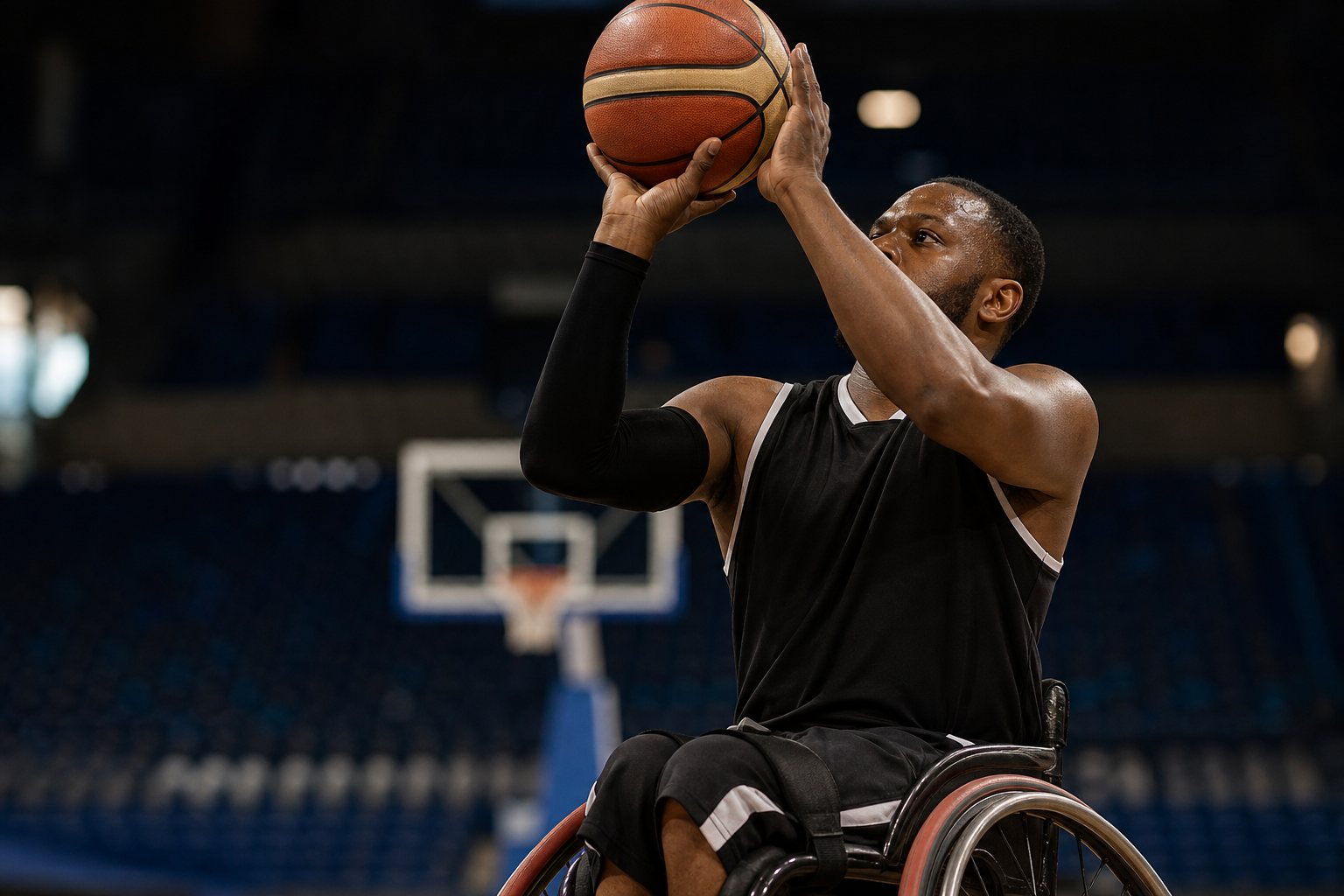
Someone new to the sport usually notices the same thing first: the chairs are part of the game. In a gym on a weeknight, a beginner is shown how to hold the ball in one hand while pushing the rim with the other, how to turn on a pivot, and how to get back after a tip, before anyone talks about plays. Wheelchair basketball uses the standing game’s court, hoop height and scoring, with a few adapted rules, and players of all backgrounds can start with a loaner chair and a local program. This page covers how a game works, the basic skills, classification in plain words and the steps to join a team.
Quick answer: Five players per team, four 10-minute periods, a 10-foot (3 m) hoop and the usual 1-2-3 scoring. The big differences are the two-push rule, the 24-second shot clock, no double-dribble rule and the 14-point classification limit on the court. To start, contact a local adaptive-sports program or the NWBA (US) and ask for a loaner chair before you buy anything.
This page is about rules and getting started. For fitness, see training; for safety, injury prevention. The full sport overview is on the wheelchair basketball hub.
How a game works
The IWBF (International Wheelchair Basketball Federation) says the court, basket height, foul line and three-point line match standard basketball. Teams have five players on court and up to 12 in total, and a game has four 10-minute periods, with extra periods if tied. Scoring is 1 point for a free throw, 2 for a basket inside the three-point line and 3 beyond it. The offense has 24 seconds to attempt a shot; if it neither scores nor hits the rim, the ball goes to the other team.
After a score, the other team restarts play. The IWBF rules page we read does not explain the opening tip or other restart details, so for those, ask your coach or read the rulebook your league uses.
The rules that are different
- Two pushes, then ball. A player may push the chair while dribbling, but after two pushes must pass, shoot or dribble again, or it is a traveling violation (IWBF).
- No double-dribble rule. The IWBF says a player may stop dribbling and start again. (Paralympic.org words this differently; we follow the federation’s own rules page.)
- The chair is part of the body. Contact rules apply to the chair as they do to a player (IWBF).
- Stay seated. Lifting the legs to gain an advantage or lifting out of the chair is a technical foul, and legs and feet may not touch the floor to steer (IWBF).
- Five fouls. A player with five personal fouls must be replaced (IWBF).
Chair specifications (seat height, wheel size, anti-tip casters, footrest height) are in the full rulebooks. The IWBF page we fetched does not list them, and the NWBA publishes its own rule book each season, so we do not quote numbers here. If you play in a league, ask the organizer for the current chair rules before buying or modifying a chair.
Classification in plain words
Each player gets a class from 1.0 to 4.5 in half-point steps. The IWBF explains that classification is based on what a player can do on court, not on a medical diagnosis: classifiers watch how well a player sits upright, leans, passes and shoots. Lower numbers mean less trunk and arm function in the game, higher numbers more. The five players on court may total no more than 14 points, so teams mix classes and every role matters. The IWBF says the goal is that no player is advantaged or disadvantaged by their impairment. Classification at a Paralympic or international event is done by the federation’s classifiers; at a recreational or youth program, the league usually has its own, simpler process, so ask.
Basic skills a beginner learns
The following is general coaching practice, not drawn from one rulebook, and the order varies by program.
- Pushing and stopping: forward strokes, braking with the hands, and smooth turns.
- Chair-and-ball coordination: pushing while holding the ball in the lap, then the two-push dribble rhythm.
- Passing and catching from a seated position, including chest and bounce passes.
- Shooting at the 10-foot hoop with the trunk set by the player’s own function.
- Picks and screens using the chair legally, and defensive positioning.
- Falls and recovering a tipped chair, ideally taught by an experienced coach before contact drills.
How to start and where to find a team
The NWBA (National Wheelchair Basketball Association), founded in 1949, lists divisions for men, women, high performance, collegiate (Divisions I, II and III), junior and prep, and says it has 225-plus teams and nearly 3,000 members in 42 states. Its site has “Find A Team” and “Become a Member” sections. Outside the US, start at your national federation through the IWBF site or your national Paralympic committee.
- Contact first. Email or call a team or adaptive-sports organization and ask if they welcome beginners and have loaner sports chairs.
- Try before you buy. Sports chairs are custom-fitted; a team, coach or seating specialist can advise before you spend on one.
- Ask about eligibility. We did not confirm from the NWBA or IWBF pages whether non-disabled players may join official or recreational play, so ask the league.
- Ask about safety policies. The NWBA site links a SafeSport reporting page; for youth, check how the program handles it.
Levels and the Paralympic route
According to Paralympic.org, wheelchair basketball began in 1945 in two US veterans’ hospitals and was one of eight sports at the Rome 1960 Games. At Paris 2024 there were 192 athletes (96 men and 96 women) from 10 countries in two medal events. Wheelchair basketball is on the initial 22-sport programme for Los Angeles 2028 (15 to 27 August 2028), per Paralympic.org. Check the official programme for the current edition. The parent sport’s overview is on our basketball hub, and the 3×3 format is at 3×3 basketball; the IWBF lists a 3×3 Open World Cup in Cairo for 26 to 28 November 2026.
Wheelchair basketball rules FAQs
How many players are on the court?
Five per team, with up to 12 players on a team, according to the IWBF.
What is the two-push rule?
A player may push the chair while dribbling, but after two pushes must pass, shoot or dribble again, or it is a traveling violation.
Is the hoop lower?
No. The IWBF says basket height matches standard basketball, 10 feet (3 m).
What does the 14-point rule mean?
Players are classed 1.0 to 4.5 by function, and the five on court may total no more than 14, so teams mix classes.
Do I need my own chair to start?
Not necessarily. Many programs have loaner sports chairs. Sports chairs are custom-fitted, so ask a team or seating specialist before buying.
Can I play if I do not have a disability?
We did not confirm eligibility rules from the sources used. Ask the league and check the NWBA or IWBF rules for the level you want.
Sources
- IWBF: basic rules of wheelchair basketball
- IWBF: what is classification
- IWBF home
- NWBA home
- NWBA about
- Paralympic.org: wheelchair basketball
- Paralympic.org: LA28 initial sport programme
General information for education only, not medical advice. It does not replace a sports medicine doctor, physical therapist, athletic trainer or seating specialist who knows chair sports. Read how we work in our editorial policy.