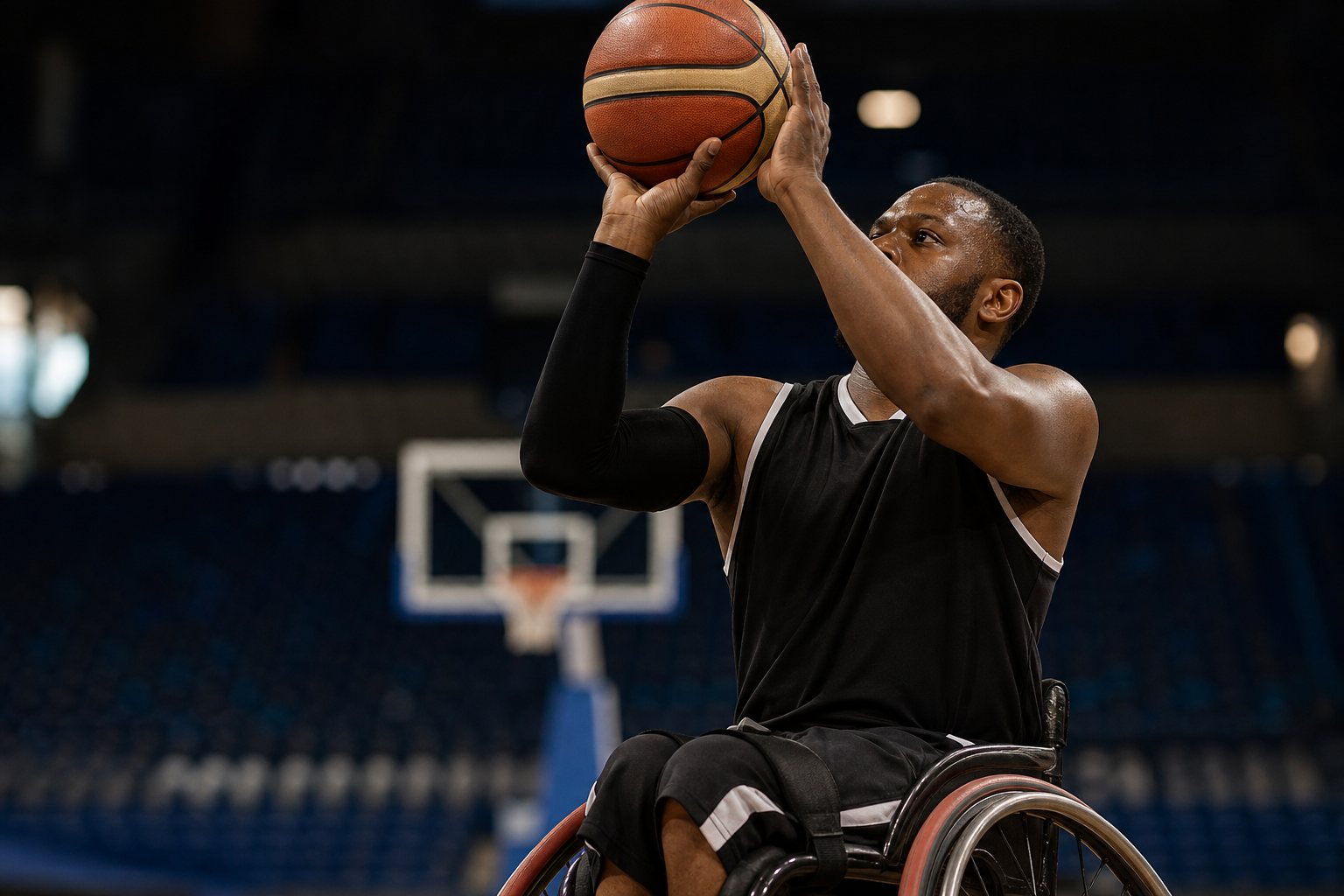
The sound a good chair player makes in practice is a steady rhythm: push, push, ball, push, push, ball, then a hard sprint to the baseline and a stop that makes the wheels bark. Behind that rhythm sits a lot of repeated work for the shoulders, arms, upper back and trunk. Wheelchair basketball training is the mix of chair skills, strength, endurance and speed work that a player does across a week and a season, tailored to their own body and classification.
Quick answer: Training for this sport builds repeated sprinting and stopping in the chair, plus upper-body and trunk strength and endurance. Published research on tests and workloads is still limited and mixed, so the weekly outline below is general coaching practice, not a prescription. Work with a coach or trainer who knows chair sports, and see a sports medicine doctor or physical therapist if pain persists.
This page is about building fitness. Protecting shoulders is on injury prevention, rules and classification on skills and rules, and rest on recovery.
What the game asks of the body
A 2026 systematic review (Choudhary and colleagues, Sports) of 22 studies, mainly in wheelchair basketball, rugby and tennis, reported links among trunk function, functional classification, wheelchair mobility and upper-body measures, and said the evidence was varied in design. A 2026 study of 31 female players across 13 international games (Bailey and colleagues) found that how researchers define speed zones changes how much high-intensity movement a match appears to contain. The practical message: a match is repeated short sprints, hard stops and turns with brief rest, but the exact numbers depend on how they are measured, so treat any single figure with caution.
What coaches test
A 2022 mini-review in Frontiers in Sports and Active Living looked at field tests in elite wheelchair basketball players. Of the studies that fit its criteria, 18 articles used heterogeneous tests, and the authors suggested a standard test set: a 10-minute warm-up, then handgrip strength (if a dynamometer is available), a 20 m sprint, a maximal pass, a modified push-up, a back-scratch mobility test and an adapted Yo-Yo intermittent recovery test. The 20 m sprint was the most common choice, often three maximal sprints with 120 seconds of rest. A 2026 study of 52 national-team players from Division B and C teams found Division B players faster over 5, 10 and 20 m (for example 5.46 s versus 5.82 s for 20 m) and in agility tests, with no difference in strength. Tests like these are useful to compare a player with their own earlier results; they are not pass-or-fail standards.
A sensible weekly shape (general coaching practice)
No source gives one correct week for every player. The outline below is a common way coaches arrange a competitive adult’s week; a beginner would do much less, and a high-level player’s team will set their own plan.
- Two chair-skills sessions: pushing, stopping, turning, ball handling and shooting. Quality over volume.
- Two strength sessions: pulling and pressing, shoulder blade control, trunk work as the player’s function allows.
- One conditioning session: repeated sprints with short rests and some steady pushing for aerobic base.
- One game or scrimmage.
- At least one full rest day, more in a heavy week, because many players also push their chair all day.
Strength and conditioning
Upper-body strength work for chair athletes usually balances pushing with pulling. A 2026 cross-sectional study of 30 wheelchair para-athletes (Kokaly and colleagues) measured strength and range of motion on both arms: the wheelchair basketball group showed about 12 percent asymmetry between sides, below the 15 percent the authors used as a cutoff for asymmetry, while some other sports were higher. That is a small sample, but it is a reminder that checking both sides, not just the strong one, is a sensible habit. Common choices include rows and pull-downs, shoulder-blade and rotator-cuff exercises and trunk work, picked with a trainer who knows the player’s impairment. The 2026 review above also links trunk function to wheelchair performance, which is why many programs include trunk work.
- Skills first when fresh, heavy strength work on a separate day from hard sprint work where possible.
- Increase load slowly: add a little weight, volume or sprint count at a time.
- Use full, controlled range without forcing painful positions.
- Record numbers (pushes, sprints, sessions) so changes are visible.
Periodization basics
Periodization means planning the year in phases. We did not find a wheelchair-basketball-specific periodization study in the sources used, so this is the general sports-training idea, not a tested template: an off-season for rest and base strength and fitness, a pre-season where speed, skills and team play build up, an in-season with fewer, sharper training sessions around games, and a planned reduction before a major event. Use a coach or sport scientist for the details, and see basketball for the standing game’s calendar.
Chair setup is part of training
How the chair is set up (seat position, wheel size and camber, and where the player sits) changes how a player pushes and turns. We did not find an official source that sets out a correct setup, and it is individual, so work with a coach or seating specialist and change one thing at a time. See our gear page for what to check.
Wheelchair basketball training FAQs
How often should a beginner train?
Start with two or three short sessions a week and add slowly. This is general practice, not a rule from the sources used; ask a coach who knows chair sports.
What fitness tests are used in wheelchair basketball?
A 2022 mini-review proposed a 20 m sprint, maximal pass, modified push-up, back-scratch test, handgrip and an adapted Yo-Yo test, among others. The tests used in studies varied a lot.
Do I need to lift weights?
Many programs include strength work for the upper body and trunk. How much depends on the player and classification; ask a trainer or physical therapist who knows the sport.
Is there a standard training plan?
No source we read gives one. Plans depend on the player’s function, level and calendar.
Can I train on my own?
Yes for general fitness, but learn chair skills and safe falls with a coach, and keep any pain under review with a clinician.
Sources
- Choudhary et al. 2026, systematic review of wheelchair court sports (PMC)
- Bailey et al. 2026, match load in female wheelchair basketball (PMC)
- Physical fitness assessment in wheelchair basketball: a mini-review, Front Sports Act Living 2022
- Competitive-level differences in basic motor skills of wheelchair basketball players, Front Physiol 2026 (doi 10.3389/fphys.2026.1846446)
- Kokaly et al. 2026, upper-limb asymmetry in wheelchair para-athletes (PMC13388735)
- IWBF: basic rules
General information for education only, not medical advice. It does not replace a sports medicine doctor, physical therapist, athletic trainer or seating specialist who knows chair sports. Read how we work in our editorial policy.