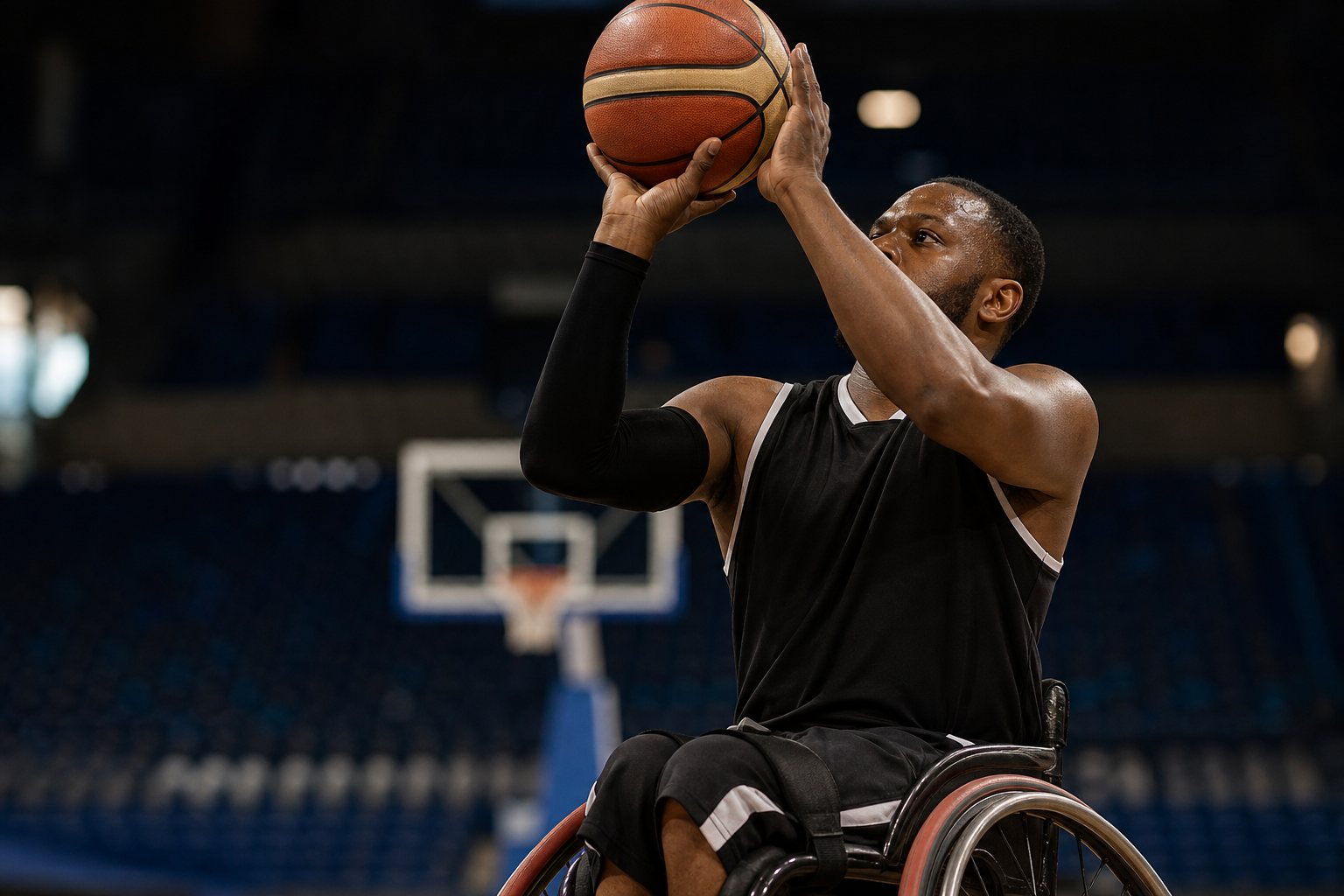
Late in the third quarter, a guard has pushed hard for a full minute and takes a pass at the elbow. Her shoulder has been nagging since last week, and she tells nobody. Wheelchair basketball injury prevention means the habits around a player, a warm-up that fits, a chair that fits, a sensible training load, strength work for the shoulders and trunk, skin and heat awareness, and speaking up about pain, that aim to lower the chance of getting hurt. They lower the odds. They cannot promise anything.
Quick answer: Published studies point to the upper limb, especially the shoulder, neck and upper back, as the main areas of injury in wheelchair basketball, and most of the reported injuries were overuse. The evidence for any specific prevention program is thin, so the best-supported habits are general ones: warm up, balance training load with rest, strengthen the shoulders and trunk, keep the chair fitted and checked, and report pain early. See a sports medicine doctor, physical therapist or athletic trainer if pain stays, spreads, or comes with numbness or weakness, and call emergency services after a head injury with danger signs.
This page is about lowering risk. What the injuries are and how they are handled is on our injuries and rehabilitation page, so we do not repeat that here. For the sport overall, start at the wheelchair basketball hub.
Where the risk is, according to studies
At the London 2012 and Rio 2016 Paralympics, a sub-study of 430 wheelchair basketball athletes (Brombacher and colleagues, 2025) recorded 75 injuries in 66 athletes, 12.5 per 1,000 athlete days; 55 percent affected the upper limb. At the 2018 world championships (Hollander and colleagues, 2020), the neck (16 percent), upper back (15 percent) and shoulder (14 percent) were most often affected, 52 percent of injuries were attributed to overuse, and only eight of 100 caused time loss. A 2022 systematic review of eight articles (IJERPH) found the shoulder the most-affected single region (22.1 percent) and the upper limbs 47.2 percent overall. Targets for prevention, then, are repeated loading of the arms and shoulders, the neck and upper back, plus contact and falls.
Warm-up
We did not find a published injury-prevention warm-up tested in wheelchair basketball players, so there is no named routine to point to. Coaches commonly use a general approach (general coaching practice): five to ten minutes of easy pushing, then dynamic shoulder, upper-back and trunk mobility, then short sprints and ball work that build toward game speed. A warm-up does not need to be long; it needs to be done every time, including before a short practice.
Technique and chair skills
Pushing technique matters because the same stroke is repeated thousands of times. A 2019 pilot study in youth with spinal cord injury (Schottler and colleagues) reported that propulsion training on rollers improved efficiency measures; the authors’ reasoning was that long-term manual wheelchair users are at increased risk of upper-limb joint pain from repetitive propulsion. It was a small study in a different group of chair users, so treat it as supporting evidence only. Coaches can also teach braking, turning and how to fall and recover, which reduces awkward loads on the arms. Ask a coach or physical therapist who knows chair sports to watch your stroke.
Training load and rest
Brombacher and colleagues suggest that daily wheelchair use outside sport adds load and limits rest for the arms, particularly in athletes with spinal cord-related disorders. A player’s real load is therefore training plus daily life. No source we read gives a rule of thumb for weekly increases in chair sports, so this is general practice: raise volume gradually, plan easy days and a full rest day each week, and ease off if soreness is not clearing between sessions. See training and recovery.
Strength, mobility and balance
A 2023 narrative review (Biomechanics) of shoulder conditions in wheelchair basketball said rotator cuff tendinopathy is the most recurrent, and that the general recommendation remains a combination of strengthening, endurance and stretching, calling for better trials. A 2024 South African thesis proposed a shoulder pain prevention program based on a scoping review and an expert panel, and its authors describe it as a starting point to be tested, not a validated program. Practically, programs often balance pushing muscles with pulling muscles, train the shoulder blade stabilizers and rotator cuff, and work the trunk within the player’s function (general coaching practice). The 2026 upper-limb asymmetry study (Kokaly and colleagues) is a reason to check both arms, not only the dominant one. Individual programs should come from a clinician.
Chair, environment and skin
- Chair fit and checks. We did not find a source that gives the correct chair setup. Check bolts, wheels, tires, camber settings, anti-tip casters and straps before each session, and have a seating specialist review the fit (general practice).
- Heat. A 2020 review in Frontiers in Sports and Active Living (Zhang and Bishop) says sweating is reduced and heat perception blunted in tetraplegia, and that epidemiological data do not show higher heat-illness rates, but cautions that mild symptoms may go unreported. A 2022 BJSM paper on Paralympic athletes’ prehospital heat stroke care says principles match the Olympic approach, with adaptations for autonomic dysfunction. Players with spinal cord injury at or above mid-chest level should ask their clinician about cooling and warning signs before hot gyms or outdoor events.
- Skin. A 2026 scoping review (Parker and colleagues) found only 10 sources on pressure injury prevention in disability sport, and said evidence is underdeveloped. Skin checks after play and cushion care are general practice; a clinician can advise individuals.
- Autonomic dysreflexia. The IPC bans deliberately inducing it (“boosting”) and its rules use a blood pressure threshold of 160 mmHg to keep athletes from competing, as Paralympic.org reports. Players who can experience dysreflexia should know their own warning signs and plan with their doctor.
Head injuries, falls and protective equipment
A 2026 study of intercollegiate wheelchair basketball (Kowalske and colleagues) counted 12 concussions over four seasons and 99 athlete-seasons, a rate of 7.60 per 10,000 athlete exposures, and an injury rate ratio of 1.79 compared with NCAA basketball players without disabilities (95 percent interval 1.01 to 3.18). The authors call for targeted prevention and response protocols. The CDC’s HEADS UP program says an athlete with a suspected concussion should stop and be seen by a healthcare provider before returning. We did not find a standard or tested helmet for the sport, so we make no equipment recommendation. Gloves, tape and clothing are personal choices, covered on our gear page.
What prevention cannot do
Nothing here guarantees an injury will not happen. Most prevention research in wheelchair basketball is observational, and the Hollander team says it still needs studies on why muscle spasms and overuse injuries occur. Prevention can improve the odds; early reporting and good care do the rest.
When to see a professional
- Shoulder, neck or upper-back pain that lasts, wakes you at night or returns every session.
- Numbness, tingling or weakness in the arm or hand.
- A skin change that does not fade after pressure is relieved, or an open area.
- Any head injury with confusion, vomiting, seizure or loss of consciousness: call emergency services.
- Symptoms of dysreflexia, such as a sudden pounding headache or flushing above the injury level, which can be an emergency for those at risk.
Wheelchair basketball injury prevention FAQs
Which injuries do wheelchair basketball players get most?
Studies point to the upper limb: 55 percent of injuries at two Paralympics, and the neck, upper back and shoulder at the 2018 world championships. Most reported injuries involved no time loss.
Is there a proven shoulder prevention program?
Not that we found. A 2023 review recommends combined strengthening, endurance and stretching but calls for trials, and a 2024 proposed program has not been validated.
Do players need to warm up differently?
No source we read describes a tested warm-up for the sport. A progressive warm-up before every session is general coaching practice.
Should I wear a helmet?
We did not find an official standard or recommendation for helmets in the sport. Ask your league and clinician.
Is heat a bigger risk for players with spinal cord injury?
Sweating and heat sensing can be impaired, but a 2020 review found epidemiological data do not show higher rates and warns mild cases may be missed. Ask your doctor for a plan.
What should I do after a fall in the chair?
Check for head injury and pain first. Stop playing if you hit your head, and follow CDC HEADS UP guidance to see a provider.
Sources
- Brombacher et al. 2025, injuries at London 2012 and Rio 2016 (PMC)
- Hollander et al. 2020, injuries at the 2018 world championships (PubMed)
- Injuries in wheelchair basketball players: a systematic review, IJERPH 2022
- Narrative review of shoulder conditions in wheelchair basketball, Biomechanics 2023
- Development of a shoulder pain prevention programme for wheelchair basketball players in South Africa (Wits)
- Schottler et al. 2019, propulsion training in youth with SCI (PMC6496966)
- Kokaly et al. 2026, upper-limb asymmetry (PMC)
- Zhang and Bishop 2020, heat illness in athletes with SCI
- Prehospital management of exertional heat stroke for Paralympic athletes, BJSM 2022
- Parker et al. 2026, pressure injury in disability sport (scoping review)
- Kowalske et al. 2026, concussion in intercollegiate wheelchair basketball, PM&R
- Paralympic.org: IPC tightens rules to clamp down on boosting
- CDC HEADS UP: signs and symptoms
General information for education only, not medical advice. It does not replace a sports medicine doctor, physical therapist, athletic trainer or seating specialist who knows chair sports. Read how we work in our editorial policy.