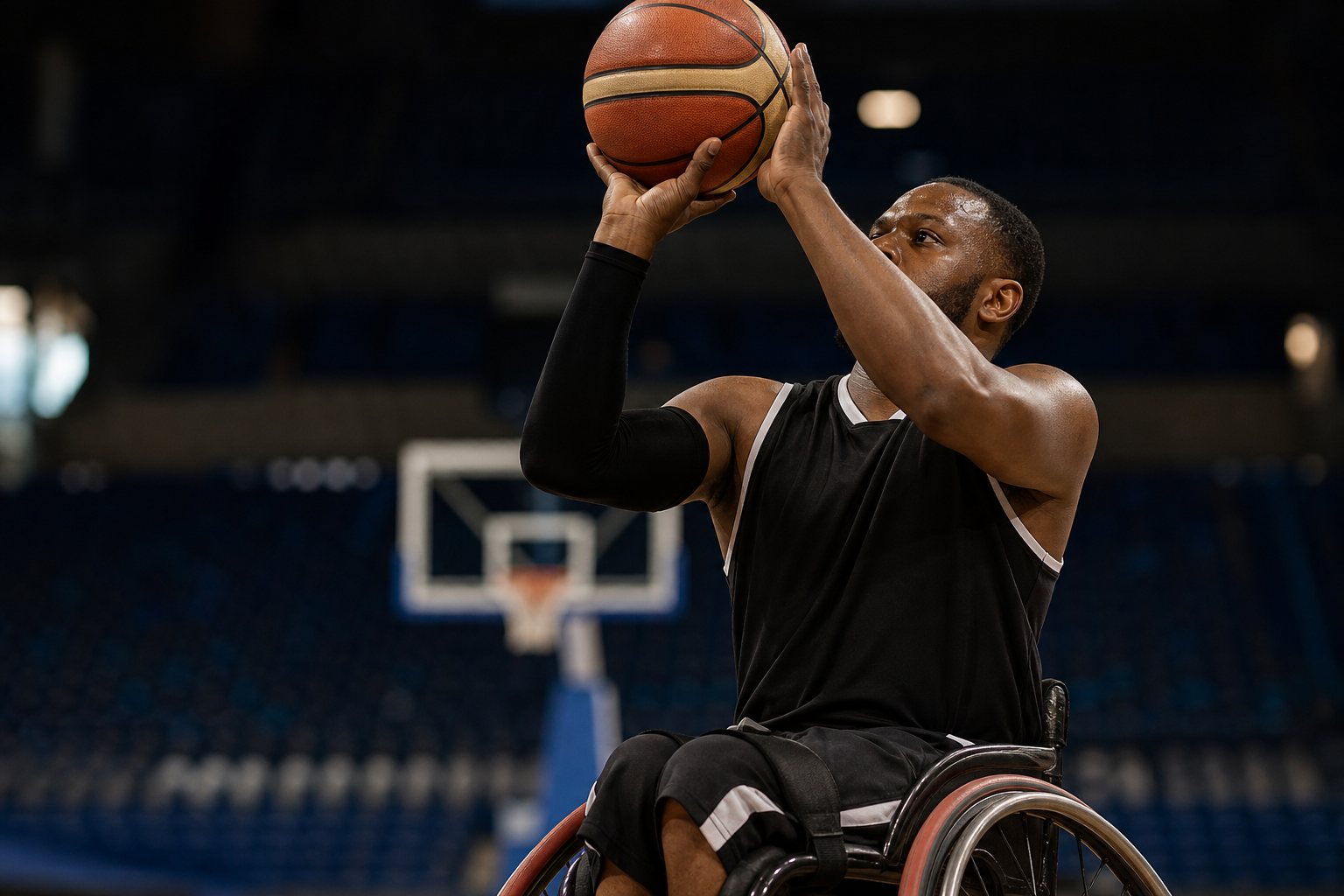
The injury report after a long tournament weekend rarely shows broken bones. More often it is a list of sore necks, tight upper backs and a shoulder that complains at the top of every push stroke. Wheelchair basketball injuries are mostly upper-body overuse problems plus some contact injuries, and studies describe them as often low in time lost. This page is about what research shows, general rehabilitation principles and when to get help; it is not a diagnosis.
Quick answer: Surveillance studies find the upper limb, shoulder, neck and upper back most affected, with overuse the most common cause and many injuries causing no time loss. Concussion also occurs. General rehab principles are an early assessment, a gradual return and a plan for the cause, but a clinician decides the plan and any return to play. See a sports medicine doctor, physical therapist or athletic trainer if pain persists or you have numbness or weakness.
Looking to lower risk? See injury prevention. For rest and soreness, see recovery.
What the surveillance numbers say
| Paralympic Games 2012 and 2016 | Brombacher et al. 2025: 430 athletes, 75 injuries in 66 athletes, 12.5 per 1,000 athlete days; upper limb 55 percent; athletes with spinal cord-related disorders 55 percent of injuries; 88 percent of Rio 2016 injuries involved no time loss. |
|---|---|
| World Championships 2018 | Hollander et al. 2020: 11 teams, 132 players, 100 injuries (75.8 per 100 players); neck 16 percent, upper back 15 percent, shoulder 14 percent; muscle spasm 25 percent; overuse 52 percent; eight time-loss injuries; more injuries in matches than training. |
| Systematic review, 2022 | IJERPH, eight articles: shoulder most affected (22.1 percent), upper limbs 47.2 percent, head and face 19.5 percent, trunk 17.8 percent, lower limbs 15.5 percent. |
| Collegiate concussion, 2021-2024 | Kowalske et al. 2026: 12 concussions in 99 athlete-seasons; 7.60 per 10,000 athlete exposures; rate ratio 1.79 versus NCAA basketball (95 percent interval 1.01 to 3.18). |
Rates differ by study because injuries are defined differently, so numbers should not be compared one-to-one. The 2018 championship study counted any new injury including those needing no time off, which is why its counts are higher than at the Paralympics.
Common patterns in plain words
- Shoulder pain. The 2023 narrative review in Biomechanics says rotator cuff tendinopathy is the most recurrent condition in wheelchair basketball. A South African review cited in a 2024 thesis reports shoulder pain prevalence of 44 to 72 percent in that country’s players, from only five studies.
- Neck, upper back and muscle spasm. These were the most common areas and diagnosis at the 2018 world championships. The authors say the causes of spasm need more study.
- Hand and finger injuries, blisters and skin problems from push rims and contact are common in chair sports, but the studies above did not break these out, so we give no numbers.
- Contact and falls. Chairs collide and can tip. The head and face made up 19.5 percent of injuries in the 2022 review.
- Skin pressure problems. A 2026 scoping review (Parker and colleagues) found only 10 sources on pressure injury in disability sport and called the evidence underdeveloped.
Concussion
The CDC’s HEADS UP program lists headache, dizziness, confusion, nausea and balance problems among concussion signs. Its principle is recognize and remove: an athlete with a suspected concussion stops playing and is seen by a healthcare provider, and only a provider decides when return is safe. Call 911 for danger signs such as repeated vomiting, a seizure or a worsening headache. A 2026 balance-task study (Moran and colleagues) looked at a wheelie assessment as a balance measure in collegiate para sport athletes, which shows that testing tools for chair users are still being developed; ask a clinician familiar with adaptive sport about baseline testing.
General rehabilitation principles
We did not find a wheelchair-basketball-specific rehabilitation guideline in the sources used, so what follows is general sports-medicine practice, not a plan or a promise of recovery time.
- Get it assessed. A clinician can tell a tight muscle from a tendon, nerve or joint problem and check the neck, shoulder and trunk together.
- Find the cause. The Hollander study points to overuse, so a plan often looks at training load, stroke, chair setup and how much the arms are used outside sport.
- Rehab usually means gradual loading. Strengthening, endurance and stretching were the combination named by the 2023 review, with a call for better trials.
- Keep what you can. A clinician may suggest ways to keep the rest of the body training while an area settles.
- Return in steps, guided by a clinician, and never by the calendar alone. We give no universal recovery times because they vary by injury and person.
Because many chair athletes use their arms all day, a sore shoulder can affect transfers, driving a vehicle and daily life, not just sport. Tell the clinician about all of it.
When to see a professional
- Pain that lasts more than a few days, grows, wakes you at night or changes how you push or shoot.
- Numbness, pins and needles or weakness in the arm or hand.
- A fall or hit to the head, or any concussion sign.
- A skin area that stays red after pressure is off it, or any wound.
- A sudden headache with flushing or sweating above the injury level in someone prone to dysreflexia: treat it as urgent.
Wheelchair basketball injuries FAQs
What is the most common wheelchair basketball injury?
Studies point to the shoulder and upper limb. At the 2018 world championships, the most common diagnosis was muscle spasm and the most common cause overuse.
Do most injuries mean time off?
Not in the surveillance data: 88 percent of Rio 2016 injuries and all but eight of 100 at the 2018 championships involved no time loss.
Is concussion common in wheelchair basketball?
A 2026 collegiate study found a higher overall rate than in NCAA basketball, but it came from one program with a small number of cases.
How long will an injury take to heal?
No universal time exists. A clinician can give an estimate for a specific diagnosis.
Can I play through shoulder pain?
Lingering pain is a reason to see a professional. Playing on can make some problems worse.
Who should I see?
A sports medicine doctor, physical therapist or athletic trainer, ideally one familiar with chair sports.
Sources
- Brombacher et al. 2025, London 2012 and Rio 2016 (PMC)
- Hollander et al. 2020, Wheelchair Basketball World Championships 2018 (PubMed)
- Injuries in wheelchair basketball players: a systematic review, IJERPH 2022
- Kowalske et al. 2026, concussion in intercollegiate wheelchair basketball
- Biomechanics 2023 narrative review of shoulder conditions in wheelchair basketball
- Wits 2024 shoulder prevention programme thesis (scoping review prevalence figures)
- Parker et al. 2026, pressure injury in disability sport
- Moran et al. 2026, wheelchair balance task in para sport athletes (PMC13465114)
- CDC HEADS UP: signs and symptoms
General information for education only, not medical advice. It does not replace a sports medicine doctor, physical therapist, athletic trainer or seating specialist who knows chair sports. Read how we work in our editorial policy.