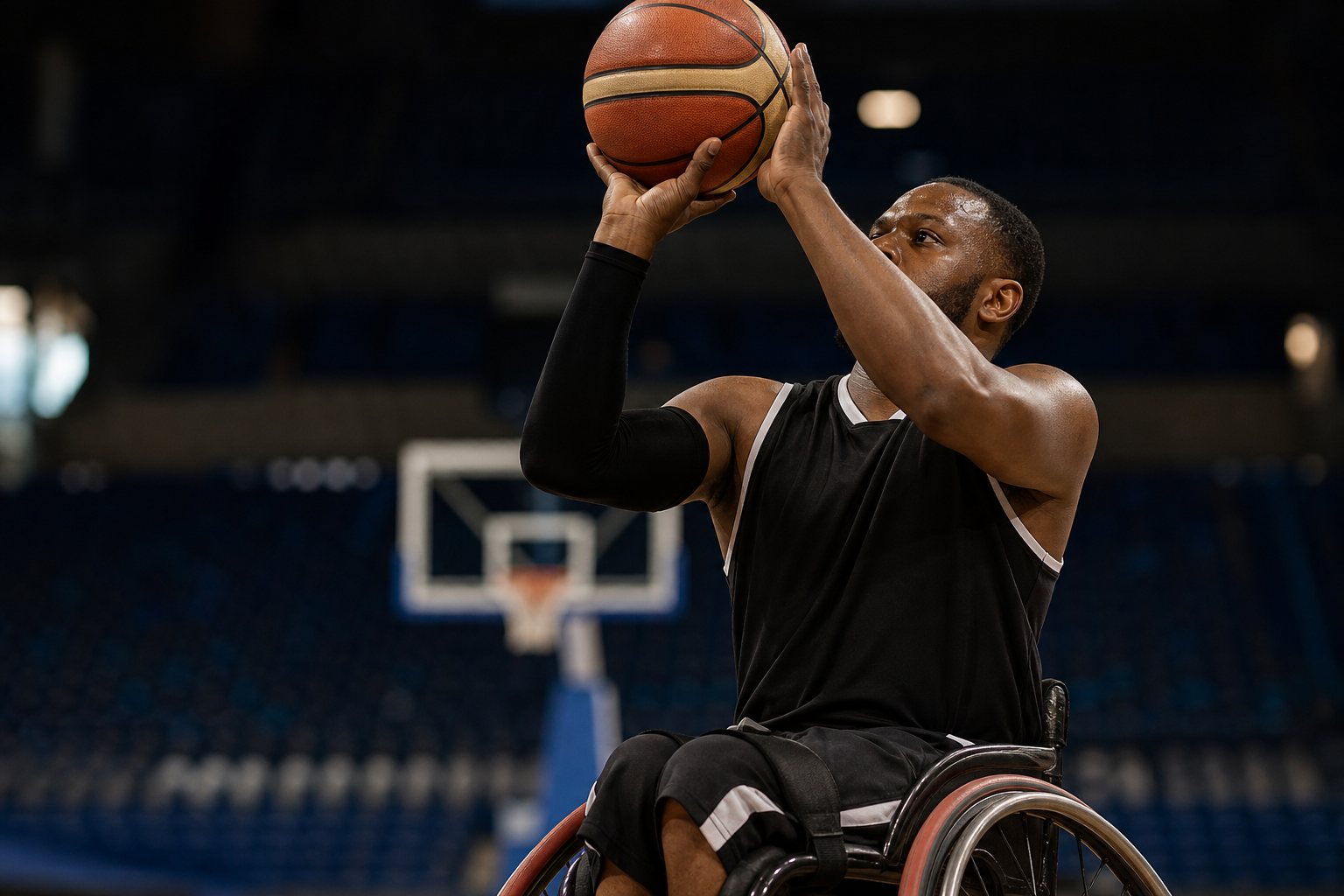
Courtside at a tournament, the snack table tells a story: bananas, bars, a cooler of sports drinks, and a few players who skipped breakfast to get to the first game on time. Wheelchair basketball nutrition is the food, fluid and health habits that support training and games; for chair athletes the right amounts depend on body size, impairment and activity, which is why generic advice does not always fit.
Quick answer: Research on the nutrition needs of Paralympic athletes is limited, and reviews say advice often borrows from able-bodied athletes. Eat regular meals with enough energy for training, drink steadily, and ask a registered dietitian, ideally one who works with para athletes, about personal needs. Supplements are optional, can be risky, and should be third-party tested for sport; see a doctor or dietitian before taking any.
General information, not medical advice. For training, see training; for sleep and rest, recovery.
Energy and fuel: why the numbers are individual
A 2025 review of Paralympic athletes’ nutrition (Ghazzawi and colleagues, 56 studies) said energy, nutrient and fluid needs vary with disability and sport, and that there is a lack of research focused on the nutritional requirements of Paralympic athletes. It stressed close monitoring of each athlete’s intake. For a chair player, energy use can be lower than for a standing athlete of similar size, but it also depends on training volume and on how much the person pushes all day. A dietitian can estimate needs better than a formula from a poster.
A 2026 survey of 66 elite Spanish wheelchair basketball players (Norte and colleagues) found low adherence to national dietary guidelines: fruit intake was below recommendations in all women and in 91.2 percent of men, and 80.3 percent followed no specific diet. This tells us habits can slip even at an elite level, not that any single food is the answer.
- Before play: a meal that is familiar and has carbohydrate, eaten with enough time to settle, is general practice.
- During long tournament days: small, easy snacks and fluids between games.
- After play: a meal with carbohydrate and protein. Eating enough overall matters more than precise timing.
Hydration and heat
In the same Spanish study, hydration practices were described as suboptimal: 66.7 percent of women drank 0.5 L of water or less during training, compared with 15.8 percent of men, and players with the greatest functional limitation drank less during matches. The Ghazzawi review notes hydration is critical, particularly for athletes with spinal cord injuries who may struggle to regulate temperature. Zhang and Bishop (2020) report that sweating is much reduced in tetraplegia and that loss of sensation can blunt the sense of overheating. Their review also says the epidemiological data they reviewed do not show higher heat illness among athletes with spinal cord injury, but that mild cases may go unreported. The 2022 BJSM paper on prehospital heat stroke care for Paralympic athletes says the Olympic principles of early recognition and rapid on-site cooling apply, with adaptations for autonomic dysfunction. For a player with spinal cord injury, ask your doctor about a personal plan for hot gyms and outdoor events. Signs such as confusion, collapse or very high body temperature need an emergency call.
Bone health and relative energy deficiency (RED-S)
Relative energy deficiency in sport (RED-S) arises when an athlete does not take in enough energy for health and training. A 2022 narrative review (Jonvik and colleagues) said the incidence of low energy availability in Paralympic athletes is relatively unknown, that there are concerns para athletes may be at higher risk, and that the usual assessment tools are hard to apply because data on energy use across impairments are lacking and some RED-S signs may reflect the impairment rather than low energy intake. In a 2024 cross-sectional DXA study of 70 Paralympic athletes (Weijer and colleagues), 34 percent had low bone mineral density at the femoral neck, and wheelchair-dependent athletes had lower hip and whole-body scores than those who were not, though low lumbar spine density was absent in the wheelchair basketball and tennis players in that sample. The sample was small. None of this means a particular player has a problem; it means skipped meals, rapid weight loss and unexplained fatigue, or repeated bone injuries, are reasons to talk to a doctor or dietitian.
Weight, body composition and weight-class cautions
Wheelchair basketball has no weight classes, but weight changes still matter for chair fit, transfers and skin. Rapid weight loss, restrictive diets and body-fat targets are best handled with a dietitian who knows para athletes, since standard body-composition formulas were not built for every impairment (Jonvik review).
Supplements: what to know
In a 2026 survey of 66 elite Spanish wheelchair basketball players (Romero-Garcia and colleagues), 72.7 percent reported using sports supplements, mostly protein, creatine monohydrate and caffeine, which the authors classed as Australian Institute of Sport (AIS) Group A, products with established evidence. The authors also said that real evidence-based practice needs individual, professionally guided advice. That is a description of what players do, not advice to copy.
- Food first. Meals, fluids and sleep come before pills and powders.
- Third-party testing. Supplements can contain banned substances not listed on the label. Look for third-party certification for sport, such as NSF Certified for Sport or Informed Sport, and check the product’s listing on the certifier’s site, rather than relying on the maker’s say-so.
- Banned-substance awareness. Athletes in drug-tested events are responsible for what they take; check the rules of your league or the anti-doping agency, and ask a doctor about any medication.
- Caffeine. It affects sleep, heart rate and, for some players, bladder and blood pressure; it is not suitable for everyone.
- Ask first. Check with a doctor or registered dietitian before any supplement, especially with a medical condition, medication or a spinal cord injury.
- Boosting is not nutrition. The IPC bans deliberately inducing autonomic dysreflexia, which it considers dangerous, and sets a 160 mmHg blood pressure limit for athletes to compete, as Paralympic.org reports.
Wheelchair basketball nutrition FAQs
Do wheelchair athletes need fewer calories?
Not always. Needs depend on body size, impairment and training volume, and research on Paralympic athletes is limited. A dietitian can estimate yours.
How much should I drink during games?
No source we read gives a number. Studies suggest many players drink little during training, so start with steady sips and ask a dietitian or doctor, especially with a spinal cord injury.
Is heat more dangerous for players with spinal cord injury?
Sweating and heat sensation can be reduced, though a 2020 review says surveillance data do not show higher rates. Mild cases may go unreported, so ask your doctor for a plan.
Which supplements are worth taking?
In a 2026 study most players using supplements took protein, creatine or caffeine. Food comes first, and any supplement should be third-party tested and approved by a doctor or dietitian.
What is RED-S?
Relative energy deficiency in sport is a state where intake does not cover training and health needs. In para athletes it is hard to assess, and a doctor or dietitian should guide it.
Are supplements tested for banned substances?
Not unless certified. Look for NSF Certified for Sport or Informed Sport and check the certifier’s listing.
Sources
- Ghazzawi et al. 2025, tailored nutrition strategies for Paralympic athletes (Europe PMC)
- Jonvik et al. 2022, assessing energy availability and RED-S risk in Para athletes (Europe PMC)
- Norte et al. 2026, eating for performance in elite wheelchair basketball players
- Romero-Garcia et al. 2026, supplement use in elite wheelchair basketball players (Front Nutr, doi 10.3389/fnut.2026.1974031)
- Weijer et al. 2024, low bone mineral density in Paralympic athletes (Bone Reports)
- Zhang and Bishop 2020, heat illness in athletes with SCI
- Prehospital management of exertional heat stroke for Paralympic athletes, BJSM 2022
- Paralympic.org: IPC tightens rules to clamp down on boosting
- NSF Certified for Sport
- Informed Sport
General information for education only, not medical advice. It does not replace a sports medicine doctor, physical therapist, athletic trainer or seating specialist who knows chair sports. Read how we work in our editorial policy.