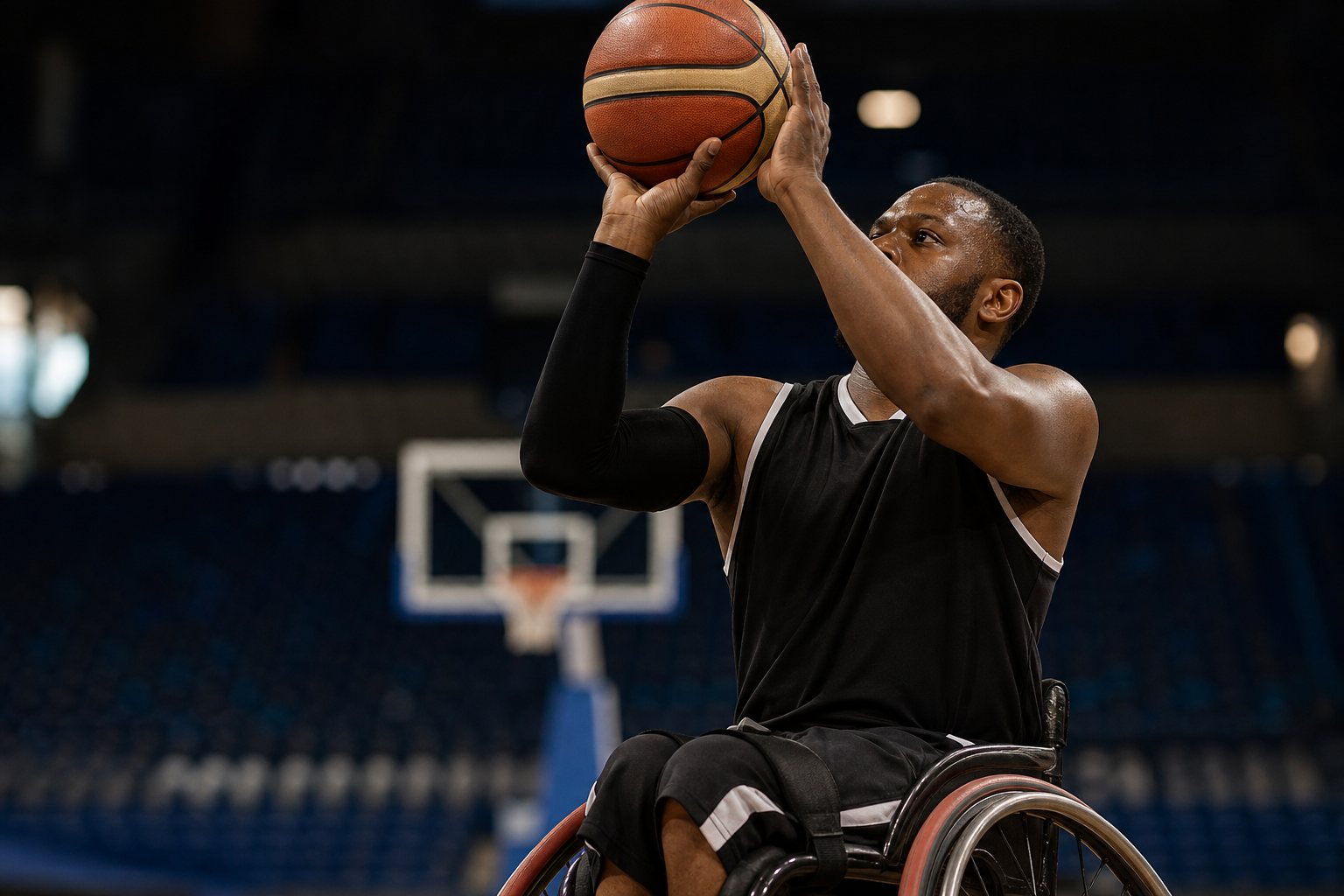
Down two with 40 seconds left, the ball comes to a player who has missed three free throws tonight. The chair is set, the crowd is loud, and the next five seconds are mostly about what goes on in her head. Wheelchair basketball mental training is the set of skills, focus, routines, imagery, goal setting and handling pressure, that help a player bring their training to the game. It is a performance skill, separate from mental health care, and neither guarantees a result.
Quick answer: Mental skills such as imagery, routines and goal setting can be practiced like any other skill. Research in wheelchair basketball is small and mostly correlational: one 2025 survey of 153 elite male players linked more mental training with less injury anxiety and better performance, and one imagery study with a Paralympic team found partial support for team confidence. Nothing here guarantees performance. Anxiety, low mood, disordered eating or burnout are health matters: talk to a qualified professional, and in the US call or text 988 in a crisis.
For the rules and positions, see skills and rules; for fitness, training; for sleep and rest, recovery.
What research says in this sport
The evidence is limited. A 2025 survey in the journal Healthcare (153 elite male wheelchair basketball players in Turkey) found that more mental training was associated with lower injury anxiety (about 7.6 percent of its variance) and that injury anxiety was linked with worse optimal performance; the design was correlational, so it shows an association, not cause and effect. A 2009 study (Shearer and colleagues) tested a video-aided imagery program with an international Paralympic wheelchair basketball team and reported partial support for raising individual and team perceptions of collective efficacy. In 2018, researchers published and validated a Wheelchair Imagery Ability Questionnaire for wheelchair sports, because suitable tools were scarce. In short: the tools are reasonable and worth trying, but the sport-specific proof is thin.
Confidence and focus
Confidence comes from preparation: a player who knows their chair setup is right, their routine is set and their skills are practiced under game-like conditions has reasons to feel ready. Focus is about the next action. In a chair sport, useful cues are simple and physical (general coaching practice): “set,” “push,” “look up,” “eyes on the rim.” Pick one or two cue words and use them in practice first.
Motivation and goal setting
A 2026 systematic review (106 studies) of people with physical disabilities found that accessibility, social support and cost were often studied, while motivation was rarely studied together with context, and that the evidence explains how current participants differ better than how participation is started, sustained or stopped. In practice, that fits what coaches see: support, transport and a place to play matter as much as willpower. Goal setting is general coaching practice rather than a tested method for this sport: set process goals (three clean passes before each shot, one full-speed sprint rep) as well as outcome goals, keep them within the player’s control, and review them at set times.
Imagery and visualization
Imagery means rehearsing a skill in the mind: seeing and feeling the push, the pass or the free throw. The Shearer study and the imagery questionnaire above are why we mention it: researchers have used imagery with this sport. A simple routine (general practice) is two to five minutes, eyes closed or open, in a quiet spot: picture the setting, feel the rim under your hands and the ball in the fingertips, and see the skill done well. Imagery supplements physical practice; it does not replace it.
Pre-game and free-throw routines
- Pre-game: a repeatable sequence from arrival to tip-off: chair check, warm-up, a short focus or breathing step, the team huddle.
- Free throws: a consistent set of steps each time, such as brakes on, two breaths, one cue word, then shoot.
- Between games: something that resets you: food, fluids, music, a short walk or roll away from the court.
- Practice them. A routine only helps if it is used in practice. These are general coaching practices, not tested in wheelchair basketball.
Pressure, setbacks and decisions
Pressure shows up as a faster heart rate, tight shoulders and racing thoughts. Slow breathing, a loosening of the grip and a single cue word are common coping tools (general practice). The 2025 Healthcare survey above suggests injury anxiety is part of the picture in this sport. After a turnover or missed shot, many coaches teach a short reset, such as a breath and “next play,” to avoid carrying the mistake into the next possession. Decision-making and tactics are practiced through small-sided games, video review and clear roles; the 14-point classification limit described on skills and rules adds a team-composition puzzle that coaches and players learn together.
Teamwork
Teams mix players of different classes, so roles must be clear: who sets the picks, who pushes the break, who scores in the key. The Shearer study looked at collective efficacy, a group’s belief in its ability to succeed together. Team habits that support that belief are general practice: honest feedback, a shared plan and everyone’s job explained.
Mental health is not the same as mental performance
Routines, cue words and imagery are performance tools. Persistent anxiety, low mood, loss of joy in playing, restricting food, panic before games, thoughts of self-harm or exhaustion that does not lift are health matters and need a qualified professional, such as a doctor or licensed mental health clinician. The International Olympic Committee consensus statement on mental health in elite athletes (2019, updated 2026) says mental health symptoms and disorders are common in elite athletes, may impair performance, and that with appropriate support and treatment many athletes can continue to train and compete safely; the 2026 update singles out elite Para athletes among groups needing attention. In the US, the 988 Suicide and Crisis Lifeline is available by call or text. A team doctor, school counselor or primary care doctor is a good first call.
Preparing for competition
Plan travel, chair checks, food and sleep in advance, as covered on recovery and nutrition. Knowing the rules for your level (rules page) and your role reduces uncertainty on the day. Mental skills are one part of readiness, not a guarantee.
Wheelchair basketball mental training FAQs
Does mental training improve wheelchair basketball performance?
Some sport-specific research links mental training with less injury anxiety and better performance, but it is correlational. No technique guarantees results.
Is imagery used in wheelchair basketball?
Yes, researchers tested a video-aided imagery program with an international Paralympic team and reported partial support for collective efficacy.
How do I handle free-throw pressure?
A consistent routine, slow breathing and one cue word are common tools. They are general practice, not guaranteed.
What if I feel anxious or down all the time?
That is a health matter, not a mental-skills problem. Talk to a doctor or licensed mental health professional. In the US, call or text 988 in a crisis.
Can goal setting help?
Many coaches use process and outcome goals. It is general practice rather than tested in this sport.
Are there sport psychologists for chair athletes?
Many sport psychologists work with para athletes; ask your team, school or national federation. The AASP lists resources.
Sources
- Mental training and flow in wheelchair basketball: the mediating role of injury anxiety, Healthcare 2025
- Shearer et al., video-aided imagery and collective efficacy in an international Paralympic wheelchair basketball team, J Imagery Res Sport Phys Act
- Development and validation of the Wheelchair Imagery Ability Questionnaire, Psychol Sport Exerc 2018
- Motivational and contextual factors in sport participation among people with physical disabilities: systematic review, Sports 2026
- IOC consensus statement: mental health in elite athletes (2019)
- IOC consensus statement: mental health in elite athletes (2026)
- 988 Suicide and Crisis Lifeline
- Association for Applied Sport Psychology resources
General information for education only, not medical advice. It does not replace a sports medicine doctor, physical therapist, athletic trainer or seating specialist who knows chair sports. Read how we work in our editorial policy.