
This article contains affiliate links: if you buy through them we may earn a commission, at no extra cost to you. Read our affiliate disclosure.
The kit bag for a new rugby player is small: boots, a mouthguard and a ball, and the rest is up to the club. Rugby union gear is the short list of equipment the laws allow, such as mouthguards, thin padding and studded boots, and the few items that matter for safety and for learning.
Quick answer: The one item USA Rugby says everyone should wear is a mouthguard, every time in contact rugby. Scrum caps and thin pads are optional, and a 2026 study found no protective effect for headgear. World Rugby limits padding to soft material no thicker than 1 cm; “approved” on a box is a maker’s claim until you see the label. Fit and condition matter more than brand.
What rugby union players actually wear
World Rugby Law 4 allows a mouthguard, headgear, shoulder pads, mitts, shin guards, washable supports and studded boots. It bans hard or sharp items, buckles, clips, zippers and rigid material, jewellery, gloves, and shorts or leggings with sewn-in padding. World Rugby Regulation 12 limits shoulder pads and headgear to soft, thin material: no part thicker than 1 cm uncompressed and no denser than 45 kg per cubic metre, and gear should meet the standard performance specification and carry the World Rugby approved clothing label. Maker claims are different from labels, so check for the actual mark and, for a league, ask which version the competition follows.
Our picks
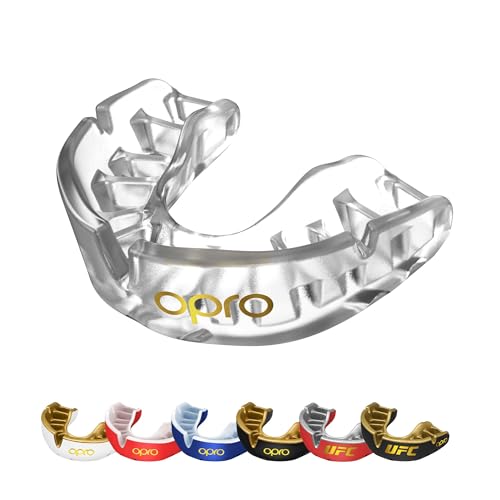
OPRO Gold Level Mouthguard
- Self-fit, no strap
- Kids' and adult sizes
- Not for fixed braces
$19.99 at Amazon, as of Nov 17, 2026 01:07 UTC
Check price on Amazon
Shock Doctor Gel Max Mouthguard
- Gel-lined fit
- Youth and adult sizes
- Detachable strap
$11.99 at Amazon, as of Nov 17, 2026 01:07 UTC
Check price on Amazon
Gilbert A-XV Training Rugby Ball
- Sizes 3, 4 and 5
- Water-resistant coating
- Hand stitched

Canterbury Raze Headguard
- EVA foam
- Breakaway chin strap
- Comfort and abrasion, not concussion protection
$54.99 at Amazon, as of Nov 17, 2026 01:07 UTC
Check price on AmazonMouthguards: the one item USA Rugby says everyone should wear
USA Rugby’s equipment guidelines say mouthguards “should be worn by every player, every time they play contact rugby,” suggest asking a dentist about a custom guard, and say no piece may extend outside the mouth. World Rugby recommends them at all levels. A 2026 review put dental injuries at about 19.6% and orofacial injuries at 40.4% of rugby injuries (very low certainty) and found mouthguards mainly worn in matches, less in training. A scoping review found custom-made guards were associated with fewer dental injuries than boil-and-bite guards. Boil-and-bite and self-fit guards are cheaper and widely used, and the maker of the OPRO model says it is not for fixed braces, so players with braces should ask an orthodontist. We found no source showing mouthguards reduce concussion.
Scrum caps and shoulder pads
Headgear is optional. A 2026 Super Rugby study found head injury incidence was higher in headgear wearers (rate ratio 1.78 after adjusting for tackle exposure) and that the lack of protection was consistent with earlier studies. Canterbury’s own page for the Raze says scrum caps are not meant to prevent concussions. A scrum cap is a choice for protecting ears and cuts, not the brain. Shoulder pads are limited by Regulation 12 to thin padding, and a 2026 shoulder review attributes most shoulder injuries to tackling, without evidence that pads prevent them. USA Rugby’s guidelines say padding on ribs, hips and back in undershirts is not allowed, chest padding is for women only, and headgear from other sports such as football, hockey or lacrosse is not permitted. Always check your league’s rules.
Balls: sizes by age
Law 2 says the ball is oval, with four panels, 410 to 460 grams and inflated to 9.5 to 10.0 psi, and that smaller balls may be used for young players. Listings for the Gilbert A-XV show size 3 for ages 7 to 10, size 4 for ages 11 to 13 and size 5 from 14 to senior, and a Rugby NorCal youth guide uses size 3 for under-8 and size 4 for under-10 and under-12. Confirm with your club. Balls usually ship deflated, so bring a pump with a gauge.
Boots and fit
Boot studs must meet World Rugby’s stud safety specification, and USA Rugby’s guidelines list no metal blades, single-material screw-in studs and moulded plastic studs, including a toe stud, as permitted. Football cleats are legal if the screw-in studs comply. Beyond that, choosing boots by position and ground, softer ground with longer screw-in studs and firm ground with moulded studs, is general buying advice, not an official rule. Fit them with the socks you will wear and leave thumb room at the toe.
Inspect before every session
- Mouthguard: no cracks, tears or sharp edges, and it still fits; replace it if it does not.
- Boots: studs not worn to sharp edges, no loose or broken studs.
- Pads and caps: foam intact, chin strap works, no rigid or hard parts.
- Ball: correct size, inflated to the recommended pressure, no cuts.
Frequently asked questions
Does a scrum cap prevent concussion?
No source supports it. A 2026 Super Rugby study found no protective effect, and the Canterbury page says scrum caps are not meant to prevent concussions. They can help with ear injuries and cuts.
What kind of mouthguard should I buy?
USA Rugby suggests asking a dentist about a custom guard. A review linked custom guards to fewer dental injuries. Boil-and-bite and self-fit models are common and cheaper, and players with braces should ask an orthodontist.
Can my child use a football helmet or shoulder pads in rugby?
No. USA Rugby says headgear from football, hockey and other sports is not permitted, and rugby shoulder pads must be thin and soft under Regulation 12.
What ball size should a youth player use?
It depends on age and club. Common guidance puts size 3 for about 7 to 10, size 4 for 11 to 13 and size 5 from 14. Ask your league.
Does “World Rugby approved” on a box mean it is safe?
It means the maker says the product meets World Rugby’s specification. Look for the label itself, and remember approval is about meeting limits on thickness and hardness, not a promise of protection.
Sources
- World Rugby, Laws of the Game 2026 (PDF)
- World Rugby, Regulation 12 (clothing and protective equipment)
- USA Rugby, Protective Equipment and Clothing Guidelines 2019/20
- World Rugby, smart mouthguard integration in the HIA (2023)
- Dental and orofacial injuries in rugby 2026, Clin Exp Dent Res, PubMed
- Custom versus boil-and-bite mouthguards, scoping review, PubMed
- Headgear and head injury in Super Rugby 2026, Eur J Sport Sci, PubMed
- Canterbury, Raze Headguard (maker page)
- Shoulder injuries in rugby meta-analysis 2026, PubMed
- Rugby NorCal, U10/U12 guidelines (ball sizes, tackle height example)
- Gilbert A-XV training ball (Amazon listing)
- OPRO Gold Level mouthguard (Amazon listing)
- Canterbury Raze headguard (Amazon listing)
- Shock Doctor Gel Max mouthguard (Amazon listing)
General information for education only, not medical advice. It does not replace a visit with a doctor, physical therapist or athletic trainer. See how we write and check our pages in our editorial policy.