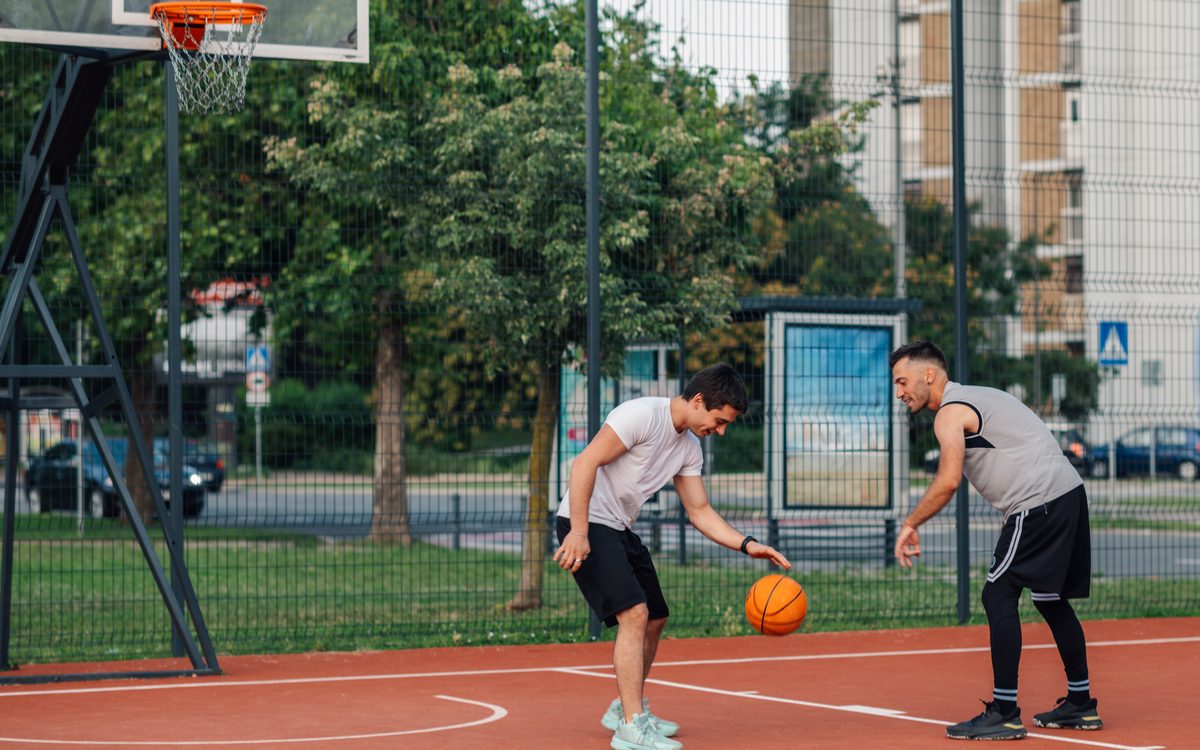
Two teams meet at one hoop with a ball that is not quite the ball they grew up with. One player from the team that just conceded steps under the basket, bounces the ball out to the top, and the other side starts a 12-second clock. 3×3 basketball (also “3×3” or three-on-three) is the FIBA-governed half-court game, and this page is the rules-and-first-steps guide: how play flows, how it is scored, the skills it asks for, and how a beginner can find a game. For the sport as a whole, start at the 3×3 basketball hub, and for the five-a-side game see basketball.
Quick answer: Three players a side (plus one substitute) play at one basket. Shots inside the arc score 1, shots behind it score 2, and the first team to 21 wins, or whoever leads after one 10-minute period; ties go to overtime, first to 2. Every dead ball restarts with a “check-ball” at the top of the court. To start, find a local event or a free profile at play.fiba3x3, and read the rules of the specific event, because casual games often use house rules.
The rule details below come from FIBA 3×3’s “Rules and Interpretations” summary document dated April 2020, which points to the full rulebook. FIBA updates its documents, so for a league or tournament, read the version that event uses.
The court, the ball and the teams
A regular 3×3 court is 15 m wide by 11 m long with one basket, a free throw line at 5.80 m, a 2-point line at 6.75 m and a “no-charge semi-circle” under the basket, and half of a traditional court may be used. Each team has no more than four players: three on the court and one substitute. FIBA says a 3×3 ball is used in all categories; the maker, Wilson, describes its official ball as a size 6 in size with the weight of a size 7. The same FIBA document says coaches may not instruct players from the court area, seats or remotely, so players run the game themselves.
How a game works
- Start. A coin flip decides first possession, and the winner may choose to take the ball at the start or at the start of any overtime. Both teams warm up at the same time.
- Scoring. A shot from inside the arc is 1 point, from behind the arc 2 points, and a free throw 1 point.
- Time. One period of 10 minutes, with the clock stopped on dead balls and free throws. The first team to 21 or more wins if that happens before time runs out. This “sudden death” applies to regular time only.
- Overtime. If tied at the end, there is a 1-minute interval and then the first team to score 2 points wins.
- Shot clock. A team must attempt a shot within 12 seconds of the ball being at the offensive player’s disposal. A player who has cleared the ball may not dribble inside the arc with the back or side to the basket for more than 3 consecutive seconds.
FIBA’s examples show a few quirks. A team on 20 that scores a 1-point basket with time left wins 21-20, and the highest possible final score in regular time is 22, because a fouled, successful 2-point shot at 20 all ends the game at 22. Where an event has no game clock, FIBA recommends tying the target score to the game length, for example 10 minutes and 10 points.
Restarts: the check-ball
After a made basket, a player from the non-scoring team dribbles or passes the ball from inside the court directly under the basket to a spot behind the arc. After a missed shot, an offensive rebounder may keep trying to score without going back behind the arc, but a defender who rebounds, steals or blocks the ball must return it behind the arc by pass or dribble. After any other dead ball, play restarts with a check-ball: the defender and offensive player exchange the ball at the top of the court, behind the arc, about a metre apart, with a normal pass. A defender may not play for the ball in the no-charge semi-circle after a made basket.
Fouls, substitutions and time-outs
Players are not excluded for the number of personal fouls; instead the team fouls add up. A team is in a penalty situation after its sixth foul. From the seventh team foul, fouls bring two free throws, and from the tenth also possession. Unsportsmanlike and disqualifying fouls count as two team fouls, a second unsportsmanlike foul disqualifies the player, and every technical foul is one free throw. Substitutions are made during dead balls, behind the end line, with no notice to officials. Each team gets one 30-second time-out, and FIBA competitions add two TV time-outs.
The basic skills
With three players on the floor, nobody specializes. A beginner will be asked to do all of these, and what follows is general coaching practice, not something from the FIBA document:
- Shooting off the catch and the dribble, from inside the arc as well as behind it. The 1-point and 2-point values make the shot choice part of the game.
- Ball security under pressure. Researchers who analyzed 3×3 World Cup knockout games found winning teams turned the ball over less and recovered more balls per possession (Conte and colleagues, 2019).
- Defending one-on-one and in help, because with one hoop each defender is guarding space and a person at once.
- Rebounding both ways, since an offensive rebound can be a second shot without clearing the ball.
- Screening and spacing, the small give-and-go and ball-screen moves that open a lane against only three defenders.
Levels and how to find a game
Common routes, in rising order of competition: park and community events, school or club tournaments, national events, FIBA’s international circuit and the Olympics. In March 2026 USA Basketball announced a 3×3 initiative for young players and programs, including 3X Play for coaches; check usab.com for what is current. For events, FIBA’s player site, play.fiba3x3, lets a player create a free profile and find endorsed events and teammates, according to FIBA’s help pages and national federation guides. Ask the organizer what rules and ball they use before you sign up.
Olympic status
3×3 made its Olympic debut at Tokyo 2020 and was played at Paris 2024. The IOC’s Los Angeles 2028 programme is reported to expand the field to 12 teams per gender; check the official programme for the current Games. For para-basketball, see wheelchair basketball.
A sensible first month for a beginner
This is general coaching practice, not a prescription. Learn the check-ball and the arc first, because most beginner confusion comes from restarts. Play a few half-court games of three-on-three with friends at a 10-minute, 10-point format. Watch one full game from a federation channel to see how clearing the ball works. Then enter one small, friendly event. For fitness, training and injury background, use our training page, injury prevention page and gear page.
3×3 basketball rules FAQs
How many points is each shot worth?
One point inside the arc, two points behind it, and one point for a free throw (FIBA 3×3 Rules and Interpretations, April 2020).
Can a 3×3 player foul out?
Not for personal fouls. Team fouls count instead, with two free throws from the seventh and possession too from the tenth. A second unsportsmanlike foul does disqualify a player.
What happens after a made basket?
A player from the other team dribbles or passes the ball from under the basket to a spot behind the arc, and play continues without a stoppage.
Do I need a referee or a clock to play?
Not for a casual game. FIBA recommends matching the score target to the game length where there is no clock, for example 10 minutes and 10 points, but check the event rules.
Where can I read the official rules?
On the FIBA 3×3 website; the summary PDF we used links to the full and short rulebooks and the interpretations.
Sources
- FIBA 3×3, Rules and Interpretations (April 2020 summary)
- FIBA, Simple, fast, entertaining: get to know the rules of FIBA 3×3
- Conte et al., FIBA 3×3 World Cup 2017 performance profile (PubMed)
- Wilson, FIBA 3×3 Official Game Basketball
- USA Basketball 3×3 initiative, March 2026 (WTOP)
- FIBA 3×3 help, what is a FIBA 3×3 profile
- IOC, LA28 event programme
- Olympics.com, Paris 2024 3×3 results
General information for education only, not medical advice. It does not replace a visit with a sports medicine doctor, physical therapist or athletic trainer. See how we write and check our pages in our editorial policy.