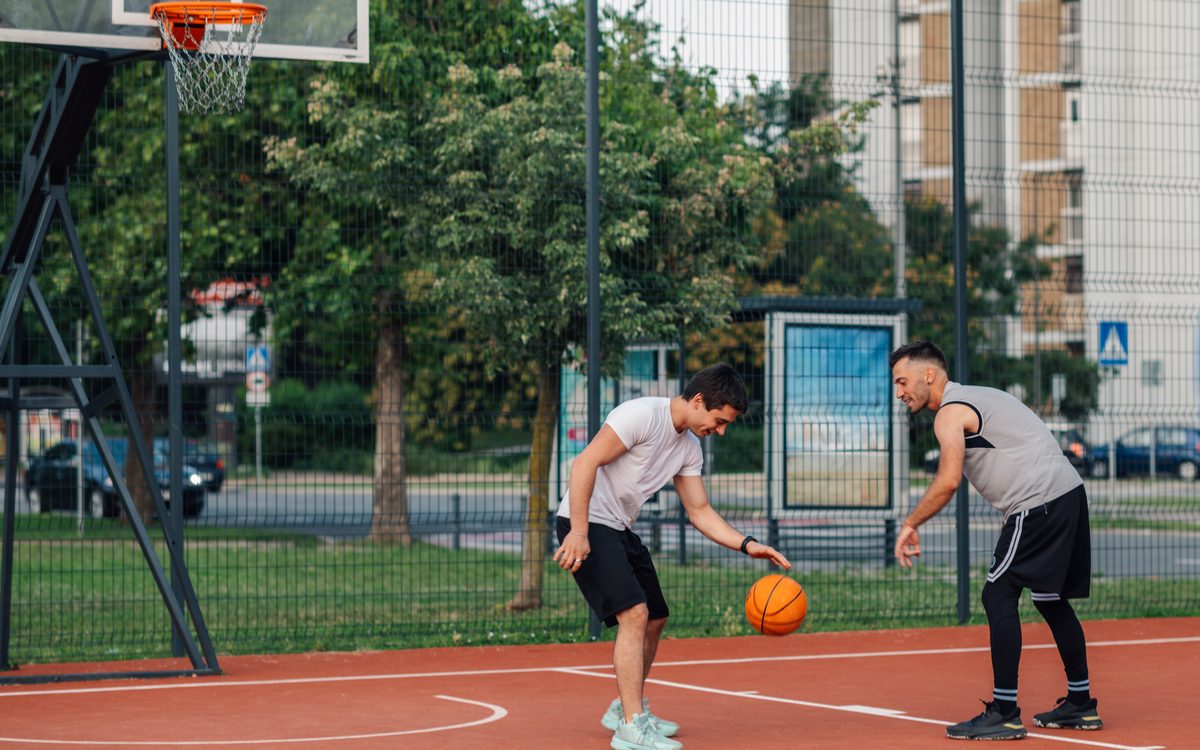
Midway through a Saturday tournament, a team plays its fourth game in the afternoon heat. The shots that fell in game one are short now, and the closeouts have slowed. 3×3 training is the work done to be able to play several short, intense games with little rest, while still making good decisions. This page covers what the sport demands, a weekly shape to adapt, and how to build strength, conditioning and skill, using only numbers that research reports. See the 3×3 basketball hub for rules and the basketball hub for the five-a-side game.
Quick answer: Research on 3×3 describes a repeated-sprint game with about as much dead time as live play, so training that mixes short bursts of game-speed work with brief rests fits it. Add strength and jump training, change-of-direction work and plenty of shooting and decision practice, and raise the load gradually. Most studies are small and on elite men, so treat any plan as a starting point and ask a coach or athletic trainer to adjust it to you.
What the game demands
Researchers who analyzed eight knockout games from the 2017 FIBA 3×3 World Cup (Conte and colleagues, 2019) found a ratio of live time to stoppage time of 0.92, and suggested training with short live phases and a work-to-rest ratio near 1. In a 2025 study of twelve elite male Lithuanian players (Paulauskas and colleagues), simulated games of 1, 2, 3 and 4 minutes, each followed by 1 minute of rest, showed that longer play brought more distance, sprints and jumps but lower average speed, a lower jump rate and fewer high-intensity efforts, while heart rate recovered better after the longer periods. A 2022 study of 15 Polish Olympic-team players (Mikolajec and colleagues) tested sprinting, change of direction and jumping and found moderate to strong links between change-of-direction ability and both sprint speed and aerobic velocity on an intermittent fitness test.
In plain words: it is a game of short bursts, quick direction changes and jumps, with fatigue showing as slower, flatter play. A 2022 study of 15 male 16-year-olds (Figueira and colleagues) found heart rate and muscle-oxygen responses between half-court 3×3 and full-court 5×5 scrimmages differed only slightly, while technical and tactical play differed a lot, so practice in the 3×3 format itself, not only fitness work.
All three studies were small. The first two involved men at or near the national-team level, so what they show may not apply to women, teenagers or recreational players.
A weekly shape (general coaching practice)
No source we found prescribes a 3×3 training week, so the following is a common way coaches arrange things, not research. Adjust it to your schedule, age and any advice from a clinician:
- Two or three skill-and-game sessions. Half-court 3-on-3 in short periods, shooting off movement, check-ball and clear-ball restarts, and decisions at the 12-second mark.
- One or two strength sessions. Lower-body strength, trunk work and single-leg work, kept to a level you can recover from.
- One conditioning or speed session. Repeated sprints and change-of-direction work, in blocks that echo the game: for example 20 to 40 seconds hard, then rest of a similar length, since the research suggests a work-to-rest ratio near 1.
- At least one full rest day, more for young players (see the NBA and USA Basketball Youth Guidelines).
Strength, jumping and speed
A 2022 meta-analysis of 32 studies with 818 basketball players (Ramirez-Campillo and colleagues) found jump training improved jump height, sprinting, change of direction, balance and maximal strength; the number of sessions or weeks did not clearly predict how much. Landing and strength work also feeds into injury prevention, on our injury prevention page. For young athletes, the American Academy of Pediatrics clinical report on resistance training says supervised, technique-focused programs are considered safe, with gains typically seen from 2 to 3 sessions a week over 8 or more weeks. Start new jumps and loads small and add gradually.
Conditioning that looks like the game
Because 3×3 play is intermittent, many coaches use game-based conditioning: small-sided 3-on-3 or 2-on-2 work, timed 1- to 4-minute blocks like those in the Lithuanian study, and finishing with shooting under fatigue. The Paulauskas study also found heart rate recovery improved most after longer blocks, which is a reason to build up from short to longer periods rather than starting at the longest. We found no published training-week template validated in 3×3 players.
Skill and decision training
A 2022 analysis of the 2019 World Cups (Boros and colleagues) compared 5-on-5 and 3×3 men’s shot selection and found that the rule differences, including the 1-point and 2-point values, changed which shots were taken and how efficient offenses were. A 2025 study of Poland and Serbia at Tokyo 2020 (Nowak and colleagues) examined 2-point shooting and highlighted shot location, defender interaction and how long an action takes. Practical read: practice shooting in game-like situations, include the 12-second clock, and rehearse when to take a 1-point shot and when to look for a 2.
Periodisation basics
Periodisation means arranging a year into phases. The IOC consensus statement on load in sport (Soligard and colleagues, 2016) describes training load as including training and competition, travel and psychological load, and notes that poor load management raises injury risk. General coaching practice for a tournament player is to build a base off-season, sharpen with game-speed work before the circuit, and ease strength work in the week of an event. For youth, the NBA and USA Basketball Youth Guidelines advise rest days and time away from the sport each year.
Tournament days
A tournament can mean several games in a day, with breaks that vary. Treat the day as a training load: warm up before game one, keep moving gently between games and eat and drink as on our nutrition page, and follow our recovery page afterward. If something hurts, see a sports medicine doctor, physical therapist or athletic trainer.
3×3 basketball training FAQs
How fit do you need to be for 3×3?
Research shows live play and stoppages in about equal measure at elite level, with repeated sprints and jumps, so a mix of sprint endurance and strength helps. There is no sourced fitness test cutoff for recreational players.
Is 3×3 harder on the body than five-a-side?
In one study of 15 male teens, heart rate and muscle oxygen responses were only slightly different between 3×3 and 5×5 scrimmages. That is one small study, not a general answer.
How many times a week should I train?
No source gives a 3×3 weekly number. Many coaches use two or three skill sessions, one or two strength sessions and at least one rest day, as outlined above; adjust to age and recovery.
Should I train with a 3×3 ball?
The official ball has a different size-and-weight combination from a five-a-side ball, so playing with it before a competition is general coaching practice. Check what your event uses.
Are plyometrics safe for teenagers?
The AAP says supervised, technique-focused strength training is considered safe for children and adolescents; ask a qualified coach and get a clinician’s advice if you have an injury.
Sources
- Conte et al., FIBA 3×3 World Cup 2017 (PubMed 31223192)
- Paulauskas et al., game intervals in 3×3 (PubMed 40453890)
- Mikolajec et al., elite 3×3 players, COD, sprint, jump (PubMed 36643835)
- Figueira et al., youth 3×3 vs 5×5 (PubMed 35719227)
- Boros et al., 5v5 vs 3×3 shot selection (PubMed 36429856)
- Nowak et al., 2-point shots in 3×3, Tokyo 2020 (PubMed 40299908)
- Ramirez-Campillo et al., plyometric training in basketball (PubMed 33359798)
- Soligard et al., IOC consensus on load in sport (PubMed 27535989)
- AAP clinical report, resistance training for children and adolescents (PDF copy)
- NBA and USA Basketball Youth Basketball Guidelines
- Stojanovic et al., physiological demands of basketball (PubMed 29039018)
General information for education only, not medical advice. It does not replace a visit with a sports medicine doctor, physical therapist or athletic trainer. See how we write and check our pages in our editorial policy.