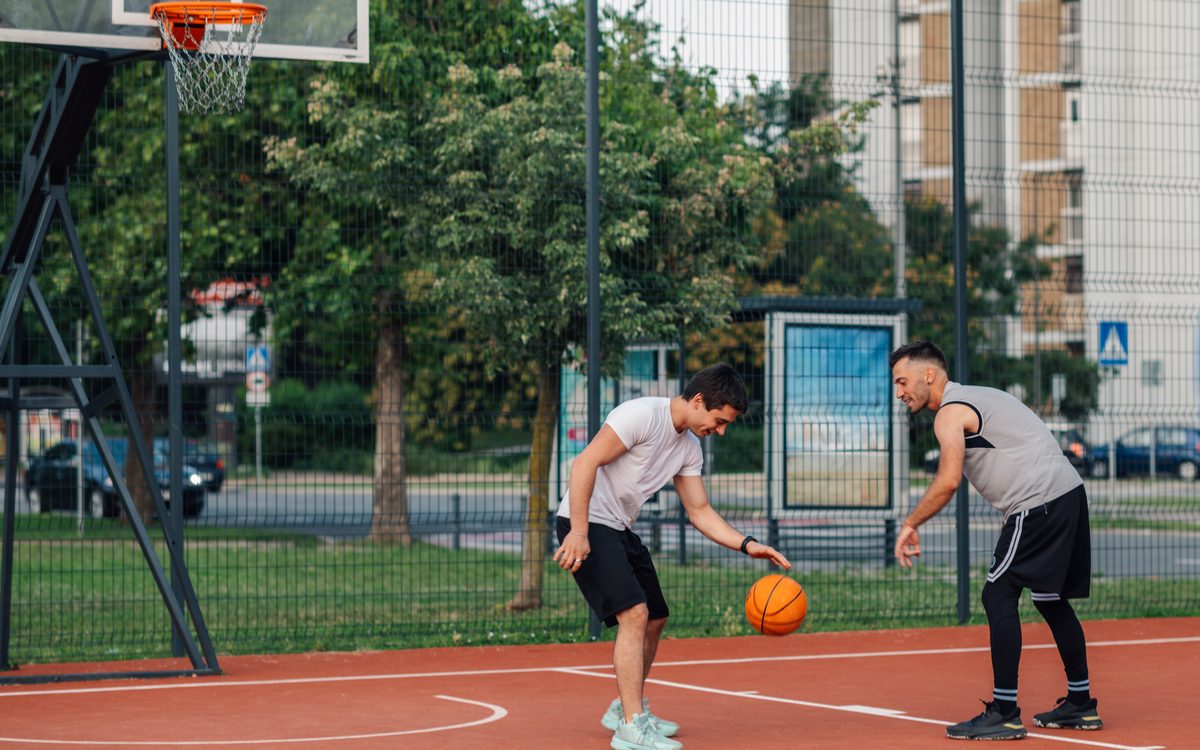
A Sunday morning park tournament: the court is still damp in one corner, the sun is already hot, and a player is landing awkwardly from her third rebound of the game with no warm-up behind her. 3×3 injury prevention is the set of habits around a player, a warm-up, sound landings, steady training load, strength and balance work, protective gear that fits, and sensible choices about heat and court conditions, that aim to lower the chance of getting hurt. They lower the odds. They cannot promise anything.
Quick answer: The best-supported steps for basketball players are a warm-up, balance and neuromuscular training, ankle bracing or taping for anyone with a past sprain, gradual increases in training, and heat acclimatization for outdoor play. We found no injury-prevention trial in 3×3 itself, so these come from basketball in general. See a sports medicine doctor, physical therapist or athletic trainer if pain stays in one place or changes how you move, and call emergency services for head-injury danger signs.
General information, not medical advice. This page is about lowering risk. What each injury is, and the numbers behind it, are on our 3×3 injuries page, so we do not repeat them here. For the sport, see the 3×3 basketball hub.
What the evidence covers, and what it does not
We found no published injury-prevention program tested in 3×3 players. The research below is from five-a-side basketball or from athletes more broadly, so it is a reasonable guide, not proof that the same effect holds on a half court with three players.
Warm up first
The American Academy of Orthopaedic Surgeons (AAOS) basketball injury-prevention page advises a short warm-up before play (3 to 5 minutes in the sources we used) and year-round fitness. Two published programs are worth knowing about. In a Calgary trial of 920 high school basketball players aged 12 to 18 (Emery and colleagues, 2007), a balance-board program was linked to fewer acute-onset injuries (relative risk 0.71), though the ankle-sprain result on its own was not statistically significant. In a study of an elite male club’s youth teams (Longo and colleagues, 2012), the FIFA 11+ program was linked to 0.95 injuries per 1,000 athlete-exposures against 2.16 without it. That was a small study from one club, so treat it as encouraging, not settled. A sample routine is general coaching practice: easy jogging and skipping, dynamic leg swings and lunges, jumps and landings, a few lay-ups and shots, then game-speed sprints. Do it before game one and again before later games if you have cooled down.
Landings and technique
A study of recreational basketball players (McKay and colleagues, 2001) found landing was involved in 45% of ankle injuries and that a previous ankle injury was the strongest risk marker (odds ratio 4.94). On the knee, the AAOS says ACL injuries often occur when landing or pivoting, and a 2005 NCAA study (Agel and colleagues) found women’s basketball had a higher ACL injury rate than men’s (0.29 against 0.08 per 1,000 athlete-exposures) while noting the actual rate remains low. The practical points are modest: land softly on both feet when you can, keep knees tracking over the toes, and avoid fatigue-driven sloppy landings late in a long day. A coach or physical therapist can check your landing mechanics.
Training load
The 2016 IOC consensus statement on load in sport (Soligard and colleagues) says poor load management is a major injury risk factor and counts training, competition and travel together. No source we read gives a safe weekly increase for basketball, so we do not give one. Rules of thumb found in other sports, like the “10% rule,” are not tested in 3×3. For young players, the NBA and USA Basketball Youth Guidelines advise rest days and time away from the sport each year, and they warn against specializing too early. Tournament days stack games, so be cautious about adding a hard training session the day before.
Strength and balance
The National Athletic Trainers’ Association (NATA) ankle sprain position statement recommends a multi-intervention balance and neuromuscular training program for at least three months and reports that bracing or taping pays off most for people with a history of sprain. A 1999 study (Hewett and colleagues) in female high school athletes in soccer, volleyball and basketball found untrained athletes had 3.6 times the knee-injury incidence of those who completed a jump-training program, and a 2013 meta-analysis (Myer and colleagues) found neuromuscular training reduced ACL injury most in mid-teen athletes. Ask a professional to tailor an exercise program to you. For strength training basics see our training page.
Heat, sun and the outdoor court
Most 3×3 events are outdoors. The NATA position statement on exertional heat illness recommends 7 to 14 days of gradual acclimatization and treats suspected exertional heat stroke as an emergency: cool first, transport second, and call 911. At Tokyo 2020, exertional heat illness affected 78 athletes (0.7% of all athletes followed), and most had no time lost from sport (Soligard and colleagues, 2022). The CDC advises broad-spectrum sunscreen of at least SPF 15, reapplied at least every 2 hours and after sweating. We found no source ranking court surfaces by injury rate, so use common sense: check for wet patches, grit, cracks and loose boards before you play.
Protective equipment and fit
Shoes and braces are covered on our gear page. The evidence points are brief: a 2011 trial of 1,460 high school players (McGuine and colleagues) found lace-up ankle braces lowered the rate of ankle injuries (0.47 against 1.41 per 1,000 exposures) without reducing their severity, and the NATA statement says braces and tape both work for people with a prior sprain. A 1993 study (Barrett and colleagues) of college intramural players found no significant difference between high-top and low-top shoes. The American Dental Association lists basketball among the limited-contact sports where a mouthguard is advised, and the 2024-25 NFHS rule change recommends but does not require one in school games; whether your event requires one is for the organizer to say. Brace claims from makers are not independent standards.
Youth players
The 2018 NBA and USA Basketball standards and the 2016 Youth Guidelines give age-based rest and participation guidance for five-a-side. We found no equivalent written for 3×3 events, though USA Basketball’s 2026 3X Play material is aimed at coaches. If a young player is entering tournaments, ask the organizer how many games a day are expected, and plan rest.
What prevention cannot do
No habit on this page removes the risk. 3×3 has jumps, cuts and contact in a small space, and the studies above are mostly observational or small. A player can do everything right and still get hurt, and an injury is not a failure of effort. Healing and return-to-play decisions belong with the person treating you; see our recovery page for between-game basics.
When to see a professional
- Emergency now: any CDC head-injury danger sign (worsening headache, repeated vomiting, a seizure, growing confusion), neck pain after a fall, numbness or weakness, a joint that looks out of place, or signs of heat stroke such as confusion.
- Soon: pain in one spot, pain at rest, swelling that does not settle, a joint that gives way, or pain that changes how you jump or land. A sports medicine doctor, physical therapist or athletic trainer can each help.
3×3 basketball injury prevention FAQs
How can 3×3 players prevent injuries?
The best-supported steps are from basketball in general: warm up, do balance and neuromuscular training, brace or tape after an ankle sprain, build training gradually and manage heat. None guarantees protection.
Do I need an ankle brace for 3×3?
Not everyone. NATA recommends tape or a brace for people with a history of ankle sprain. Ask a clinician what fits you.
How do I stay safe playing outdoors in the heat?
NATA suggests 7 to 14 days of gradual heat acclimatization, and the CDC suggests sunscreen of at least SPF 15. Treat suspected heat stroke as an emergency.
Is there a 3×3-specific warm-up?
We found none published. The FIFA 11+ and balance programs have been studied in basketball players more generally.
Are high-top shoes better for preventing sprains?
A 1993 study of college intramural players found no significant difference; see the gear page for fit points.
Sources
- AAOS OrthoInfo, Basketball Injury Prevention
- Emery et al., balance program in high school basketball (PubMed 17304001)
- Longo et al., FIFA 11+ in basketball (PubMed 22415208)
- McKay et al., ankle injuries in basketball (PubMed 11273971)
- Agel et al., NCAA ACL injury rates (PubMed 15722283)
- AAOS, ACL injuries
- Soligard et al., IOC consensus on load in sport (PubMed 27535989)
- NBA and USA Basketball age-appropriate rules and standards (2018)
- NBA and USA Basketball Youth Basketball Guidelines
- NATA, ankle sprains position statement
- Hewett et al., plyometric training in female athletes (PubMed 10569353)
- Myer et al., neuromuscular training by age (PubMed 23048042)
- NATA, exertional heat illnesses (PubMed 26381473)
- Soligard et al., Tokyo 2020 injuries and illnesses (PubMed 36588430)
- CDC, sun safety
- McGuine et al., lace-up braces (PubMed 21795671)
- Barrett et al., high- vs low-top shoes (PubMed 8368420)
- ADA, athletic mouth protectors
- NFHS, basketball equipment rule changes 2024-25
- CDC HEADS UP, signs and symptoms
General information for education only, not medical advice. It does not replace a visit with a sports medicine doctor, physical therapist or athletic trainer. See how we write and check our pages in our editorial policy.