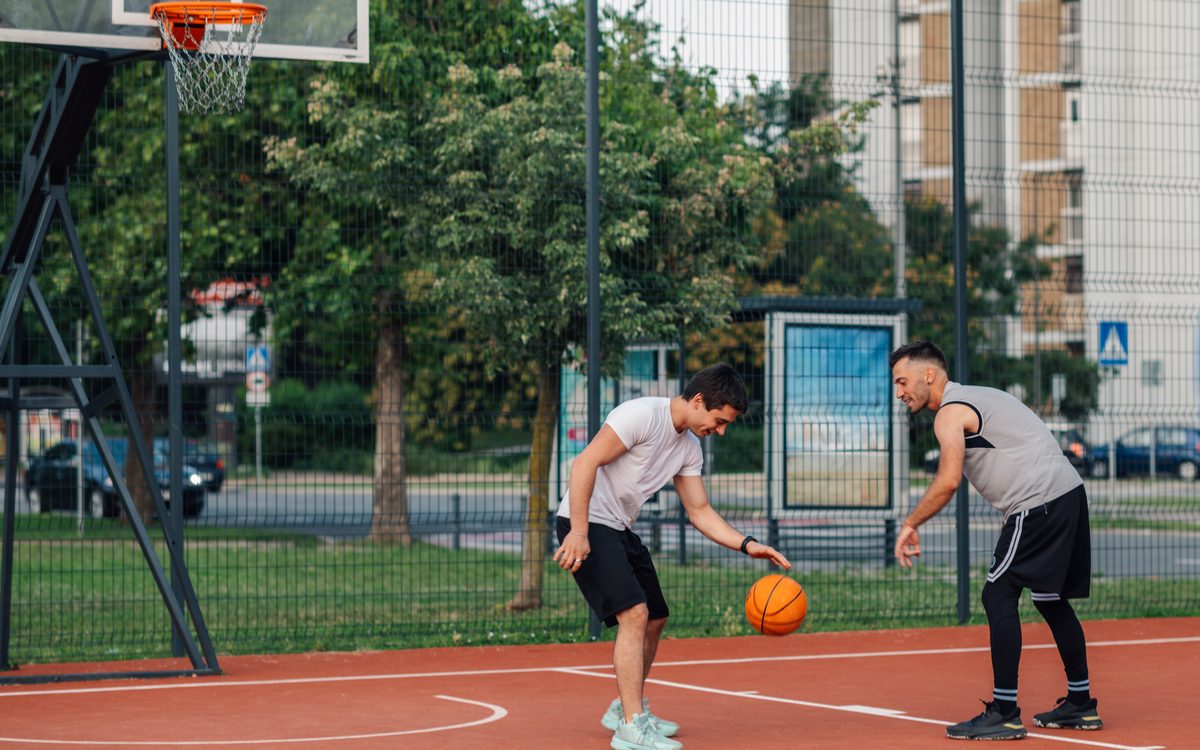
It is 9 p.m. after a tournament Saturday, five games and a long drive behind you. Your legs are heavy, your shoulders are tight and you have another event tomorrow. Recovery in 3×3 means everything that helps your body and mind come back between games, between days and between seasons: sleep, food and fluids, easing off when you need to, and gentle movement. This page covers what is known, says plainly where evidence is thin, and helps tell soreness from injury.
Quick answer: The basics have the most support: sleep (the CDC advises at least 7 hours for adults and 8 to 10 for teens), eating and drinking after games, and managing training load. Many popular tools, like foam rolling or compression, are comfort measures with limited or mixed evidence. Normal soreness eases within days; pain that is sharp, in one spot, swelling or getting worse is a reason to see a sports medicine doctor, physical therapist or athletic trainer.
General information, not medical advice. Injury detail is on our 3×3 injuries page, fuel on the nutrition page. For the sport, see the 3×3 basketball hub.
Between games on a tournament day
The one 3×3 recovery study we found (Paulauskas and colleagues, 2025, 12 elite Lithuanian men) found heart rate recovered better after longer play periods of up to 4 minutes than after 1 minute, while muscle-oxygen levels stayed stable during recovery regardless of how long play had lasted. The authors say recovery strategies should be tailored to the play duration. That was a simulated game in elite men, so it is not a rule for everyone. General practice between games, not taken from a study, is to keep warm with light movement, shade yourself, rehydrate and have a small snack, and stay mentally relaxed. For fuel details see our nutrition page.
Sleep
The CDC says adults need at least 7 hours of sleep a night, teens 8 to 10 hours and school-age children 9 to 12. In a small 2011 Stanford study of 11 college basketball players (Mah and colleagues), extending sleep to at least 10 hours in bed for 5 to 7 weeks was linked to faster sprints and better shooting percentages. It had no control group and a small sample, so it shows a possibility, not a guarantee. Tournaments often mean early starts, so plan an early night before and avoid heavy caffeine late in the day (a caffeine dose can delay the body clock; check labels and talk to a doctor if you are unsure). Naps and a dark, cool room are general sleep hygiene, not 3×3-specific.
How long does recovery take?
It varies. A study of basketball players (Doeven and colleagues, 2018) reported that performance tends to recover before biochemical markers, with creatine kinase staying elevated up to 72 hours or longer after games. Reviewers of recovery in basketball (Calleja-Gonzalez and colleagues, 2016) said players spend more time recovering than training and that evidence for many strategies is limited. For youth, the NBA and USA Basketball Youth Guidelines suggest extra rest after consecutive-day games. We do not give universal recovery times.
What after-game recovery methods can and cannot do
- Food and fluids. The strongest-backed step. The ACSM, Academy of Nutrition and Dietetics and Dietitians of Canada joint position says to replace 125 to 150% of fluid lost (1.25 to 1.5 L per kg lost), and for athletes with less than 8 hours before the next session, carbohydrate of about 1 to 1.2 g per kg per hour for the first 4 hours.
- Protein. The same position suggests about 0.25 to 0.3 g per kg early after exercise, and a narrative review of basketball (Davis and colleagues, 2022) mentions 30 to 40 g before sleep. Check with a dietitian for your needs.
- Massage, foam rolling, stretching, active recovery. In a survey of 107 sports practitioners (Pernigoni and colleagues, 2022) these were the most used and judged most useful; a survey shows what people do, not what works.
- Compression and cold-water immersion. Davis and colleagues list them as options in-season, with evidence that is mixed. Cold plunges carry safety cautions (talk to a doctor first if you have a heart condition, are pregnant or have circulation problems).
- Massage guns, boots, red-light and similar devices. We found no 3×3-specific evidence; read them as comfort tools, not treatment.
Load management and rest
The 2016 IOC consensus on load (Soligard and colleagues) says that poor load management is a major injury risk factor and that load includes travel and psychological stress. In practice that means: do not stack a hard training day on a tournament weekend, keep at least one full rest day a week (the NBA and USA Basketball guidelines advise rest days for youth players), and drop volume when you feel run-down. A flat feeling, heavy legs for days, poor sleep and low mood together can mean you are not recovering; discuss with a coach or clinician. Our training page covers how to arrange a week.
Mobility and flexibility
Mobility work is mostly valued for comfort and for keeping range of motion at the ankles, hips and shoulders. The AAOS advises year-round fitness including flexibility, and short dynamic warm-ups before play. We found no 3×3-specific trial showing that stretching prevents injury or speeds recovery; a gentle 5 to 10 minute routine of calf, hip and hamstring stretches and ankle circles is general practice, not a research finding.
Soreness or injury?
- Likely normal soreness: both legs or both sides feel stiff or achy, it comes on a day or so after hard play, and it eases with light movement over a few days.
- Worth a professional look: pain on one side or in one joint, swelling, a joint that gives way, pain at rest or at night, pain that is getting worse, or soreness that is not easing. The AAOS advises not to play through pain.
- Urgent: head-injury danger signs from the CDC, numbness or weakness, or a joint that looks out of place.
3×3 basketball recovery FAQs
How should I recover between 3×3 games?
Keep warm with light movement, drink and have a small snack, and rest in the shade. These are general practices; the one 3×3 study found only that heart rate recovery differed by play length.
How much sleep do I need during a tournament weekend?
The CDC advises at least 7 hours for adults and 8 to 10 for teens.
Do massage guns or foam rollers speed up recovery?
Evidence for most tools is limited, and practitioners use them mainly for comfort. We found no 3×3 trials.
What should I eat after a game?
ACSM position-stand guidance is to replace fluid and eat carbohydrate and protein soon after, in amounts that depend on body size and time to the next game. See the nutrition page and a dietitian.
How do I know soreness from injury?
Soreness is usually both-sided and eases within days; one-sided, sharp, swelling or worsening pain should be checked by a professional.
Sources
- Paulauskas et al., game intervals in 3×3 (PubMed 40453890)
- CDC, About Sleep
- Mah et al., sleep extension in basketball players (PubMed 21731144)
- Doeven et al., recovery after basketball games (PubMed 29527320)
- Calleja-Gonzalez et al., recovery in basketball (PubMed 26512912)
- Davis et al., in-season nutrition and recovery for basketball (PMC9023401)
- ACSM/AND/DC, Nutrition and Athletic Performance 2016 (PubMed 26891166)
- Pernigoni et al., recovery practices survey (PubMed 35784884)
- Soligard et al., IOC consensus on load in sport (PubMed 27535989)
- NBA and USA Basketball Youth Basketball Guidelines
- AAOS OrthoInfo, Basketball Injury Prevention
- CDC HEADS UP, signs and symptoms
General information for education only, not medical advice. It does not replace a visit with a sports medicine doctor, physical therapist or athletic trainer. See how we write and check our pages in our editorial policy.