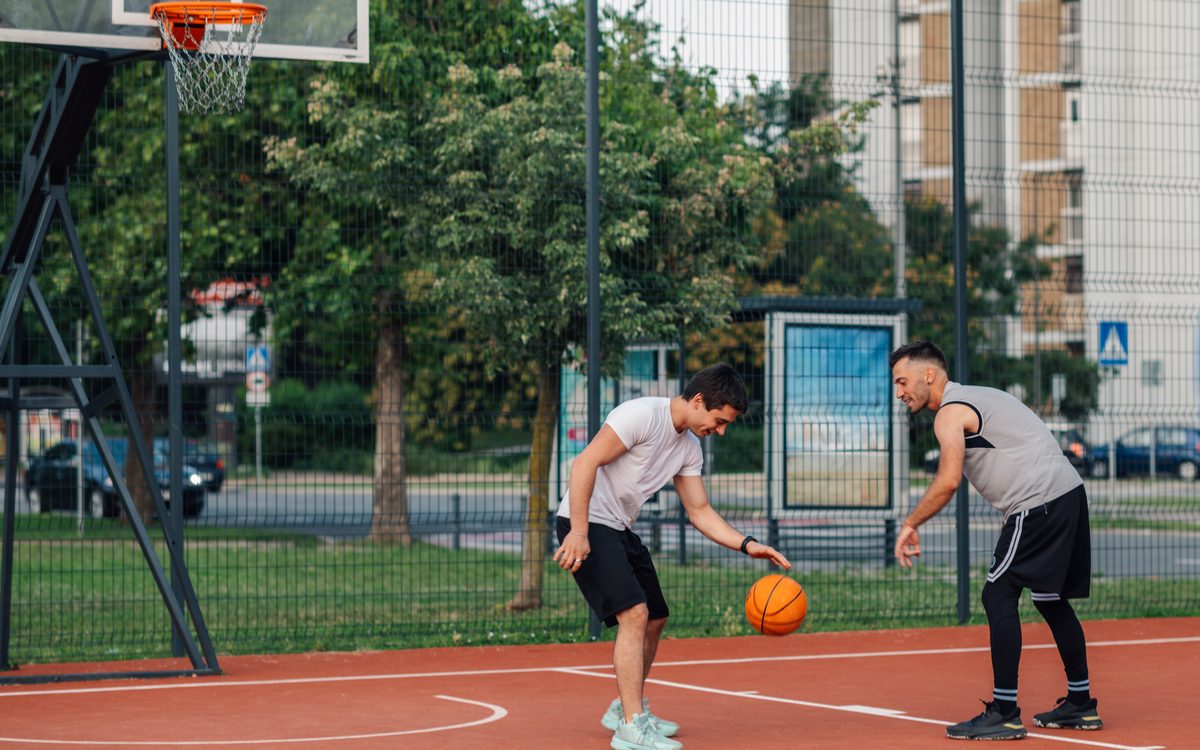
Score tied at 20, eight seconds left on the 12-second clock, and your teammate looks at you as the check-ball comes back. No coach can call anything: the FIBA 3×3 summary says players may not interact with coaches during the game. 3×3 mental training is the practice of building focus, confidence, routines and decision-making so you can play well under that pressure. This page covers mental performance skills and keeps them separate from mental health, which needs qualified help.
Quick answer: Mental skills such as routines, imagery, focus cues and calm breathing are trainable, and the research supports using them, but none guarantees results. 3×3 has no coaching during games, one time-out and a 12-second shot clock, so quick decisions and self-talk matter. If worry, low mood, disordered eating or burnout is affecting your life, that is a health matter: talk to a doctor or mental health professional, and in the US call or text 988.
General information, not medical or psychological advice. For rules see our rules page, for fitness the training page, and for the sport the 3×3 basketball hub.
What is different about 3×3
- No coach on the floor. The FIBA 3×3 document says people outside the court, including coaches seated away or remote coaches, may not give instructions during the game, so the three players are their own coaching staff.
- One period, sudden death. A single 10-minute period that can end at 21 compresses momentum swings, and a 2-point overtime makes every possession matter.
- One time-out and a substitute. Each team has a single 30-second time-out. Use it on purpose, for a reset, not out of panic.
- Decisions every possession. A 2022 analysis of the 2019 World Cups (Boros and colleagues) found the 1-point and 2-point values changed shot selection and efficiency, which makes shot choice a mental skill as well as a physical one.
Confidence and focus
Confidence comes mostly from preparation and from evidence in your own training, not from hype. A 2024 systematic review of ball sports (Pan and colleagues) found that mental fatigue hurts technical and cognitive performance, and that short strategies, including music listening, mindfulness training, self-talk and natural visual stimuli, appeared helpful in six studies, mostly in basketball, soccer and golf; the authors say more real-game research is needed. A practical reading for a tournament: expect your decision quality to fade late in a long day, plan breaks that rest your mind (quiet time, headphones, a walk), and keep a short focus cue for each possession, such as “check, space, shoot.” Cues like these are general coaching practice, not tested in 3×3.
Routines and handling pressure
The ESSA position statement on performing under pressure (Schweickle and colleagues, Sports Medicine, 2026) describes pressure as something that can help or hurt performance, and reviews tools such as pre-performance routines, attention strategies, psychological skills training, mindfulness and practicing under pressure. A check-ball is a built-in routine: take a breath, look at the clock, call the play. For free throws, which decide many close games, use the same routine each time. In an 8-week study of 67 randomized basketball players (Wu and Du, 2026), a mindfulness program was tested; we have not read its full results and do not claim any effect. A network meta-analysis of competitive anxiety interventions (Li and colleagues, 2026, 46 trials) concluded that substantial uncertainty remains. So try a method for several weeks and keep what helps you.
Imagery and visualization
A 2026 systematic review and meta-analysis of imagery practice in basketball (Shan and colleagues) pooled 14 studies and found an overall positive effect, clearest for free throws, with less certain results for self-efficacy and for time-pressured shots. The reviewers described their estimates as imprecise in some cases. A short, general routine is to spend a few minutes before a game picturing yourself making a closeout, a screen and a catch-and-shoot from both sides of the arc, then do the real thing. The session length is not from a study.
Goals and handling setbacks
Goal-setting that separates outcome (win), performance (shot percentage) and process (talk on every defensive possession) is general coaching practice. For setbacks, a common approach is a short reset cue between possessions, a stock phrase, one breath, eyes up, and a quick review after the game of what went well and one thing to change. Neither is tied to a 3×3 study here. Sleep matters for mood and focus, and our recovery page covers it.
Teamwork and decisions
A 2025 analysis of two Olympic teams at Tokyo 2020 (Nowak and colleagues) describes 3×3 as relying more on cooperation, creativity and improvisation than set systems, and found Serbia, the more effective shooting team of the two, had the better result. Agree beforehand on simple roles and signals with your teammates, such as who inbounds the check-ball and what you call for a high ball screen, since there is no coach to call them for you.
Competition preparation
Arrive early, warm up as a team, and learn the rules the event uses (see our rules page). Pack food and water (see the nutrition page), and have a plan for waiting between games. Keep your routine the same for game one and game five.
Mental health is not the same as mental performance
Mental performance skills are for playing well. Anxiety that will not ease, low mood, loss of interest, thoughts of self-harm, disordered eating, or burnout are health matters that deserve a qualified professional. The 2026 IOC consensus statement on mental health in elite athletes (Reardon and colleagues) says mental health conditions are common in athletes, can affect performance, are treatable and that many athletes keep competing; younger, Para and transitioning athletes are less studied. In the US you can call or text 988 (the 988 Suicide and Crisis Lifeline, free and open 24 hours) at any time. Outside the US, ask a doctor for local services. Youth players can also talk to a pediatrician or school counselor.
3×3 basketball mental training FAQs
How do I stay calm in a close 3×3 game?
Use a routine you have practiced, such as one breath and a focus cue at each check-ball. Research on pressure supports routines and attention strategies, but no method guarantees results.
Can visualization help my shooting?
A 2026 meta-analysis of basketball imagery studies found positive effects, clearest for free throws, with imprecise estimates for pressured shots.
What can I do when there is no coach?
Agree on roles and signals before the game and use your one 30-second time-out deliberately. This is general coaching practice.
How do I handle mental fatigue on a long tournament day?
A review of ball sports found short strategies such as music, mindfulness and self-talk may help; plan quiet breaks between games.
When is it more than nerves?
If worry, low mood, eating problems or exhaustion persist or affect daily life, talk to a doctor or mental health professional; in the US, call or text 988.
Sources
- FIBA 3×3, Rules and Interpretations (April 2020)
- Boros et al., 5v5 vs 3×3 shot selection (PubMed 36429856)
- Pan et al., mental fatigue in ball sports (PubMed 39514612)
- Schweickle et al., ESSA position statement, performance under pressure (PubMed 42271117)
- Wu and Du, mindfulness in basketball players (PubMed 42099737)
- Li et al., network meta-analysis of competitive anxiety interventions (PubMed 41866642)
- Shan et al., imagery practice in basketball (PubMed 42601963)
- Nowak et al., 2-point shots in 3×3, Tokyo 2020 (PubMed 40299908)
- Reardon et al., IOC consensus statement on mental health in elite athletes (PubMed 42580854)
- 988 Suicide and Crisis Lifeline
General information for education only, not medical advice. It does not replace a visit with a sports medicine doctor, physical therapist or athletic trainer. See how we write and check our pages in our editorial policy.