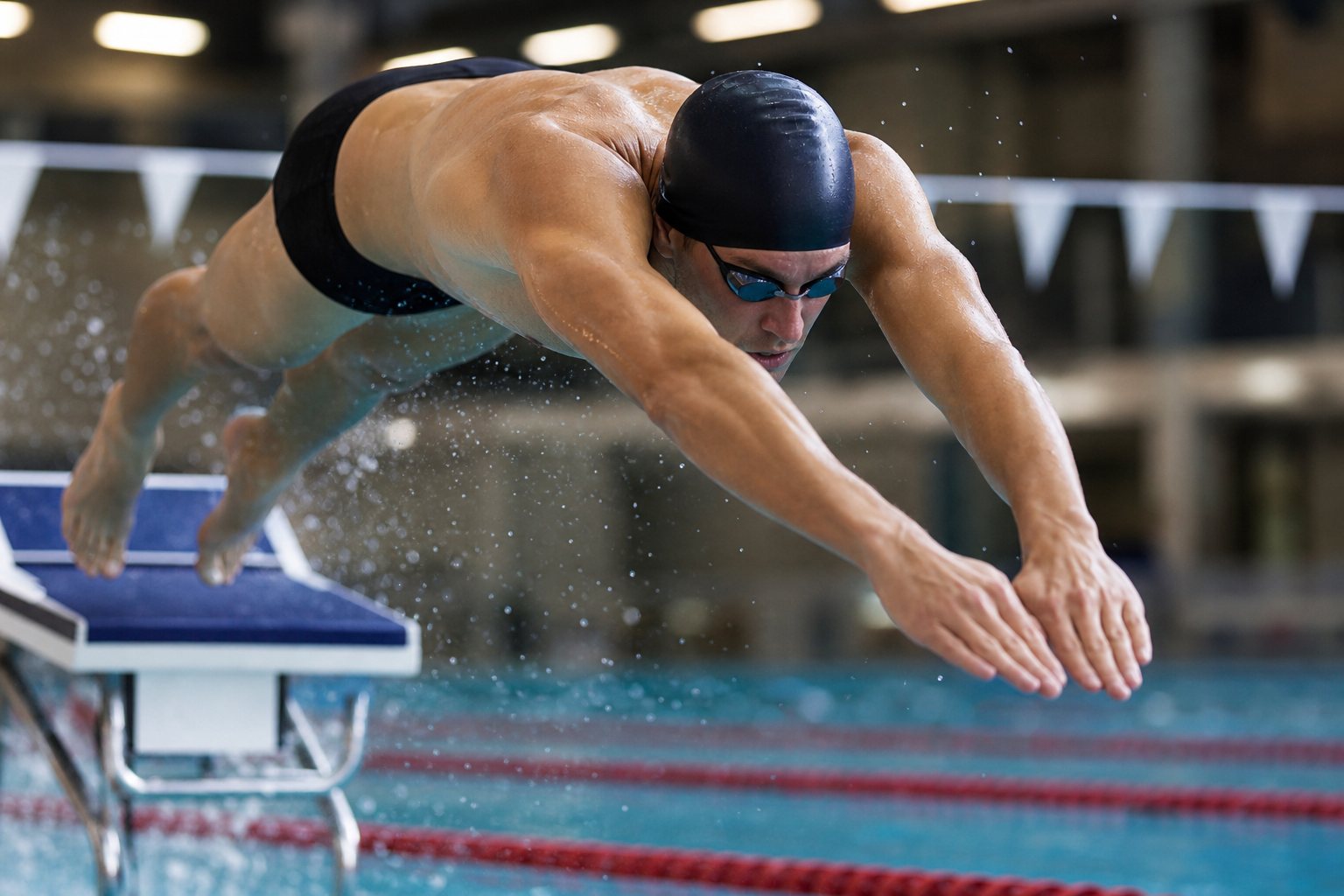
The team stands in a line at the pool edge, waiting for the announcer. Smiles are fixed, hearts are racing and everyone is silently running through the opening pattern once more. Then the music starts, and for the next three minutes every swimmer must stay calm underwater, stay in time with seven others and look as though it costs nothing. Mental training in artistic swimming is the practice of skills such as focus, imagery, routines and self-talk that help swimmers perform under pressure, and it is separate from mental health care, which is covered below.
Quick answer: Mental skills are trainable habits, not magic. Research is limited in artistic swimming itself, so most of what follows comes from related sports and is labelled that way. The habits with the best support are positive self-talk, a repeatable pre-routine, imagery practice and relaxation or mindfulness, and none of them guarantees a result. Anxiety, depression, disordered eating or burnout are health matters: talk to a qualified professional, and in the US call or text 988 in a crisis.
General information, not medical advice. For the rules and scoring that create the pressure, see skills, rules and getting started; for the sport overall, see the artistic swimming hub.
What is different about this sport
Artistic swimming has several mental demands at once. Swimmers hold their breath while performing, depend on teammates for timing and are judged on appearance and difficulty at the same time. A 2026 scoping review (Zhou and colleagues, Frontiers in Physiology) reported that the Base Mark penalty (the minimum difficulty applied when an element fails or does not conform) correlated with increased cognitive load, and also reported stress-related cortisol elevations in some studies. The review is an overview of studies with gaps, not a coaching manual, but it explains why a missed element can rattle a whole routine.
Confidence and self-talk
A 2026 study of 76 senior female rhythmic gymnasts (Gomez-Landero and colleagues, Journal of Human Kinetics) compared individual and team gymnasts in the same sport. Team gymnasts perceived more intra-team rivalry and used more positive self-talk in training, and across both groups the predictors of pre-competition anxiety were negative self-talk during training and positivity. The authors concluded that self-talk and positivity matter for managing competitive anxiety. Rhythmic gymnastics is a comparable judged, artistic sport, not artistic swimming. General coaching practice: swap “don’t sink” for a cue about the next movement, and keep corrections specific.
Focus, routines and goal setting (general coaching practice)
No artistic-swimming study tested these, so treat them as common practice. A pre-routine is a short, repeatable set of steps before entering the water: the same warm-up, a breathing pattern, one thought about the opening position and a quiet team moment. Goals work best as process goals (clean entries, tight timing in the first 30 seconds) rather than a medal or a score. Focus cues should be short and about what to do next. After a mistake, a reset word helps swimmers drop the last element and rejoin the pattern. Choose a routine in training, test it in practice meets and keep it the same on competition day.
Imagery and mental rehearsal
A 2026 systematic review of mental imagery in competitive gymnasts (Yang, Frontiers in Psychology) found 16 studies. Several controlled studies reported better judged skill execution with imagery-based approaches, while others found no performance benefit despite gains in confidence, and effects varied with expertise and dose. The review also rated the studies as having many risk-of-bias concerns. So imagery is worth trying as one tool, with modest expectations. General practice: run through the routine with eyes closed on dry land, adding sounds, timing and the feeling of the water, in sessions of a few minutes.
Handling pressure and competitive anxiety
A 2026 network meta-analysis of 46 trials with 2,049 athletes (Li and colleagues, Sports Medicine Open) compared psychological interventions for competitive anxiety. Mindfulness-acceptance-commitment training had the largest point estimate, relaxation the largest for cognitive anxiety, and imagery the largest among elite athletes, but the credible intervals were wide and several touched zero, so no method was proven best. In a small 2026 trial of 30 elite swimmers (Su and colleagues, Behavioral Sciences), an 8-week mindfulness programme reduced psychological strain and cortisol compared with usual practice. Slow breathing before the routine, a familiar warm-up and a plan for the first 30 seconds are common-sense extras; a sport psychologist can tailor the approach.
Setbacks, teammates and the team
Eight swimmers share one result. The rhythmic gymnast study above suggests that rivalry inside a team can raise pressure, and general coaching practice favours role clarity, short debriefs after practice and a rule that feedback goes to the performance, not the person. After a poor performance, many coaches wait until everyone has eaten and rested before talking details. A bad swim does not say anything about who a swimmer is.
Preparing for competition
Plan the logistics first: warm-up time, hair and make-up timing, food and travel. Read recovery and mobility for multi-day events and nutrition and athlete health for eating on the road. Mental rehearsal works best when it matches what the day will actually look like.
Young athletes
Evidence for artistic swimming is thin, so we rely on general guidance: keep sessions fun and age-appropriate, praise effort and learning, and avoid comments on bodies or weight. A swimmer who stops enjoying the sport, becomes unusually tearful or secretive about food, or withdraws from friends needs an adult’s attention, not a pep talk.
Mental performance versus mental health
Mental training helps with performance. Anxiety disorders, depression, disordered eating, burnout and thoughts of self-harm are health matters for a doctor, psychologist or other qualified mental health professional. The 2026 International Olympic Committee consensus statement on mental health in elite athletes (Reardon and colleagues) addresses these issues in elite sport. In the United States, call or text the 988 Suicide and Crisis Lifeline in a crisis, and see the ANAD helpline for eating concerns; USA Artistic Swimming also lists mental wellness resources through TrueSport. A certified mental performance consultant listed by the Association for Applied Sport Psychology can help with mental skills.
Artistic swimming mental training FAQs
How do artistic swimmers deal with nerves?
Common approaches are a repeatable pre-routine, slow breathing, positive self-talk and imagery. A 2026 network meta-analysis found several approaches may reduce competitive anxiety, with wide uncertainty. None is guaranteed.
Does visualisation work?
Evidence from gymnasts is mixed. A 2026 review of 16 studies found benefits in several controlled studies and none in others, with many risk-of-bias concerns.
How do you stay in time with the team?
Counts, music cues and practice matter, and that is coaching, not a study result. Mental training adds a focus cue and a reset after mistakes.
What if my child cries before every meet?
Some nerves are normal. If worry is constant, tied to food, or affects sleep or school, talk to a paediatrician or mental health professional.
Where can I get help?
In the US, call or text 988 in a crisis, contact the ANAD helpline for eating concerns, or find a mental performance consultant through AASP.
General information for education only, not medical advice. It does not replace a sports medicine doctor, physical therapist, athletic trainer or registered dietitian who knows the athlete. See our editorial policy for how we research and write.
Sources
- Zhou et al. 2026, scoping review (Base Mark penalty, cognitive load, cortisol).
- Gomez-Landero LA et al. 2026, individual versus team rhythmic gymnasts, J Hum Kinet (PMID 42211797).
- Yang W 2026, mental imagery in competitive gymnasts, Front Psychol (PMID 41890922).
- Li L et al. 2026, psychological interventions for competitive anxiety, Sports Med Open (PMID 41866642).
- Su N et al. 2026, MAIC training in elite swimmers, Behav Sci (PMID 42510189).
- Reardon et al. 2026, IOC consensus statement on mental health in elite athletes.
- 988 Lifeline; ANAD; AASP resources; USA Artistic Swimming (links TrueSport mental wellness resources).