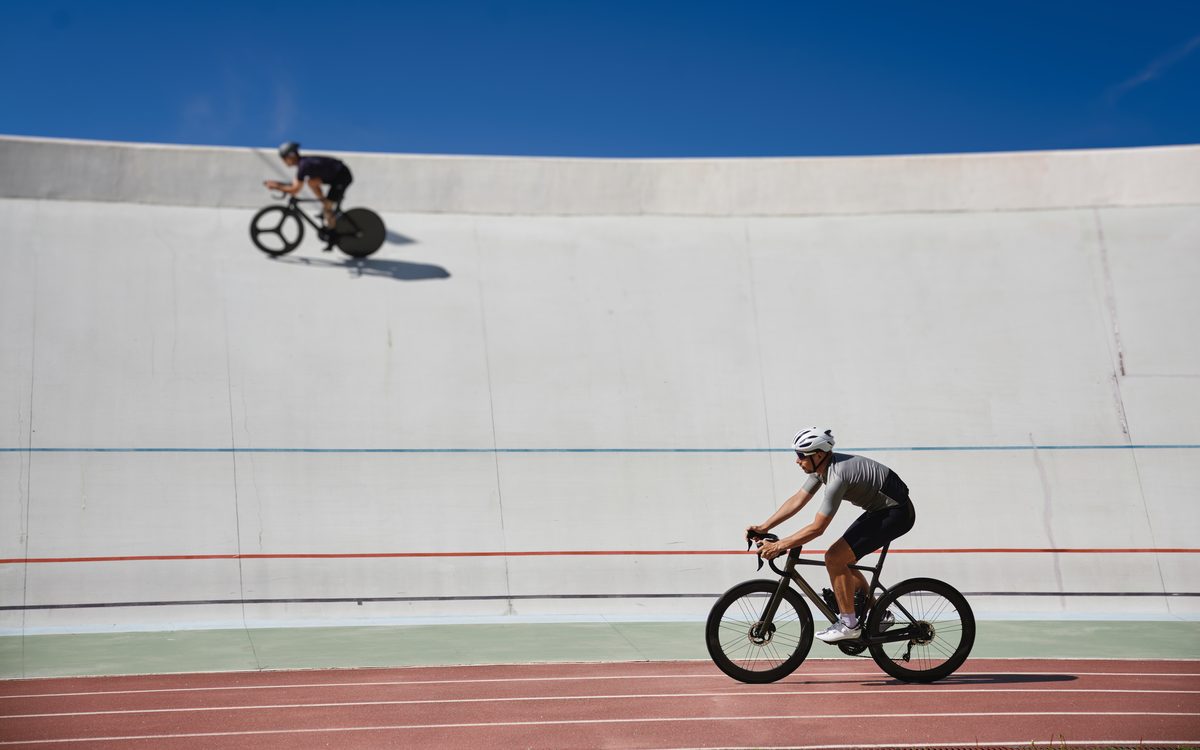
Two riders are walking their bikes around the infield of a velodrome, waiting for a sprint semifinal. Neither speaks. Each of them knows the first rider to commit loses a little, and the one who waits too long gets boxed in. In track cycling the mind makes decisions at 60 km/h with a rival close enough to touch. Mental training is the practice of building skills such as focus, confidence, routines and decision-making so that you can use your fitness under pressure. It sits beside the physical plan on our track cycling hub.
Quick answer: Mental skills are trainable habits, not a guarantee of results: pick goals you control, build a short pre-race routine, practice imagery and calm self-talk, and rehearse what you will do when things go wrong. Track research on this area is thin; a 2022 review found only one study on the mental side of track cycling. If anxiety, low mood, disordered eating or burnout are affecting daily life, that is a health matter: talk to a qualified professional, and in the US call or text 988 in a crisis.
What the research can and cannot tell us
A 2022 systematic mapping review of track cycling research (Stadnyk and colleagues, Sports Medicine) screened 4,019 records, included 71 studies and found most were about testing, none were true experiments and only one addressed the mental side of the sport. A 2024 survey of 159 coaches, practitioners and athletes (Stadnyk and colleagues) found that respondents saw evidence for tactics (30%) and mental skills (26%) as lacking, and relied on personal experience for them (74% and 62%). So the advice below mixes studies from cycling and other endurance sports with general sport psychology practice. We label which is which.
Confidence and focus
Confidence comes mainly from preparation you can point to: sessions completed, efforts hit, practice starts and mock races. A simple log of what went well in training gives you evidence to read before a race. Focus is about choosing where your attention goes. In a sprint, that might be one cue, such as the wheel ahead or the line you want; in a pursuit, your pace and your technique. Self-talk can help. A 2011 meta-analysis of 32 studies (Hatzigeorgiadis and colleagues, Perspectives on Psychological Science) found self-talk interventions worked better for fine-motor and new tasks than for gross-strength tasks. In a 10 km cycling time trial, a 2015 study of 14 men (Barwood and colleagues) found motivational self-talk was linked to a faster time with higher power (1,120 to 1,078 seconds), while neutral self-talk slowed slightly; the authors stress that the content of the self-talk matters.
Goals, motivation and the A/B/C ladder
Many coaches ask riders to set three goals for a race: an outcome goal (such as a final), a performance goal (such as a personal best) and a process goal (such as holding position through the turn). Process goals are within your control, which is useful because results depend on rivals. This three-goal pattern is common coaching practice; we did not find a track-cycling study testing it. Keep goals short, specific and written down, and revise them when injury or schedule changes the plan.
Imagery and pre-race routines
Imagery means rehearsing the race in your mind, including how it should feel, and also what you will do if the plan changes. Riders often rehearse the start, a key attack and the finish. A routine is a short, repeatable sequence before a race, such as warm-up, a check of the bike, a breathing pattern and a cue word. Routines give a nervous mind something to do. Both are general sport psychology practice; the Association for Applied Sport Psychology (AASP) lists qualified consultants. The evidence for imagery in cycling specifically is limited, so treat it as one tool.
Tactics, pacing and decisions in head-to-head racing
Track events ask for different mental skills. Pursuit and time-trial riders are racing the clock; a 1999 modelling study (de Koning, Bobbert and Foster, Journal of Science and Medicine in Sport) found the best 1,000 m result came from an all-out start by the rider with the highest peak anaerobic power, and that a 4,000 m pursuit was fastest with an all-out start and then an even pace, with small changes in pacing making a large difference. Head-to-head events such as the sprint and keirin are different. Hettinga and colleagues (2017, Frontiers in Physiology) describe how opponents change the way athletes regulate effort: the behavior of other riders can pull you away from your best individual pace. Tucker (2009) proposed that pacing is regulated by perceived effort and feedback from the body, which is why learning to read your effort in training matters. In team events, such as the team pursuit and madison, communication, trust and clear roles matter; the 2024 survey above found tactics are valued highly (over 96% agreed they were important) even though the research is thin.
Pressure, mistakes and bad days
Setbacks happen: a rival blocks you, a handoff goes wrong, a crash takes you out. Many coaches teach riders to name the mistake, reset with a breath and a cue word and focus on the next lap. After a crash, returning gradually and rebuilding trust in a safe setting is sensible, and a clinician should clear any return after a head injury (CDC HEADS UP). We did not find a study of fear after crashes in track riders; this is general practice. Reading about nerves, remember that arousal is not always a problem: the goal is to channel it.
Race-day preparation
A plan for the day (what to eat, when to warm up, who to talk to, what to do between rounds) takes weight off the mind. See our cycling race-day page for logistics. For a first race, ride the track beforehand, if the velodrome allows it, and visit the infield so the setting is familiar. Our getting-started page covers the basics.
Mental performance and mental health are different things
Focus training does not treat anxiety, depression, disordered eating or burnout. Those are health matters. The IOC consensus statement on mental health in elite athletes (Reardon and colleagues, 2019, British Journal of Sports Medicine) says they deserve proper assessment and care. If you notice persistent low mood, constant worry, trouble sleeping, loss of interest or thoughts of self-harm, talk to a doctor, therapist or a sport psychologist. In the US, you can call or text 988, the Suicide and Crisis Lifeline, at any time. Young riders can talk to a pediatrician or school counselor, and our nutrition page covers eating and energy.
Track cycling FAQs
Is there research on mental training in track cycling?
Very little. A 2022 mapping review of 71 track studies found only one on the mental side. Advice usually comes from other sports and coaching practice.
Does visualization help?
Many athletes use imagery, and sport psychologists teach it, but we found no track-specific trials. Treat it as a skill to practice, not a guarantee.
How do I handle nerves before a sprint?
A short routine, slow breathing and a cue word are common techniques. They are general practice, not proven fixes. If anxiety is constant or severe, talk to a mental health professional.
How should I set goals for a race?
Many coaches pair an outcome goal, a performance goal and a process goal you control. This is common practice, not a track-specific finding.
Where can I find a sport psychologist?
The Association for Applied Sport Psychology (AASP) lists resources and consultants. For a mental health concern, see a licensed clinician. In the US, 988 is available around the clock.
Sources
- Stadnyk et al. 2022, systematic mapping review of track cycling research (PubMed)
- Stadnyk et al. 2024, survey of track cycling coaches, practitioners and athletes (PubMed)
- Hatzigeorgiadis et al. 2011, self-talk meta-analysis (PubMed)
- Barwood et al. 2015, motivational self-talk in a 10 km cycling time trial (PubMed)
- de Koning, Bobbert and Foster 1999, pacing in track cycling (PubMed)
- Hettinga et al. 2017, racing against opponents (PubMed)
- Tucker 2009, perception of effort and pacing (PubMed)
- Reardon et al. 2019, IOC consensus statement on mental health in elite athletes (PubMed)
- AASP: resources
- 988 Suicide and Crisis Lifeline
- CDC HEADS UP: signs and symptoms
General information for education only, not medical advice. It does not replace a sports medicine doctor, physical therapist, athletic trainer or registered dietitian who knows you. See our editorial policy for how we research and write. More on this sport: track cycling hub, cycling hub and all sports.