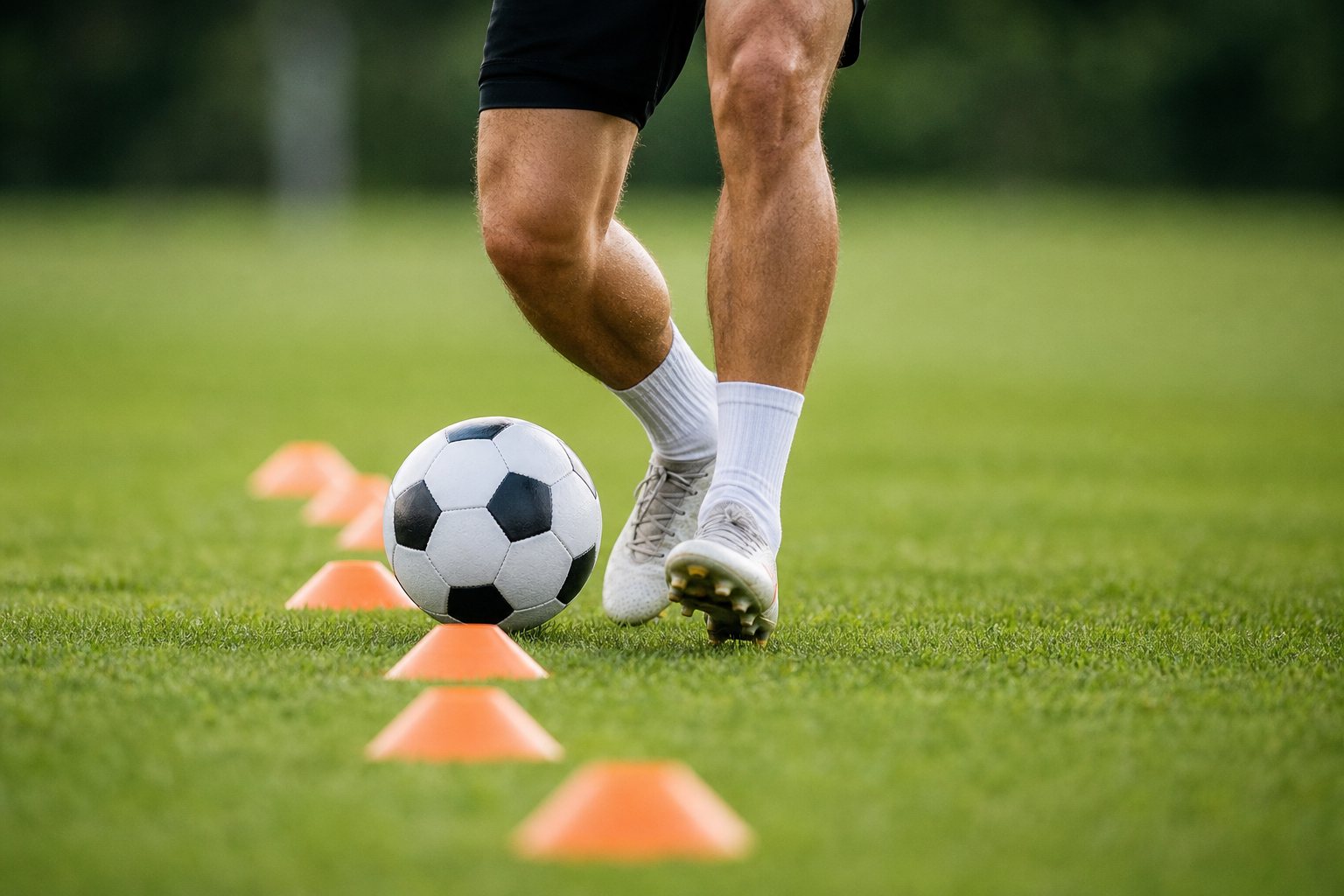
This page is for athletes, parents, coaches and adults learning a new sport who want to get better at the skills themselves: kicking, shooting, swinging, passing, turning, reading the game. It answers how movement skills are learned, how to practise so they hold up in a real game, and how to use feedback and drills well.
Fitness helps you do a skill for longer, but technique decides how well you do it. Skill work is also where beginners and young athletes gain fastest. This is general coaching education; a qualified coach in your sport can see what a page cannot.
How people learn movement skills
Skills are usually learned in stages. At first you think about every part and results are inconsistent. With practice the movement becomes smoother and needs less attention. Eventually it runs almost automatically, which frees your mind to read opponents and teammates.
Progress is not a straight line. Plateaus, and even short dips when you change something, are normal. Sleep matters too: skills tend to settle in between practice sessions, which is one more reason rest belongs in the plan (see Training Principles & Planning).
Designing good practice
Little and often
Short, focused sessions several times a week usually teach more than one long session. Attention drops when you are tired, and tired practice can lock in sloppy habits.
Mix it up
Repeating the same movement in the same way feels productive, but varying it is often better for lasting learning. Change distance, speed, angle or the surface. Practise a few skills in a rotating order rather than all of one, then all of the next. Practice can feel harder this way, which is a good sign rather than a bad one.
Start simple, then add pressure
Begin with the movement slowed down and uncontested. Then add a moving target, a time limit, a defender or a score. If a skill falls apart at the final step, go back one step rather than forcing it.
Make it count
Practice with a goal (“land five of ten,” “complete the pass before the cone”) keeps focus higher than drifting through repetitions.
Feedback that helps
Feedback comes from a coach, a video, a teammate, or your own sense of how it felt and what happened. Too much, too often, makes athletes dependent on it. Good coaches give one or two cues at a time, often about the outcome or the target rather than the position of every joint. Asking “what did you notice?” builds self-awareness.
Video is powerful but easy to overuse. Watch a few attempts with a clear question in mind, then go and try again. Beginners should lean on simple, repeatable cues; more experienced athletes can handle finer detail.
Drills, coordination and decision-making
Drills isolate a piece of a skill so you can repeat it cleanly. They are useful for learning and warming up, but a drill that never meets a game situation teaches less than it seems to. A good rule is to move from closed drills (predictable) to open ones (you must read and react) as quickly as you can handle.
Coordination, balance and agility underpin almost every sport, and they are best built early through variety. Children benefit from playing many activities rather than specialising too soon, because it builds a broad movement base. See our Speed & Agility page for the movement side.
Decision-making is a skill too. Where to pass, when to shoot, which shot to play: athletes improve this by playing small, quick games and by being asked to choose, not just execute. Many coaches use small-sided games for exactly this reason.
Transfer to competition
The real test is whether a skill appears when it matters. Transfer improves when practice looks like the game in speed, space, decisions and pressure. Build in mild stress: score keeping, small consequences, a noisy environment, tiredness. Practise your pre-performance routine too, such as a breath, a cue word or a reset between points. The mental side is covered in Mental Training & Competition. This is performance coaching only, not mental-health care; anyone struggling with anxiety or low mood should speak to a doctor or qualified professional.
Knowing the game: why the rules page matters
Skills are shaped by the rules: what counts, what is legal contact, how play restarts, what equipment is allowed. Learning technique without understanding the rules leads to penalties and, in contact sports, to unsafe habits. Each sport on this site has a rules and basics page, linked below for several popular sports. Rules and equipment details vary by league and age group, so confirm with your own governing body.
Guides to read next
- Training Principles & Planning
- Speed & Agility
- Mental Training & Competition
- Training & Performance by Sport
- Soccer Rules & Basics
- Basketball Rules & Basics
- Tennis Rules & Basics
- Golf Rules & Basics
- Volleyball Rules & Basics
- Swimming Rules & Basics
- Baseball Training & Performance
- Best Mental Training Tools for Athletes
Frequently asked questions
How long does it take to learn a new sports skill?
It varies a lot with the skill, your starting point and how well you practise. Regular short sessions with good feedback usually beat occasional long ones.
Is it better to repeat one drill many times?
Some repetition is needed, but mixing variations and adding game-like decisions usually teaches skills that last better under pressure.
Should kids specialise in one sport early?
Many youth coaches and sports medicine groups favour a variety of activities in childhood to build general coordination and reduce overuse. Ask a coach about what suits your child’s age and goals.
Why do I play well in practice but not in games?
Practice may be too easy or too predictable. Add speed, decisions, opponents and a little pressure, and rehearse a simple routine for nerves.