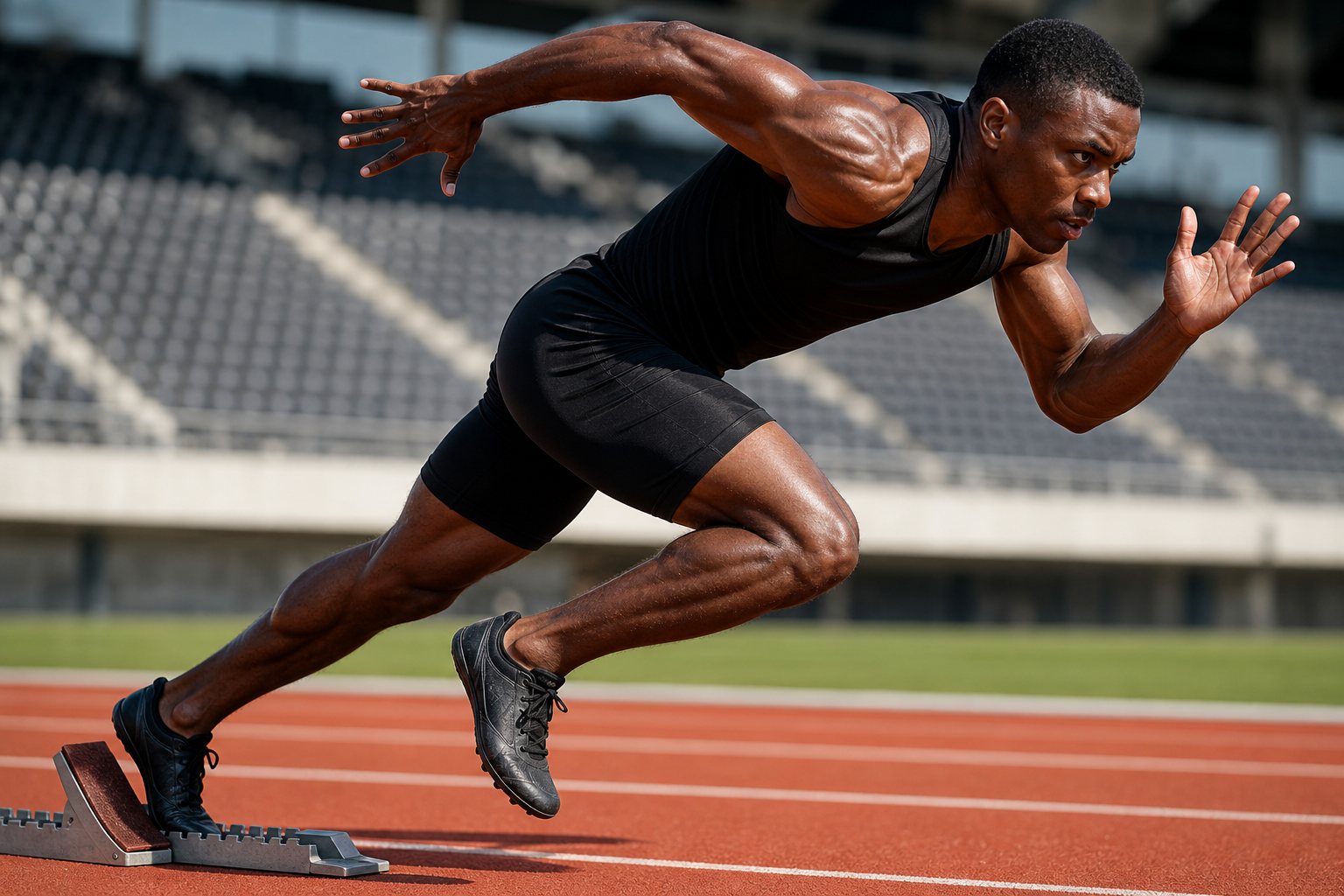
This page is for athletes, parents and coaches who want to move faster, change direction sharply and move with control. It also suits adult beginners and returning players who feel slower than they used to. It explains the different kinds of speed, why they are separate skills, and how to think about practising them safely.
It answers common questions. Is sprinting the same as agility? Why do some players look quick over five steps but not over fifty? What does coordination add? It is general education, not a personal programme. A coach or qualified trainer can fit the details to your age, sport and health.
Speed is not one thing
People say “fast” and mean several different abilities. Getting going from a standstill is acceleration. Holding top pace over open ground is maximum speed. Slowing down under control is deceleration. Changing direction on a planned path is change of direction. Reacting to what an opponent or ball does is reactive agility.
These overlap but are not the same. A basketball guard may need sharp starts and stops in a few steps, while a sprinter or a soccer winger also needs top speed. Training that matches what your sport asks usually pays off most.
Acceleration
Acceleration is about pushing against the ground and building speed quickly. Body angle matters: in the first steps the body leans forward and the feet strike under or behind the hips, then the body gradually rises. Strong, springy legs help, and so does clear technique.
Coaches usually teach acceleration in short, fully rested efforts. Quality matters more than volume, because tired sprinting teaches poor movement. Our Strength & Power hub covers the force side of the story.
Maximum speed
At top speed the athlete is upright and relaxed, with quick, light ground contact and a smooth arm swing. Many athletes try to force speed by tensing up, which tends to slow them down. Maximum-speed work needs space, good footing and a proper warm-up, since fast running puts real load on the hamstrings and calves.
Many team-sport athletes only reach near top speed occasionally, so ask how often your sport really needs it. For sprinters it is the whole event. For others it is a useful tool that sits alongside the skills of the game. See Track & Field Training for sprint-led sports.
Deceleration and change of direction
Slowing down is a skill. Athletes brake with bent hips and knees, a lowered centre of mass and the feet placed so the body stays balanced. Poor braking is common in non-contact knee and ankle injuries, which is why good technique and enough strength matter. For more on how professionals think about this, see Knee Injuries in Athletes and Ankle Sprains.
Change-of-direction drills, such as set cone patterns, teach the body to brake, turn and push off. They are planned, so the athlete knows where to go. They build technique and confidence, and they are a sensible place to start before anything unpredictable.
Reactive agility
True agility adds a decision. The athlete reads a defender, a ball or a partner and then moves. In games the reading often matters as much as the leg speed. Coaches build this with small games, mirror drills and reaction cues that copy real situations.
Because the movement is less predictable, it is best added after planned drills feel solid, and with a clear surface and enough space. Young athletes in particular gain a lot from varied play, not repeated drills alone.
Balance and coordination
Balance is staying in control over a small base. Coordination is linking body parts so movement flows. Both improve with varied practice: hopping, landing, skipping, throwing, catching and playing different games. Children and teens often benefit from trying several sports, because broad movement experience supports later skill.
Balance work also helps joints cope with awkward moments, which is one reason it appears in warm-up and prevention routines.
Matching speed to your sport
Work out what your sport asks. A tennis player makes many short, sharp movements with quick recovery. A rugby or football player may need powerful starts and collisions. A soccer midfielder repeats short sprints over a long match. Watching a game and noting how far and how often athletes move is a useful first step.
Speed work is demanding on muscles and tendons, so it should come when you are fresh, with rest between efforts. Ramp up gradually and watch for signs of overload, as explained in Overtraining and Overuse Injuries. If something hurts sharply or keeps hurting, stop and get it checked by a qualified professional.
Guides to read next
- Training Principles
- Strength & Power Training
- Skills & Technique
- Endurance & Sport Conditioning
- Warm-Ups and Preparation
- Knee Injuries in Athletes
- Ankle Sprains
- Overtraining and Overuse Injuries
- Soccer Training & Performance
- Basketball Training & Performance
- Tennis Training & Performance
- Track & Field Training & Performance
- Best Speed Training Equipment
- Best GPS Trackers for Team Sports
Frequently asked questions
Are speed and agility the same thing?
No. Speed is how fast you move in a line. Agility adds changing direction and reacting to what is happening. They help each other, but each needs its own practice.
Can adults get faster?
Many adults improve their movement quality, starts and confidence with good coaching and gradual progress. Natural top speed changes with age, so focus on skill, strength and staying healthy.
How often should young athletes do speed work?
Short, fun sessions mixed with plenty of varied play usually suit young athletes best. A coach who works with your child’s age group can advise on amounts.
Do I need special equipment?
Not to begin. Open space, a safe surface and good shoes are enough. Cones, ladders and timing tools can add variety later but do not replace good technique.
Why do I feel tightness after fast running?
Sprinting loads the back of the leg heavily, so some muscle soreness is common when you are new to it. Sharp pain, or pain that does not settle, should be assessed by a health professional.