This article contains affiliate links: if you buy through them we may earn a commission, at no extra cost to you. Read our affiliate disclosure.
It is the first practice of the season and a parent is standing in the sports aisle, holding two balls that look almost the same. One says indoor, one says beach, and the youth ball in the next bin is a different weight. Which one does an eleven-year-old actually need?
The short answer: almost every volleyball sold today is the same size 5, so the real choice is between indoor and beach or outdoor construction, and then between a regulation-weight ball and a lighter one for younger or newer players. Very young children sometimes start on an oversized, soft ball. This guide explains each case, uses the governing-body rulebooks for the official numbers, and compares six balls from the Amazon listings we reviewed. It is written for parents, coaches and adult players.
Our top picks

Wilson Pro Tour Indoor Volleyball
- Official size and weight (listing)
- Listing says ideal for ages 13 and up
- Wound carcass construction
- Synthetic leather cover
$13.99 at Amazon, as of Nov 22, 2026 12:07 UTC
Check price on Amazon
Tachikara SV5WS/C Official Indoor Volleyball
- Listing says NFHS approved
- Official size 5, 260-280 g (listing)
- Microfiber composite leather cover
- Loose bladder construction
$33.20 at Amazon, as of Nov 22, 2026 12:07 UTC
Check price on Amazon
Tachikara Volley-Lite Youth Volleyball
- Listing says 25% lighter than a standard ball
- Official size 5 dimensions (listing)
- Microfiber composite leather cover
- Aimed at schools and junior club training
$33.42 at Amazon, as of Nov 22, 2026 12:07 UTC
Check price on Amazon
Baden Softlight VXT2 Youth Oversized Training Volleyball
- About 30 in circumference, about 8 oz (listing)
- Listing says ideal for players 8 and under
- FlexFoam cover
- Listing says 20% larger and lighter
$19.99 at Amazon, as of Nov 22, 2026 12:07 UTC
Check price on Amazon
Mikasa BV550C Official Beach Volleyball
- Size 5 (listing)
- Listing says official FIVB game ball
- Listing says made with recycled materials
- Soft-touch feel (listing)
$51.72 at Amazon, as of Nov 22, 2026 12:07 UTC
Check price on Amazon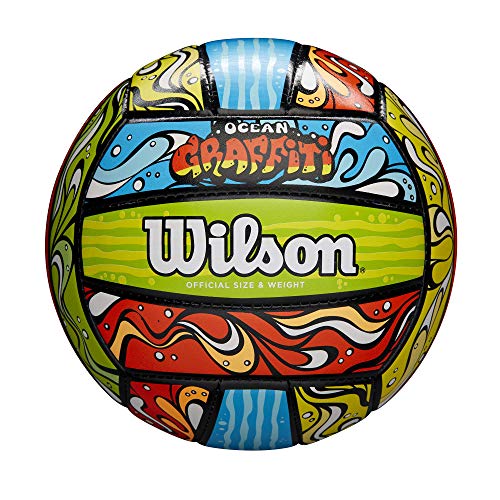
Wilson Ocean Graffiti Outdoor Recreation Volleyball
- Official size and weight, ideal for ages 13 and up (listing)
- 18-panel machine-sewn construction
- Butyl rubber bladder for air retention
- Listed for backyard, park or beach
$16.70 at Amazon, as of Nov 22, 2026 12:07 UTC
Check price on AmazonThe picks compared
| Product | Best setting | Size and weight (listing) | Weight class | Level | What the listing says |
|---|---|---|---|---|---|
| Wilson Pro Tour Indoor | Indoor | Official size and weight | Regulation | Ages 13 and up | Wound carcass, synthetic leather |
| Tachikara SV5WS/C | Indoor | Size 5, 260-280 g | Regulation | School, club, competition | NFHS approved, loose bladder, microfiber cover |
| Tachikara Volley-Lite | Indoor training | Size 5, about 25% lighter | Light | Youth and beginners | 25% lighter, microfiber cover |
| Baden Softlight VXT2 | Indoor, learning | About 30 in circumference, about 8 oz | Oversized and light | Ages 8 and under | Foam cover, about 30 in, about 8 oz |
| Mikasa BV550C | Beach | Size 5 | Beach match style | Beach players, all levels | FIVB game ball, recycled materials |
| Wilson Ocean Graffiti | Outdoor recreation | Official size and weight | Regulation | Casual play, ages 13 and up | 18 panels, butyl bladder, recreational |
The picks in detail
1. Wilson Pro Tour Indoor Volleyball: regulation indoor ball for ages 13 and up
This is the plain regulation indoor ball in our set. The listing describes it as the size and weight used at the pro level and recommends it for ages 13 and up, which matches the stage where most players move to the full-weight ball.
What the Amazon listing says
- Listing: official size and weight, 'the size and weight used at the pro level', ideal for ages 13 and up
- Listing: wound carcass construction that helps keep the ball round
- Listing: high-performance synthetic leather cover
- Listing: indoor ball with pro-style graphics
What the research says: The USA Volleyball and FIVB indoor rules we opened set 65-67 cm and 260-280 g. The listing says 'official size and weight' but gives no numbers, so check the printed specs on the ball, and ask your league whether it must be an approved model.
- Strengths: Regulation size and weight, so training matches the match ball; Wound carcass is described as helping the ball keep its round shape; Synthetic leather cover aimed at touch
- Limitations: The listing does not say it is approved for any particular league or school competition; Regulation weight can sting on forearms for newer players
- Suits: Teen and adult players training or playing indoors who are ready for a full-weight ball.
- Look elsewhere if: Players under about 12, or anyone whose league requires a specific approved ball: check the league first.
2. Tachikara SV5WS/C Official Indoor Volleyball: indoor ball listed as nfhs approved
For school and club players who need a ball their program will accept, this is the one in our set whose listing states school-association approval. Its stated weight of 260-280 g sits inside the FIVB and USA Volleyball indoor range we checked.
What the Amazon listing says
- Listing: NFHS approved, official size 5
- Listing: weight of 260-280 grams
- Listing: Sensi-Tec micro-fiber composite leather cover with textured grip
- Listing: patented loose bladder construction meant to keep shape and bounce
What the research says: The stated 260-280 g matches the weight range in both the FIVB and USA Volleyball indoor rules we opened. We could not open an NFHS page, so the approval itself is the listing's claim: your school or state association has the final say. USA Volleyball's rules separately say it must approve the balls for nationally sanctioned events (rule USAV3.2).
- Strengths: Weight range stated and consistent with the official indoor range; Listing says it is approved by the National Federation of State High School Associations; Soft-feel cover with a textured grip
- Limitations: Approval is the listing's claim: confirm with your school, club or state association; Built for indoor courts, not sand or wet grass
- Suits: High school and club players and coaches buying a match or team-practice ball.
- Look elsewhere if: Families buying for a backyard or beach, or for children who find a full-weight ball too hard on the arms.
3. Tachikara Volley-Lite Youth Volleyball: lightest option at regulation size
This ball keeps the regulation size but cuts the weight, which is the approach the USA Volleyball rulebook also takes for 12 and under play at its Junior National Championships. It lets younger players learn passing and setting without the sting.
What the Amazon listing says
- Listing: 25% lighter than a standard ball, for youth and beginners
- Listing: official size 5 footprint
- Listing: Sensi-Tec microfiber composite leather cover
- Listing: for schools, recreational programs and junior club training
What the research says: USA Volleyball uses a ball of the same size and pressure but 198-227 g (7 to 8 oz) for 12 and under at its Junior National Championships. A 25% cut from 260-280 g would land near 195-210 g, but the listing gives no exact weight, so treat that as a rough guide only, not a match to the rule.
- Strengths: Same size as the full ball, so hand position and court feel carry over; Lighter weight is easier on small arms; Soft cover made for passing and serving drills
- Limitations: The listing gives a percentage, not an exact weight, so do not assume it equals the 198-227 g used in the USA Volleyball rule; Not a match ball for adult or high school play
- Suits: Children and new players, roughly the 12 and under stage, plus coaches running beginner drills.
- Look elsewhere if: Players 13 and up who want match weight, and very young children who may do better on an oversized soft ball.
4. Baden Softlight VXT2 Youth Oversized Training Volleyball: oversized soft ball for the youngest players
It is the only ball here that is deliberately not regulation size. The listing says the larger, lighter ball is easier for small children to track and to get over the net, which can make the first weeks more fun.
What the Amazon listing says
- Listing: about 30 in circumference and 8 oz
- Listing: ideal for players 8 and under; 20% larger and lighter
- Listing: FlexFoam cover that removes the sting
- Listing: ships deflated, no pump
What the research says: The indoor rules we opened set an official circumference of 25.6 to 26.4 in (65-67 cm), so this ball is deliberately well outside the official size. That is fine for a first-contact toy; no rulebook we opened covers oversized youth balls, so ask your program.
- Strengths: Large and light, easy for small children to see and send over the net; Foam cover made to remove the sting; Ships ready for first-time players learning the basics
- Limitations: About 30 in is well above the 65-67 cm (roughly 26 in) official indoor circumference, so it does not feel like the real ball; Meant only for the youngest age group; ships deflated without a pump
- Suits: Children about 8 and under, school K-5 programs and parents introducing the game at home.
- Look elsewhere if: Anyone 9 or older, or a child already playing in a league: move to a regulation-size lighter ball.
5. Mikasa BV550C Official Beach Volleyball: beach ball listed as the fivb game ball
If the game is on sand, this is the ball in our set that the listing ties to FIVB events. The FIVB beach rulebook describes a beach ball as slightly larger and softer than an indoor one, so a true beach ball feels different from an indoor ball.
What the Amazon listing says
- Listing: official FIVB game ball for beach, the only beach ball officially used in FIVB events (listing's claim)
- Listing: size 5, for beach players of all levels
- Listing: made with recycled materials, soft touch
- Listing gives no weight or pressure
What the research says: The FIVB beach rules we opened set 66-68 cm, 260-280 g and 0.175-0.225 kg/cm2 for a beach ball. The listing gives none of these numbers, so the FIVB link is the listing's statement, not something we confirmed on an FIVB approvals page.
- Strengths: Listing links it to FIVB international events; Described as made for beach players of all levels; Soft touch with recycled materials noted
- Limitations: The listing gives no weight or pressure, so check against the FIVB beach range yourself; Beach construction is not intended for the indoor gym
- Suits: Serious beach players and clubs that want the match-style ball.
- Look elsewhere if: Casual backyard or pool play, where a simpler recreational ball is enough.
6. Wilson Ocean Graffiti Outdoor Recreation Volleyball: recreational outdoor ball for park, yard and beach
For relaxed games outside, it pairs regulation size with a bladder the listing says keeps air for longer. It is a straightforward choice when nobody needs a competition-approved ball.
What the Amazon listing says
- Listing: official size and weight, ideal for ages 13 and up
- Listing: 18-panel, machine-sewn construction
- Listing: butyl rubber bladder for longer air retention
- Listing: for backyard, park or beach recreation
What the research says: Beach and indoor rules differ slightly (66-68 cm and lower pressure for beach, 65-67 cm indoors). A single recreational ball will not match either exactly, which is fine for fun play; for a match, use the ball your event requires.
- Strengths: Regulation size and weight (listing), so it still feels like real volleyball; Butyl bladder is described as slowing air loss; Aimed at park, yard and beach recreation
- Limitations: Listing describes it as recreational and does not claim approval for tournaments; Not a match ball for indoor leagues
- Suits: Teens and adults playing for fun outdoors.
- Look elsewhere if: Players who need an approved competition ball, or younger children who want a lighter ball.
What the official ball size is
Two governing-body rulebooks give the numbers. The FIVB indoor rules (2025-2028) and the USA Volleyball indoor rules (2025-2027) both set the ball at 65-67 cm around (25.6 to 26.4 in) and 260-280 g (9 to 10 oz), with an inside pressure of 0.30 to 0.325 kg/cm2 (4.26 to 4.61 psi). Both say every ball in one match must match in size, weight, pressure, type and colour.
Beach is a little different. The FIVB beach rules (2021-2024) set a circumference of 66-68 cm, the same 260-280 g weight, and a lower inside pressure of 0.175 to 0.225 kg/cm2. In plain words, a beach ball is a touch larger and softer than an indoor one.
One more rule worth knowing: USA Volleyball says that for nationally sanctioned competitions it must approve the game balls (rule USAV3.2) and recommends a three-ball system. If you play only in a rec league, none of that applies, but it explains why tournament programs name a specific ball.
Which ball for which level
- Ages 8 and under: an oversized, soft ball such as the Baden listed above can help. These balls are not regulation, so treat them as a first step only.
- Roughly 9 to 12: a regulation-size ball that is lighter, like the Volley-Lite. USA Volleyball’s own rulebook uses a ball of the same size and pressure but weighing 198-227 g for 12 and under at its Junior National Championships. Local leagues may differ, so ask your coach.
- 13 and up, and adults indoors: the regulation indoor ball, 260-280 g.
- Sand: a beach ball built for sand and light wind. A recreational outdoor ball is fine for casual games.
Follow the rules of the league or school, not the age on the package. If a program supplies match balls, a lighter ball is a practice choice, not a replacement.
Indoor, beach and outdoor: how they differ
Indoor balls are made for gym floors and a consistent bounce. Beach balls use covers and a larger size meant for sand and weather. A ball marked indoor/outdoor is a compromise for casual play. If you play both indoors and on sand regularly, keep two balls, because they feel different off the hands.
Competition approval
School and club competitions often require a specific approved ball. The Tachikara listing says it is approved by the NFHS, but we did not open an NFHS page to confirm the rule, so ask your school or state association which balls are allowed before you buy a set.
How to choose
- Ask your coach or league which ball is required, if any.
- Pick indoor or beach by where most games happen.
- Pick the weight by age: lighter for beginners and 12 and under practice, regulation from about 13.
- Match the ball you practise with to the one you will compete with as early as you can.
Essential versus optional features
Essential: the right size and weight class, and a cover suited to the surface. Helpful: a soft touch for new players, and a bladder that holds air. Optional: bright graphics, packaging and bundled bags. Many listings ship the ball deflated and without a pump, so check what is in the box.
Care and replacement
Inflate to the pressure printed on the ball or required by your league, and avoid overinflating, which can strain seams. Keep balls out of hot cars and wipe sand and moisture off after play. Replace a ball when the cover peels, the shape is no longer round or it will not hold air.
Common mistakes when buying a volleyball
Most disappointments come from a handful of avoidable slips.
- Buying by colour or graphics. A bright design does not change size, weight or cover. Read the listing for what the ball is made for.
- Using an oversized toy ball for too long. The Baden-style ball is a first step for roughly 8 and under; the listing itself says so. Moving on keeps hands used to the real size.
- Skipping the league rule. A school or club may require a specific approved ball. Ask before you spend, because a ball that is not allowed cannot be used in matches.
- Using a sand ball indoors, or the other way round. The covers and pressures are designed for different surfaces.
- Forgetting the pump. Several listings here say the ball ships deflated and without a pump, so check what is in the box.
- Overinflating. Pumping to rock-hard makes the ball sting more and strains seams. Use the pressure printed on the ball.
- Buying one ball for everything. A single recreational ball is fine for the yard, but players who train and compete should practise with the ball they will play with.
If you avoid these seven, you will already be ahead of most first-time buyers.
By age and level, no prices needed
Age is a rough guide, not a rule. Use these steps as a conversation starter with your coach.
- First touches (about 8 and under): a large, soft foam-style ball makes tracking and contact easy. It is a toy-like stage, so keep it short.
- Learning the real game (about 9 to 12): official size with lighter weight. USA Volleyball itself uses a 198-227 g ball of the standard size for 12 and under at its Junior National Championships, which shows lighter, same-size balls are a recognised step. Your local league may choose differently.
- Teens (13 and up) and adults: the regulation 260-280 g ball. Several listings here state ages 13 and up for their full-weight balls.
- Adult beginners and returners: a lighter or softer cover can help the first few sessions if the forearms are sore, but move to the regulation ball once passing feels comfortable, since that is what you will meet in a game.
- Competitive players: match the ball your league uses. Ask for the model name.
Notice that size 5 appears at almost every stage. Weight and cover change; the footprint mostly does not, which is why hand position carries over as players grow.
How to check size and weight yourself
You do not need special tools to confirm what you bought.
- Read the ball. Many balls print a size or pressure range near the valve. Compare it with the official indoor range of 4.26 to 4.61 psi, or the beach range of 0.175 to 0.225 kg/cm2, if you play to those rules.
- Measure around the ball. A soft tape or a piece of string wrapped around the widest part, then laid against a ruler, gives the circumference. Indoor should land between 65 and 67 cm (25.6 to 26.4 in); beach between 66 and 68 cm.
- Weigh it. A kitchen scale works. The regulation weight is 260-280 g (9 to 10 oz); the 12 and under ball in the USA Volleyball rulebook is 198-227 g (7 to 8 oz).
- Use a gauge. A needle-type pressure gauge is cheap and stops guessing. Wet the needle first so it slides in without damaging the bladder.
- Compare two balls. Hold the indoor ball and the beach ball side by side; the beach ball should feel slightly bigger and softer.
If a figure on the ball differs from the rulebook, trust the rulebook and your league, and note that new balls can settle slightly after first use.
League and tournament requirements
What counts as the right ball depends on who is running the game. We verified a few points in the rulebooks we opened and flag what we could not verify.
- FIVB and USA Volleyball indoor: 65-67 cm, 260-280 g, 0.30-0.325 kg/cm2, all balls in a match identical.
- USA Volleyball nationally sanctioned events: the governing body must approve game balls, and a three-ball retrieval system is recommended.
- 12 and under at USA Volleyball Junior Nationals: same circumference and pressure, with a 198-227 g ball.
- FIVB beach: 66-68 cm, 260-280 g, lower pressure of 0.175-0.225 kg/cm2.
- High school (NFHS): one listing says its ball is NFHS approved. We could not open an NFHS rules page, so we do not state the NFHS requirement. Ask your athletic director or state association.
Rec leagues, school PE and backyard play usually have no ball rule at all. When in doubt, send the coach the model name before you pay and ask, ‘Is this allowed?’.
Care, cleaning and storage
A ball that is looked after lasts noticeably longer, and it plays the same through the season.
- Clean it. Wipe with a damp cloth. Mild soap is fine for most synthetic covers; avoid strong cleaners that could dry the surface. Let it air dry.
- Beach balls: shake or brush off sand and rinse salt water off, since grit wears the cover.
- Store it right. Keep it in a cool, dry place out of direct sun and hot cars. Stored slightly softer than playing pressure is fine; keep it away from sharp edges.
- Inflate carefully. Wet the needle, insert it straight and gently, and stop at the printed pressure. One listing in the set warns against overinflating, which can crack or burst a ball.
- Rotate balls. If a team has several, rotate them so one does not take all the wear.
- Replace when the cover peels, the panels bulge, the shape is no longer round, or it will not hold air even after a new needle fit. A worn ball bounces unpredictably and can hurt more.
Myths and facts
- Myth: all volleyballs are the same. Fact: indoor and beach balls differ slightly in size and pressure under the FIVB rules, and youth balls differ in weight.
- Myth: a lighter ball makes a player weaker. Fact: lighter same-size balls are a recognised step for younger players. USA Volleyball uses one for 12 and under at Junior Nationals.
- Myth: bigger is easier for everyone. Fact: an oversized soft ball helps the youngest players, but at about 30 in versus the official 25.6 to 26.4 in it is a different feel, so it is a temporary tool.
- Myth: more expensive means more correct. Fact: the rules care about size, weight, pressure and approval, not cost. Check specs and league rules, not a price tag.
- Myth: an indoor/outdoor ball is a perfect match ball. Fact: it is a compromise. It suits casual play, but a competition ball built for one surface is more consistent.
- Myth: soft cover means no technique needed. Fact: it only reduces the sting. Good platform and footwork still decide the pass.
A one-minute checklist
- Who is the player and what age? (Under 9, 9-12, 13 and up, adult.)
- Where will it be played most: gym, sand, or yard?
- Does the league or school require a named or approved ball?
- Is the ball official size 5, or deliberately larger or smaller?
- Does the listing give a weight or just ‘official’?
- Is a pump, needle or bag included, or do you need to buy one?
- Does the cover match the surface (soft synthetic for gym, sand-ready for beach)?
- Is the listing the ball’s own claim or backed by a rulebook we can check?
If you can answer all eight in a minute, you are ready to choose. If not, the coach or league contact is the quickest fix.
Glossary of terms
- Size 5: the standard adult and youth volleyball size, about 65-67 cm around indoors.
- Carcass: the layers under the cover. A wound carcass is built by winding thread around the bladder, which makers say helps keep shape.
- Bladder: the air-holding rubber or butyl bag inside. A loose bladder floats separately from the outer shell, per the maker.
- Panels: the sections that form the cover; 18-panel and 10-panel are common designs.
- Machine-stitched or sewn: panels are stitched rather than glued or moulded.
- Moulded: the cover is formed in a mould rather than stitched; ask the maker if it matters for your use.
- Composite or microfibre leather: synthetic cover materials designed to feel soft and keep grip.
- psi and kg/cm2: two ways to write inside pressure. 0.30 kg/cm2 is about 4.26 psi.
- NFHS: the National Federation of State High School Associations, the US body behind high school rules.
- FIVB: the international volleyball federation that writes the world rulebook.
What to buy first, and what can wait
Start with the ball that matches where and how you play, then add only what you will use.
- First: one correctly sized ball for the main setting, and a pump with a needle if the box lacks one.
- Next: a second ball so two people can drill, or a lighter practice ball for younger players if the main ball is full weight.
- Later: a bag for carrying balls, a pressure gauge, and a beach ball if you start playing on sand.
- Related protective gear: volleyball is a jumping, diving sport, so shoes, ankle support and knee sleeves matter for safety. See our guides to volleyball shoes, ankle braces and knee sleeves. Follow the manufacturer’s sizing; do not buy larger protective gear for a child to grow into.
None of these needs to happen on day one. A good ball and a safe place to play get you most of the way.
Safety and injury prevention basics
The ball matters for comfort, but safety depends on the whole session. This is general information, not medical advice; for pain or injury, see a doctor, physiotherapist or athletic trainer.
- Warm up. A few minutes of easy movement and shoulder, hip and ankle mobility before hitting and jumping.
- Soft balls for sore forearms. A softer or lighter ball can make early drills more comfortable. Remember that forearm redness from passing is common, and sharp pain, swelling or numbness is not.
- Landing matters. Ankle sprains are common in jumping sports. Practise landing on both feet, and wear court shoes made for the surface.
- Sand needs care. Barefoot on sand can hide hard objects, and hot sand burns. Check the surface and hydrate.
- Increase gradually. Jump and serving volume should build slowly, especially in growing children.
- Keep the court clear. Stray balls under feet cause avoidable ankle injuries.
Rest days and recovery are part of training. Our foam roller guide covers one simple recovery tool.
How we chose these picks
This is a research-based comparison, not a hands-on test. We started from the Amazon listings found by searches for indoor, beach, lightweight youth and soft beginner volleyballs, kept like-for-like balls, and chose six that cover indoor regulation, school-approved, light, oversized, beach and recreational use. Listing facts come only from each listing’s own title and feature text and are labelled as the listing’s claim. Official sizes, weights, pressures and the 12-and-under ball come from the FIVB and USA Volleyball rulebooks we opened and read; the USA Volleyball approval and three-ball rules were read in the same rulebook. We did not use prices, star ratings, sales rankings or customer reviews, and we did not handle or test any ball. We could not open an NFHS page, so the NFHS approval is the listing’s claim, and we point you to your school or state association.
Sources
- FIVB Official Volleyball Rules 2025-2028 (Rule 3, the ball) (checked 2026-11-13)
- FIVB Official Beach Volleyball Rules 2021-2024 (Rule 3, the ball) (checked 2026-11-13)
- USA Volleyball Indoor Rules 2025-2027 (Rule 3, USAV3.1, USAV3.2, USAV3.3) (checked 2026-11-13)
- Amazon product listing (ASIN B0DCF35KNB) (checked 2026-11-13)
- Amazon product listing (ASIN B00099YJ2M) (checked 2026-11-13)
- Amazon product listing (ASIN B000PGHAZW) (checked 2026-11-13)
- Amazon product listing (ASIN B002OM8XII) (checked 2026-11-13)
- Amazon product listing (ASIN B0CYRDJ4YW) (checked 2026-11-13)
- Amazon product listing (ASIN B0812JRW36) (checked 2026-11-13)
Frequently asked questions
What size volleyball do most players use?
Size 5 is the standard. The FIVB and USA Volleyball indoor rules set it at 65-67 cm around and 260-280 g. Beach rules allow 66-68 cm.
Can I use an indoor ball on the beach?
You can for casual play, but beach balls are made for sand and use a slightly larger, softer design under FIVB beach rules. Serious beach players should use a beach ball.
Is there a different ball for kids?
Yes. USA Volleyball's rulebook uses a lighter 198-227 g ball of the same size for 12 and under play at its Junior National Championships. Ask your league what it uses. Very young children may start on an oversized soft ball.
Do I need an NFHS approved ball?
Only if your school or state association requires it. The Tachikara listing says it is NFHS approved, but check with your association because we did not verify it on an NFHS page.
Do lighter balls hurt development?
They are meant to reduce sting while players learn technique. Many programs move to the full ball around the early teens; ask your coach when your child is ready.
What size volleyball should a 10-year-old use?
Most 10-year-olds play with a size 5 ball. Many programs choose a lighter version of the same size; USA Volleyball uses a 198-227 g ball for 12 and under at Junior Nationals. Ask your coach which ball your league uses.
Can I use a beach volleyball indoors?
For casual play you can, but a beach ball is slightly larger and softer under FIVB rules, so it feels different off the hands. For indoor practice and games, use an indoor ball.
How long does a volleyball last?
It depends on use and care. Replace it when the cover peels, the shape is no longer round, or it will not hold air. Keeping it clean, dry and out of heat helps.
What psi should a volleyball be?
The FIVB and USA Volleyball indoor rules set 0.30 to 0.325 kg/cm2 (4.26 to 4.61 psi). The FIVB beach rules set 0.175 to 0.225 kg/cm2. Always check the range printed on your own ball.
Are oversized volleyballs good for kids?
They can help the youngest players, about 8 and under per the Baden listing, because they are easy to see and light. They are about 30 in around versus 25.6 to 26.4 in for the official ball, so move to size 5 when the child is ready.