This article contains affiliate links: if you buy through them we may earn a commission, at no extra cost to you. Learn more.
The LANXESS arena in Cologne erupting as Barça beat Füchse Berlin 37:34 in the 2026 EHF Champions League final. A college gym at North Carolina State in April, where Army West Point won its 18th straight college title. A Sunday-morning youth session in a New York elementary-school gym where eight-year-olds learn to jump, throw and land. Handball is fast, physical and loud, and it is coming to the United States in a big way: the Olympic tournament at Los Angeles 2028 will be played at the Long Beach Arena.
Handball, page by page
- Rules: how the game works at every level
- Leagues & associations: pro, college, high school and youth
- Youth & high school: ages, safety and recruiting, for players and parents
- Injuries & sports health: prevention, concussion, when to see a pro
- Training & conditioning: before: off-season to in-season
- Game day: during: fueling, hydration, heat
- Recovery: after: games, tournaments, sleep
- Nutrition & supplements: what to eat, tested supplements
- Best wearables: trackers and watches for the sport
- Gear: the complete equipment list
Buying guide · Our Handball buying guide compares the gear we'd pick, with prices and sizing:
This page is team handball for athletes and the people who look after them: how the game works, what it looks like from mini-handball to the Olympics, and, most of all, how to stay healthy playing it. Sports health is the heart of it: the injuries handball players get most, the warm-up programs that research says can prevent many of them, shoulder care for throwers, concussion and when to see a professional. Then training, recovery and the gear you really need. One note on names: in the US, “handball” can also mean the wall game played with a small ball and gloves, run by the US Handball Association. That’s a different sport; this page is about the Olympic team game.
Handball at a glance
| Players per side | 7 on the court: 6 court players and a goalkeeper. A team can list up to 16 players, and substitutes come on and off at any time through their own substitution zone. |
|---|---|
| Game length | Two 30-minute halves for players 16 and older, with a 10-minute break. Youth: 2 × 25 minutes at ages 12–16 and 2 × 20 minutes at ages 8–12 (IHF rules). |
| Court and goal | 40 × 20 meters (about 131 × 66 feet). Goal 3 meters wide and 2 meters high. Only the goalkeeper may stand in the goal area, marked by the 6-meter line. |
| Ball | Size 3 for men and boys 16+, size 2 for women, girls 14+ and boys 12–16, size 1 for girls 8–14 and boys 8–12. Each size comes in a version for play with or without resin. |
| Governing bodies | The International Handball Federation (IHF), with 211 member federations; the European Handball Federation (EHF) and other continental bodies; USA Team Handball in the US. |
| Main physical demands | Running, sprinting, jumping, throwing and hard body contact. Elite players in a Danish study covered about 4.7 km (women) and 3.9 km (men) per full match, and men took about 35 tackles in attack each game. |
| Most common injuries | Knee and ankle sprains and bruises, ACL tears (more often in girls and women), shoulder overuse in throwers, cuts and contact injuries, concussions. |
How handball works
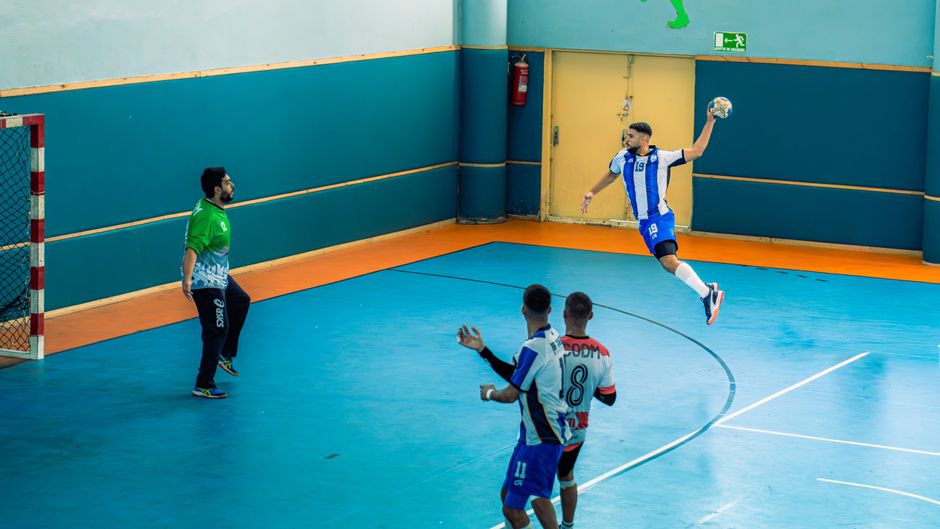
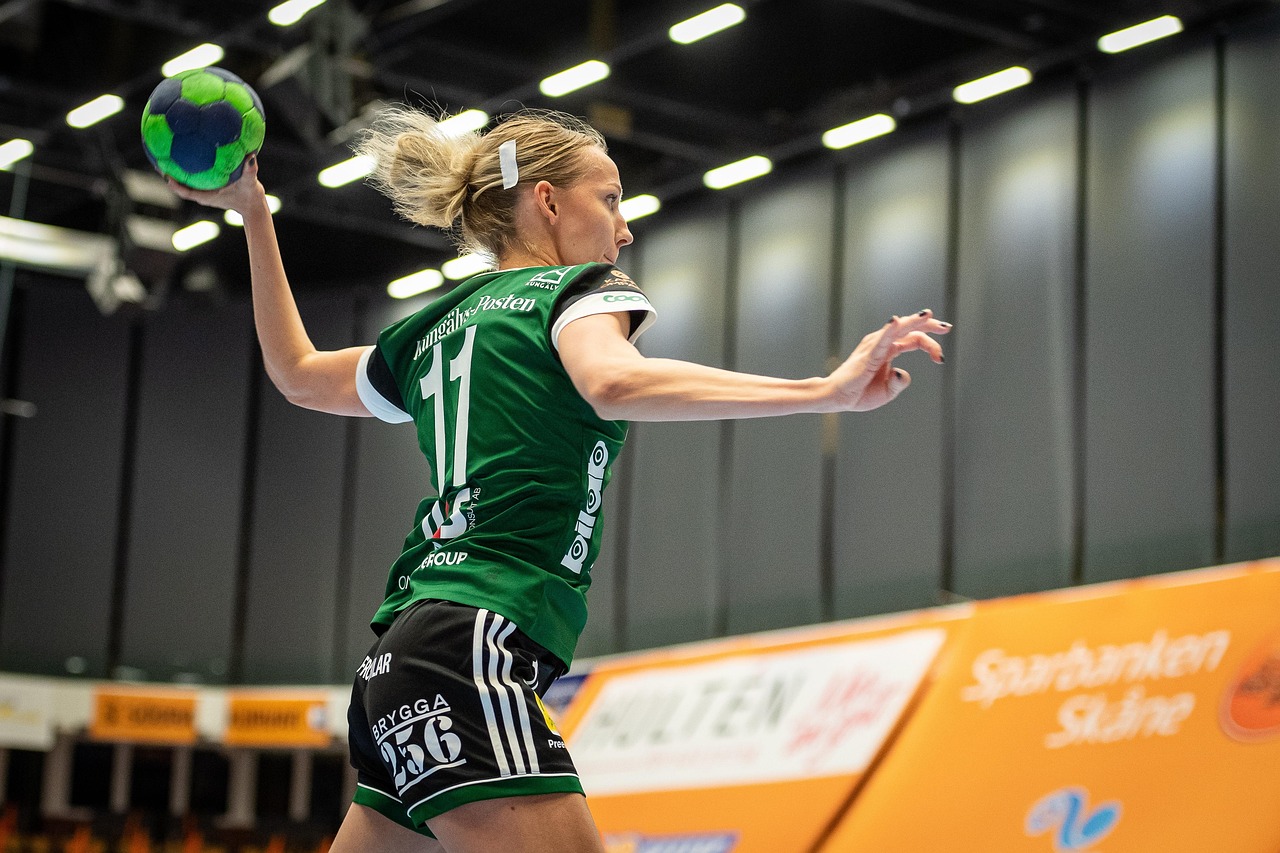
Two teams pass a ball with their hands and try to throw it into the other team’s goal. Players may take up to three steps with the ball and hold it for up to three seconds; to move further they dribble it like a basketball, but only once per possession. Only the goalkeeper may stand in the goal area, so attackers jump from outside the 6-meter line and shoot in mid-air before landing. Defenders may use their body and bent arms to block, but not push, hold, hit or trip.
Fouls give the other team a free throw from where the foul happened, or from the 9-meter line if it was closer to goal. If a defender illegally destroys a clear scoring chance, the attackers get a 7-meter throw: one shooter against the goalkeeper, like a soccer penalty. Punishments go up in steps: a yellow card warning, then 2-minute suspensions, during which the team plays a player short, and a red card for a disqualification; a third 2-minute suspension for the same player also means a red card. Teams that stall get a passive-play warning, and then have at most four more passes before they must shoot. Our handball rules page explains it all in plain words.
Each team plays with a goalkeeper, two wings, three backs (left, center and right; the center back is the playmaker) and a pivot, or line player, who battles among the defenders at the 6-meter line.
Handball at every level
Kids and youth
The IHF’s mini-handball is built for children from about 5–6 up to 8–9 years old: a smaller court, smaller goals, a soft, small ball, five players a side and a supervisor who teaches instead of a referee. Then come the youth ball sizes and shorter halves. In the US, youth handball runs through local clubs. A few examples: New York City Team Handball’s academy takes kids from 8 to 17, and the San Francisco CalHeat club runs middle school and high school leagues in the Bay Area. USA Team Handball fielded its first-ever U16 women’s national team in 2026, which qualified for the first IHF U16 Women’s World Championship. See our youth handball guide for ages, ball sizes and parents’ questions.
High school and college
Handball isn’t an NCAA sport, and few US high schools offer it, so most young Americans find it through clubs, PE classes or college. College handball is played by club teams, many at military academies and big universities. USA Team Handball’s College Nationals were held at NC State in Raleigh on April 24–26, 2026, where Army West Point beat Air Force 46-36 for its 18th straight men’s title and 40th overall since 1976, and West Point teams also won the women’s final.
Pro, national teams and the Olympics
The top club competition is the EHF Champions League. In 2025–26, 16 men’s clubs played a group phase before the Final4 in Cologne, which Barça won for the 12th time; in the women’s Champions League, Metz Handball beat Győri Audi ETO KC 31:29 in Budapest for its first title. National teams play IHF World Championships and continental championships.
Handball was first played at the Olympics outdoors in 1936; indoor handball joined in 1972 and the women’s tournament in 1976. The United States has never won an Olympic medal in handball. At LA28, 12 men’s and 12 women’s teams play at the Long Beach Arena from July 12 to 28, 2028, starting two days before the Opening Ceremony, and the US men’s and women’s teams are already qualified as hosts. More in our handball leagues and associations guide.
Adults, beach and wheelchair handball
Adult club teams around the US meet at USA Team Handball’s national championships, held in Bettendorf, Iowa, on May 14–17, 2026, with a men’s elite and a women’s open division. Beach handball, recognized by the IHF in 1994, is played barefoot on sand on a 27 × 12 meter court, three court players and a goalkeeper per side, in two 10-minute periods scored separately; creative and spectacular goals count double. US beach teams won gold at the 2026 North America and Caribbean championships. There’s also wheelchair handball, with its own US national team.
Sports health for handball players
Handball mixes sprints, sharp cuts, jump landings, hundreds of throws and constant contact, so injuries come with the game. At the London 2012 Olympics, handball was among the sports where athletes were most likely to get hurt. The good news is that some of the best injury-prevention research in sport was done with handball players. This section is general information, not medical advice. If you’re hurt, see a professional.
The most common handball injuries
- Knee and ankle injuries: a 2026 review of 16 studies with more than 11,000 players found the knee and ankle were injured most often, mostly bruises and sprains, and that injury rates were much higher in matches than in training.
- ACL tears: the anterior cruciate ligament usually tears when a player plants and cuts or lands from a jump shot. In a study of elite Turkish league players, ACL injuries were more common in women than men.
- Shoulder problems: overuse shoulder pain is very common in throwers. In a trial of 660 elite players, almost 1 in 4 in the usual-warm-up group had shoulder problems at any given time during the season.
- Contact injuries: at the Partille Cup in Sweden, the world’s largest youth handball tournament, cuts and wounds made up 29% of the injuries treated in 2024, almost as many as leg injuries.
- Concussions: in a Danish study of 945 club players aged 11–17, concussions happened about 0.8 times per 1,000 hours of handball, and more often in the U15 and U17 groups than in U13.
Injury prevention: warm-ups that work
Norwegian handball has led the way. In a trial of 1,837 players aged 15–17 from 120 clubs (BMJ, 2005), clubs that used a structured warm-up for running, cutting, landing, balance and strength had about half as many players with acute knee or ankle injuries: 4.8% against 8.6%. An earlier study of women’s league teams used a 15-minute balance and landing program; in the elite division, players who completed it had a much lower ACL injury risk than those who didn’t. For shoulders, the Oslo Sports Trauma Research Center’s shoulder program, done three times a week as part of the warm-up, lowered the risk of shoulder problems by 28% in elite players, though a 2025 review of several trials found the overall evidence for shoulder programs is still mixed. If your team has no structured warm-up, ask a coach, athletic trainer or physical therapist about one; our handball injuries page goes deeper.
Concussion: recognize and remove
The CDC’s HEADS UP program asks coaches and parents to watch for a player who looks dazed or confused or is suddenly slow to react, and to listen for headache, dizziness or balance problems, sensitivity to light or noise, feeling slowed down, trouble concentrating, irritability or sleep changes.
- Remove the player from play right away if you see signs after a knock to the head or body.
- Keep them out for the rest of that day and until a healthcare provider clears them. Don’t try to judge how serious it is yourself.
- Return slowly: returning to sport goes in steps and usually takes a week or more.
- Call 911 for danger signs: seizures, passing out with growing drowsiness, a headache that gets worse and won’t go away, or one pupil larger than the other or double vision.
When to see a doctor, physical therapist or athletic trainer
Don’t play through pain. See a professional for pain that doesn’t settle, swelling, a knee that “pops” or gives way, an ankle you can’t put weight on, a shoulder that hurts every time you throw, or any concussion signs. A sports medicine physician manages most sports injuries without surgery and refers to physical therapy or a surgeon when needed. A physical therapist guides rehab and the return to play. Athletic trainers are licensed or regulated health care professionals in all 50 states who work with physicians; if your school or club has one, start there.
Training and conditioning for handball
Off-season and preseason: handball fitness means repeated sprints and jumps with short recoveries, plus the strength to take and give contact. Build it gradually: interval running, agility and speed work (see our speed training equipment guide), leg, hip and core strength, and shoulder and upper-back strength for throwing. Researchers who studied elite handball describe frequent intensity changes, hard body contact and high technical demands, so practice with the ball counts as conditioning too. Our handball training page has the details.
In season: keep the injury-prevention warm-up going, keep some strength work, and watch the total throwing and jumping load, especially for young players on more than one team. Many athletes track sleep and recovery with a wearable (see HRV for athletes), and if your team tracks running loads, our GPS tracker guide compares the options.
Game day: the sports-nutrition position statement from the American College of Sports Medicine and two dietitians’ groups recommends a pre-exercise meal that is high in carbohydrate, moderate in protein, low in fat and fiber, made of familiar foods and eaten roughly 1–4 hours before. Gyms get warm and handball rarely stops for long, so bring a water bottle and drink at time-outs and half-time; on long tournament days many players add electrolytes (see our electrolyte powder guide). Our handball game day page covers tournament weekends.
Recovery after handball games
Recovery starts with the basics. Sleep comes first: the CDC, citing the American Academy of Sleep Medicine, recommends 9–12 hours a night for children 6–12, 8–10 hours for teens and 7 or more for adults. Then real food and fluids after the game; many players reach for a protein shake when a meal is hours away (see our protein powder guide). For a personal plan, the same position statement recommends a registered dietitian.
Simple tools help many players feel better between games: a foam roller or massage gun for tight calves, quads and upper back, and soft recovery shoes once the court shoes come off. They’re about comfort, not treatment; pain or swelling that doesn’t go away needs a professional. Our handball recovery page and recovery tools guide go further.
Gear for handball
- Indoor court shoes: the rules simply require sports shoes. Handball is played in grippy indoor court shoes made for side-to-side moves and landings.
- The right ball: size by age and sex (see the table above), and a resin or resin-free ball depending on your gym. Resin is the sticky wax players put on their fingers for grip; ask your club whether it’s allowed where you play.
- Knee and ankle supports: the IHF allows soft knee pads and sleeves, and ankle braces as long as hard parts are fully padded and the brace matches the sock color.
- Mouthguard: allowed if clear or a single color. Helmets, face masks and gloves are not allowed, even for goalkeepers.
Four picks for a handball bag: the Molten 5000, a hand-stitched synthetic-leather match ball that the listing calls the official ball of the IHF, here in size 3 (about $82, seen October 2026); Rehband knee pads, 5 mm padded neoprene sleeves made for handball and volleyball floors; the McDavid 195, a lace-up ankle brace with figure-8 straps and no hard parts; and the OOFOS OOahh Slide from our recovery shoes guide for after the final whistle. The full list is on our handball gear page.
Molten 5000 Handball (H3A5000)
- Size 3, hand-stitched
- Official IHF ball (listing)
- About $82
Rehband Handball Knee Pads
- 5 mm padded neoprene
- For handball and volleyball
- About $70 a pair
McDavid 195 Ankle Brace
- Lace-up with figure-8 straps
- No hard parts
- About $35
OOFOS OOahh Slide
- OOfoam slide
- APMA Seal of Acceptance
- Machine washable
For more after the game, browse Recovery & Regeneration and Training & Performance.
Handball FAQs
How long is a handball game?
Sixty minutes of playing time (two 30-minute halves with a 10-minute break) for players 16 and older. Youth games are 2 × 25 minutes at ages 12–16 and 2 × 20 minutes at ages 8–12. Tied knockout games go to two 5-minute overtime halves, then a second overtime and, if the competition uses one, a 7-meter shootout.
How many players are on a handball team?
Seven on the court per side, one of them the goalkeeper, and up to 16 on the team sheet. Substitutes can come in at any time through their team’s substitution zone, as often as the coach likes.
Is team handball the same as American handball?
No. American handball is a wall game in which players hit a small ball against a wall with their hands, usually wearing gloves, run by the US Handball Association. Team handball, also called Olympic handball, is the seven-a-side court game with goals described on this page.
Is handball a dangerous sport?
It’s a contact sport with real injury risk, mostly knee and ankle sprains, bruises, shoulder overuse and some ACL tears and concussions. Structured warm-ups have cut knee and ankle injuries in youth players in research trials, and good coaching, the right gear and listening to pain go a long way.
Will the US play handball at the LA28 Olympics?
Yes. As hosts, the US men’s and women’s teams are automatically qualified for the 12-team tournaments at the Long Beach Arena, July 12–28, 2028.
How do I find a handball team near me?
Start with USA Team Handball’s club directory and collegiate club list. Many clubs welcome complete beginners, and several run youth programs; if you live near a college with a club team, that’s often the easiest way in.
Handball rewards speed, courage and teamwork, and the players who last are the ones who warm up well, protect their knees, ankles and shoulders, sleep and listen to pain. Keep exploring: our recovery tools guide, knee sleeves and ankle braces, Nutrition & Supplements for tournament days, basketball and water polo for two cousins of the game, and every other sport on our sports hub.