This article contains affiliate links: if you buy through them we may earn a commission, at no extra cost to you. Read our affiliate disclosure.
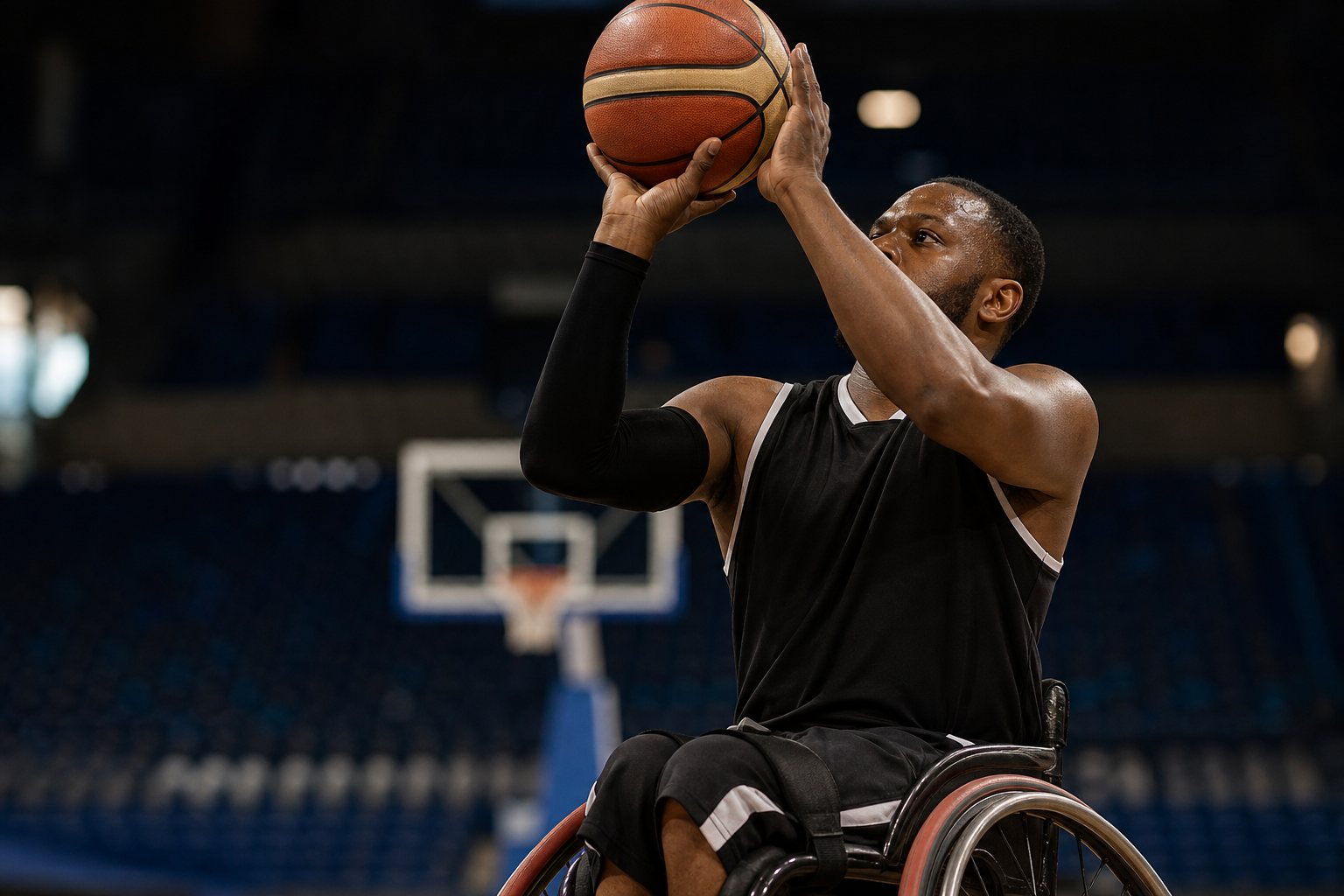
A fast break in wheelchair basketball sounds different. There are no sneakers squeaking, but the rubber of the tires on the hardwood, the clack of chairs touching and the rattle of a ball on the rim. A guard pushes twice, bounces the ball, pushes twice again, then whips a pass to a teammate cutting to the key. The same hoop height, the same court and the same three-point line as the standing game, played from a sports chair. Wheelchair basketball is basketball played from sports wheelchairs by athletes with physical impairments, with the chair treated as part of the player, and it is one of the most popular Paralympic sports.
Wheelchair Basketball guides: what do you need?
New to wheelchair basketball? Start with the first card. Everything here is general education, not medical advice.
History & Origins of Wheelchair Basketball
Wheelchair basketball grew out of rehabilitation after the Second World War. The International Wheelchair Basketball Federation (IWBF) says it was first played in 1945 by war veterans at Corona Naval Station in California and at Framingham, Massachusetts. Around the same time, British veterans at Stoke Mandeville Hospital, led by Dr Ludwig Guttmann, were playing wheelchair netball (IWBF history). The International Paralympic Committee gives 1948 for the British start and notes that American teams at the 1955 International Stoke Mandeville Games pushed the focus from netball to basketball (Paralympic.org). Sources therefore differ slightly on the exact British year, and we give both.
The sport then moved quickly from hospital courts to national and world competition. It was one of the eight sports at the first Paralympic Games in Rome in 1960.
- 1945: First played by US veterans at Corona Naval Station (California) and Framingham (Massachusetts).
- 1949: First national tournament, in Illinois, with six teams; the US National Wheelchair Basketball Association is formed.
- 1955: The US Pan Am Jets play at the International Stoke Mandeville Games and shift interest from netball to basketball.
- 1960: Wheelchair basketball is an official sport at the first Paralympic Games, Rome (96 athletes from 12 countries across all eight sports, per the IPC).
- 1973: First unofficial men’s World Championship, Bruges, Belgium (European teams only).
- 1975: First official men’s World Championship, Bruges; Israel win.
- 1990: First women’s World Championship, St. Etienne, France; the USA win.
Official results and records
We do not publish a recent-champions or records table for wheelchair basketball, because we have not confirmed results on an official results page. The IPC reports that the USA is the most successful Paralympic nation with 10 men’s and four women’s golds, and that the Netherlands won women’s gold at Tokyo 2020 and Paris 2024 (Paralympic.org). For full results, use the official sources:
- Paralympic.org: wheelchair basketball
- International Wheelchair Basketball Federation (news, events, stats)
Legends of the Sport
Athletes profiled by the International Paralympic Committee. This is not a ranking (Paralympic.org). We have left out others we could not confirm on an official page.
- Jiske Visser (Netherlands): has played at five Summer Paralympics, winning two golds and two bronzes, and chaired the IPC Athletes’ Council at Paris 2024.
- Patrick Anderson (Canada): a three-time Paralympic champion who has announced his retirement.
- Bridie Kean (Australia): a two-time Paralympian who has spoken about what Sydney 2000 meant for disability sport.
Also in the story: Dr Ludwig Guttmann (Stoke Mandeville rehabilitation pioneer) is a founder-figure of the Paralympic movement, not a player (IWBF).
How we keep this current: we re-check facts after each major championship. Spot an error? See our editorial policy.
Wheelchair basketball at a glance
| What it is | Five-a-side basketball played in sports wheelchairs on a standard court, with a 10-foot (3 m) hoop. |
|---|---|
| How it is won | Most points. A free throw is 1 point, a basket inside the three-point line 2 and a basket beyond it 3. The offense has 24 seconds to attempt a shot. |
| Game length | Four 10-minute periods, with extra periods if tied. |
| Participants and levels | Two teams of five on court, up to 12 players on a team. Youth, adult, collegiate and Paralympic levels. Players have a classification of 1.0 to 4.5 points. |
| Governing bodies | International Wheelchair Basketball Federation (IWBF) worldwide; National Wheelchair Basketball Association (NWBA) in the US. |
| Games | One of the eight sports at the first Paralympics in Rome in 1960; men’s and women’s tournaments at Paris 2024. |
How it works: rules in plain words
The rules are basketball’s rules, adapted for the chair. The IWBF’s basic rules explain the biggest differences:
- The pushing rule: a player may push the chair while dribbling, but after every two pushes must pass, shoot or dribble again, or it is a traveling violation. There is no double-dribble rule, so a player may stop dribbling and start again.
- The chair is part of the body: contact rules apply to the chair as to a player. Players must stay seated: lifting the legs to gain an advantage, or lifting out of the chair, is a technical foul, and legs and feet may not touch the floor to steer.
- Fouls: a player with five personal fouls must be replaced.
One timing note: the offense has 24 seconds to attempt a shot, and if it neither scores nor hits the rim in that time, possession passes to the other team. For the standing game’s rules compare our basketball rules page.
Classification: the 14-point rule
Each player is given a classification from 1.0 to 4.5 in steps of 0.5; lower numbers mean more impairment and higher numbers more functional capacity in the game. The IWBF explains that examiners watch players on court, looking at how well each sits upright, leans in each direction, passes and shoots, because the system is based on function, not on a medical diagnosis. The rule that balances the teams: the five players on court may not total more than 14 points. A team can therefore mix players of all classes, and every player has a role. The IWBF says the aim is that no player is advantaged or disadvantaged against others in the same class.
Who plays, and at what level
In the US. The NWBA was founded in 1949 and lists divisions for men, women, high performance, collegiate (Divisions I, II and III), junior and prep, with 225-plus teams and nearly 3,000 members in 42 states. Look for a team through the NWBA’s “Find a Team” page or your local adaptive-sports organization. Ask each program whether it welcomes beginners, and check the rules of any league you want to join.
Paralympic status, by edition. The sport began in 1945 in two US veterans’ hospitals and was one of eight sports at Rome 1960. At Paris 2024, 192 athletes (96 men and 96 women) from 10 countries competed in two medal events, according to Paralympic.org. The Netherlands women retained their title by beating the USA; paralympic.org says the USA men’s team has won gold at the last three Games, and the USA has won 10 men’s and four women’s gold medals since 1960. Wheelchair basketball is on the initial 22-sport program for Los Angeles 2028 (15 to 27 August 2028). The IWBF also runs 3×3 events; check the official programme for what is on offer at any Games.
Physical demands
Players push their chairs, dribble, shoot and defend all game, so the work falls on the shoulders, arms, upper back and trunk, with the trunk’s role depending on classification. A 2026 systematic review of 22 studies, mainly on wheelchair basketball, rugby and tennis, reported links among trunk function, functional classification, wheelchair mobility and upper-body measures. Sensors are now used to measure matches: in a study of 31 female players across 13 international games, researchers found that how speed zones are defined changes how much high-intensity movement a game seems to contain. In short, it is repeated sprints, stops and turns, with the chair setup affecting how the body moves. See basketball training and ask a coach who knows chair sports.
Health and safety in wheelchair basketball
This is general information, not medical advice, and the right approach depends on the athlete. See a sports medicine doctor, physical therapist or athletic trainer who knows chair sports.
Upper-body injuries
Two studies give a picture. At the London 2012 and Rio 2016 Paralympics, a sub-study of 430 wheelchair basketball athletes recorded 75 injuries in 66 athletes, a rate of 12.5 per 1,000 athlete days; the upper limb was the most injured region (55 percent), and 88 percent of Rio 2016 injuries involved no time loss. At the 2018 Wheelchair Basketball World Championships, medical staff from 11 teams (132 players) reported 100 injuries; most affected the neck (16 percent), upper back (15 percent) and shoulder (14 percent), the most common diagnosis was muscle spasm (25 percent) and the most common cause overuse (52 percent). Only eight were time-loss injuries. The authors of the first study suggest that daily wheelchair use outside sport adds load and limits rest for the upper limb. Shoulder pain that lingers, numbness or weakness in the arm or hand needs a professional, not more games.
Falls, contact and concussion
Chairs touch, and chairs can tip. The rules count the chair as part of the player, so legal and illegal contact is judged on the chair. The CDC’s HEADS UP program lists headache, dizziness, confusion and balance problems as signs of concussion; anyone who hits their head should stop and see a healthcare provider before returning, and call 911 for danger signs such as repeated vomiting or a seizure. Whatever your sport chair, have it fitted and checked by a qualified person. We did not find a source that sets out the chair measurements for the sport, so check your league’s rulebook.
Training, recovery and nutrition
Sleep comes first: the CDC recommends at least 7 hours for adults and 8 to 10 for teens. Tools such as a foam roller or a small massage gun are about comfort, not treatment, and may not suit every body; talk with your clinician. See basketball recovery and nutrition and supplements.
Gear
The key piece of equipment, the sports chair, is custom-fitted to the player and is not something to buy off a list; talk with your team, a coach or a seating specialist. Beyond the chair you need a ball. The IWBF basic rules page does not specify the ball, so check your league. A player might also want gloves for the push rims, which are personal and we do not recommend a model, and a way to look after tired shoulders.
Three picks: the Wilson Evolution indoor game ball, the Theragun Mini massage gun and the TriggerPoint GRID 1.0 foam roller. See our massage gun guide.

Wilson Evolution Game Basketball
- Microfiber composite cover
- Cushion core
- Indoor

Theragun Mini
- Compact massage gun
- Portable
- Comfort tool, not treatment
$219.99 at Amazon, as of Nov 17, 2026 01:07 UTC
Check price on Amazon
TriggerPoint GRID 1.0 Foam Roller
- Firm roller
- Back and shoulder work
- Comfort tool
Related sports
Parent: basketball. Siblings: 3×3 basketball, wheelchair rugby, Para athletics, Para swimming, sitting volleyball.
Wheelchair basketball FAQs
Is the hoop lower in wheelchair basketball?
No. The hoop is at the standard height of 3 meters, with the same court and three-point line.
How do players dribble in a chair?
They push the chair and dribble at the same time, but after every two pushes they must pass, shoot or dribble again. There is no double-dribble rule.
What does 14 points mean?
Each player has a classification of 1.0 to 4.5; the five players on court together cannot add up to more than 14.
Can people without disabilities play?
We did not confirm eligibility rules from the sources used here. Ask the team or league, and check the NWBA or IWBF rules for the level you want.
How do I find a team?
Use the NWBA’s “Find a Team” page, or contact a local adaptive-sports organization or parks and recreation program. The NWBA lists junior and prep divisions for younger players.
Sources
- Paralympic.org: wheelchair basketball
- IWBF: basic rules of wheelchair basketball
- IWBF: what is classification
- National Wheelchair Basketball Association: about
- Paralympic.org: LA28 initial sport programme
- Brombacher et al. 2025, wheelchair basketball injuries at London 2012 and Rio 2016 (PMC)
- Hollander et al. 2020, injuries at the Wheelchair Basketball World Championships 2018 (PubMed)
- Choudhary et al. 2026, systematic review of wheelchair court sports (PMC)
- Bailey et al. 2026, match load in female wheelchair basketball (PMC)
- CDC HEADS UP: signs and symptoms
Keep exploring: the basketball hub, basketball injuries, basketball gear, our recovery tools guide, and every other sport on the sports hub.