This article contains affiliate links: if you buy through them we may earn a commission, at no extra cost to you. Read our affiliate disclosure.
It is a quarter past six on a Saturday and the club ride is rolling out of the parking lot. Before anyone clips in, somebody squeezes the brake levers, somebody else flicks a tire with a thumb, and the rider in the new kit gets told, kindly, that her saddle looks a little high. Those two minutes are cycling injury prevention: the habits around a rider, bike fit, a bike that works, a sensible build-up in miles, strength work, and choices about light, traffic and weather, that aim to lower the chance of getting hurt. They can lower the odds. They cannot promise a thing.
Quick answer: The American Academy of Orthopaedic Surgeons (AAOS) advises riders to wear a helmet that fits, check the bike before every ride, have a bike that fits the rider (a professional fit if you ride often), be seen with lights and bright clothing, and pace themselves. Add one or two strength sessions a week and build your miles gradually. See a sports medicine doctor, physical therapist or athletic trainer if knee, back or hand pain lasts more than a week or two or changes how you ride, and call 911 after any crash with loss of consciousness, neck pain or numbness.
General information, not medical advice. This page is about lowering risk. For what each cycling injury looks like and when to get it checked, see our cycling injuries guide.
Know where the risk sits
Cyclists face two different kinds of risk, and each needs its own prevention. The first is the crash. The US Consumer Product Safety Commission reported 405,688 emergency department-treated injuries related to bicycles and accessories in 2023, according to AAOS. The second is the slow kind: in a study of 109 professional road cyclists, 45% of overuse injuries were in the low back and 23% in the knee (Clarsen, Krosshaug and Bahr, American Journal of Sports Medicine, 2010). A rider can have either one, so this page covers both.
Warm up and check the bike first
Unlike soccer or basketball, cycling has no widely tested named warm-up program such as the FIFA 11+, so be wary of anyone who says there is one. What exists is general guidance. Many riders spin easily for 10 to 15 minutes, with a few short pickups on the way to a hard ride or race. This is common practice, not a published trial. Race-day timing is in our race day guide.
The check matters more than the stretch. AAOS tells riders to inspect brakes, tires and gears regularly and not to ride a bike that is not in good condition. A quick version: squeeze the brakes, spin each wheel, check the tires and make sure the quick-release or thru-axle is tight. The League of American Bicyclists calls this being “ride ready”.
Bike fit and riding technique
Fit is the nearest thing cycling has to a technique fix, because a rider turns the pedals roughly 5,000 times in an hour at an 85 rpm cadence, and a small setup error repeats every turn. AAOS says an appropriately sized frame, handlebar height and seat height improve control and reduce the risk of overuse injuries, and suggests a professional fit for riders who ride regularly. What the research adds:
- Low back. A 2026 systematic review (Barrajon et al., Cureus) found three studies, one randomized trial and two others, and all reported less low back pain after an individualized bike fit. Only three studies, short follow-up and varied methods mean it is encouraging, not settled.
- Knees and saddle height. A review of saddle height found that a 5% change in height changed knee movement by 35%, and the authors suggested a knee bend of 25 to 30 degrees at the bottom of the pedal stroke (Bini, Hume and Croft, Sports Medicine, 2011). A 2018 review of knee pain in cyclists found riders with pain showed larger knee-inward movement, but the studies compared riders after the pain began, so they cannot say what caused it (Bini and Flores Bini, 2018).
- Hands and contact points. AAOS advises changing riding positions to relieve pressure points and wearing padded gloves. Handlebar palsy (numb ring and little fingers) is linked to long days with unchanged hand positions, according to British Cycling physiotherapy guidance.
- Saddle pressure. NIOSH, the US workplace safety institute, found that no-nose saddles reduced groin pressure in male bike patrol officers.
Build your miles gradually
The 2016 IOC consensus statement on load in sport (Soligard et al.) makes the general point that quick jumps in training load are risky and that a gradual, planned build is part of protecting athletes. It gives no cycling number, and neither do we. AAOS says simply to pace yourself, use the gears to control effort, and see a doctor before starting an exercise program. How to structure a season is in our cycling training guide, and what to do afterwards is in cycling recovery.
Strength and conditioning
Strength work is now widely recommended for riders. A 2026 narrative review (de Pablos et al., Scandinavian Journal of Medicine & Science in Sports) found that one or two sessions a week, with 3 to 5 compound lower-body lifts, helped key performance measures and did not appear to cause unwanted bulk. It examined performance, not injury rates, so it does not show strength training prevents injury. A 2025 review of low-impact athletes, including cyclists, found a higher risk of low bone density and said resistance training and jumping were promising but evidence was limited (Florvag et al., BMC Musculoskeletal Disorders). The CDC’s adult guideline of at least two days a week of muscle-strengthening is a safe floor for most adults. A physical therapist can tailor a plan to your back, knees and hips, and many riders keep a simple loop band at home for glute and hip work.
Roads, weather and light
For most crash injuries the prevention is about the road and the riders on it. The National Highway Traffic Safety Administration (NHTSA) counted 1,166 pedalcyclists killed in 2023, and 81% of those deaths were in urban areas. In a Canadian review of 83 fatal cyclist collisions, rural crashes more often involved high speeds and darkness, while urban ones more often involved intersections and heavy vehicles (Charyk Stewart et al., Injury Epidemiology, 2025). So what changes the odds depends on where you ride:
- Traffic. AAOS advises riding with traffic, riding defensively, watching for opening car doors, picking quieter streets over the most direct route, and avoiding headphones and phones.
- Being seen. AAOS says to wear bright fluorescent colors at night, with rear reflectors and a headlight and taillight visible from 500 feet. Radar tail lights exist, but we know of no trial showing they prevent crashes.
- Surfaces. AAOS warns against underestimating road conditions: potholes, rocks, wet or uneven surfaces and wildlife. On gravel and off-road, expect looser grip and plan for falls, not just avoid them (see gravel cycling and cyclocross).
- Heat. The National Athletic Trainers’ Association (NATA) says athletes should acclimatize over 7 to 14 days and that exertional heat stroke needs fast cooling, with cold-water immersion the most effective method. AAOS suggests a full bottle each hour on the bike. See race day for fueling and the UCI heat protocol.
- Lightning. NATA’s rule is “When Thunder Roars, Go Indoors”, then wait 30 minutes after the last thunder.
Helmets, clothing and fit
This is the best-supported piece of protective equipment in the sport. A meta-analysis of 55 studies (Olivier and Creighton, International Journal of Epidemiology, 2017) found helmet use went with about half the odds of head injury and about 69% lower odds of serious head injury, and AAOS repeats the figure of nearly 70% for serious head injury and 65% for fatal head injury. These are observational studies, so they show a strong link, not proof for any one crash. The US Consumer Product Safety Commission (CPSC) requires bike helmets sold in the US to meet 16 CFR 1203, and it says no helmet has been proven to prevent concussion.
- Fit. According to CPSC and AAOS, a helmet should sit level, fit snugly without blocking your vision and not move around. Do not add stickers or accessories.
- After a hit. The CPSC label says impact damage may not be visible, so replace a helmet that took a hit.
- Ratings and MIPS. The Virginia Tech Helmet Lab rates helmets by simulated impact and suggests choosing 4 or 5 stars. Systems like MIPS are described by the maker as reducing rotational energy in certain impacts; we do not claim a result for any brand.
- Race rules. USA Cycling requires a helmet at its permitted events, and full-face helmets in downhill mountain biking (check the current rulebook).
- The rest of the kit. AAOS advises padded gloves, padded shorts for longer rides, real shoes (never flip-flops or clogs), sunscreen and no loose clothing that can catch in the chain.

Giro Register MIPS Helmet
- MIPS rotational liner
- Universal adult fit (54-61 cm)
- Dial fit system
$39.99 at Amazon, as of Nov 17, 2026 02:07 UTC
Check price on Amazon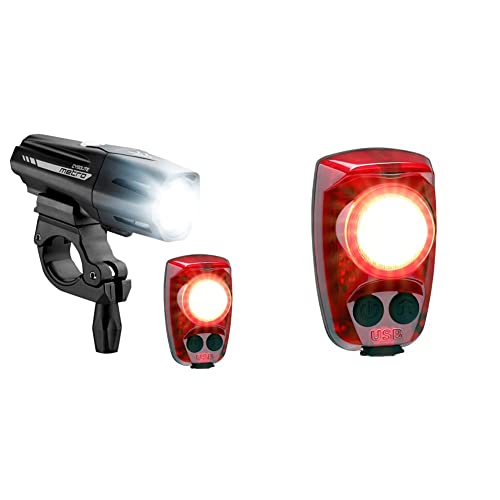
Cygolite Metro Plus 800 + Hotshot Pro 150
- 800-lumen headlight
- 150-lumen taillight
- USB rechargeable
Choosing and sizing gear is covered in our cycling gear guide.
Young riders
The American Academy of Pediatrics (AAP) says a child needs a bike that fits now, not one to grow into, and that a helmet goes on for every ride, even near home. For young riders who train and race, the AAP (Brenner 2016) recommends 1 to 2 days off each week and time away from a single sport during the year. Sizing and school mountain bike leagues are in our youth cycling guide.
What prevention cannot do
Most crashes involve other people, a patch of gravel or a split-second mistake, and most overuse comes from thousands of repeated pedal strokes. A perfect fit, a good helmet and bright lights make a bad day less likely or less severe, but they do not make you safe. The knee and back evidence above comes from small or retrospective studies, so it is a guide, not a guarantee.
When to see a professional
- Call 911: a rider who lost consciousness, is confused or vomiting, has neck or back pain, numbness or weakness after a crash, or has a visibly deformed limb. Do not move someone with neck pain.
- See someone within a day or two: a suspected concussion (the CDC says to remove the person from riding and have a provider decide on return), a sagging shoulder that cannot lift after a fall, or a deep or dirty road rash wound.
- Book a visit soon: knee, back, neck or hand pain that lasts more than a week or two, that changes how you ride, or that shows up at night. Numbness in the ring and little fingers or in the groin that keeps coming back is also worth a visit. These timeframes are general guidance, not research thresholds.
A sports medicine doctor diagnoses, a physical therapist plans the strengthening and the return to riding, and a bike fitter with a clinician’s input can adjust the bike. For injury detail, see cycling injuries.
Cycling injury prevention: FAQs
Does a bike fit prevent injuries?
AAOS says a correctly sized bike improves control and reduces the risk of overuse injuries. A 2026 review found all three studies on individualized fitting reported less low back pain, though the studies were few and short. Ask a PT or a fitter you trust.
How much does a helmet help?
A 2017 meta-analysis found helmet use went with about 69% lower odds of serious head injury, and AAOS cites nearly 70%. These are links from observational studies. The CPSC says no helmet has been proven to prevent concussion.
Should cyclists lift weights?
A 2026 review supports one or two sessions a week for performance and likely bone health, and the CDC advises at least two days a week of muscle-strengthening for adults. None of it proves fewer injuries, so ask a PT if you have knee or back pain.
Why do my hands go numb on long rides?
Pressure on the ulnar nerve is the usual suspect, according to British Cycling physiotherapy guidance, and AAOS recommends padded gloves and changing hand positions. If numbness keeps coming back or you feel weakness, see a doctor.
Sources
- AAOS OrthoInfo, Bicycle Safety
- Clarsen, Krosshaug and Bahr, overuse injuries in professional road cyclists, 2010
- Effects of bike-fitting on lower back pain in cyclists: a systematic review, Cureus, 2026
- Bini, Hume and Croft, cycling saddle height review, 2011
- Bini and Flores Bini, knee pain in cyclists: a systematic review, 2018
- NIOSH, No-nose saddles (Publication 2009-131)
- British Cycling, hand and wrist pain on the bike
- Soligard et al., IOC consensus statement on load and injury, 2016
- Resistance training for cyclists, Scand J Med Sci Sports, 2026
- Florvag et al., bone health in low-impact athletes, 2025
- CDC, Physical Activity Guidelines for Adults
- NHTSA, Traffic Safety Facts: Bicyclists and Other Cyclists, 2023 data
- Safe system approach to preventing cyclist fatalities, Injury Epidemiology, 2025
- League of American Bicyclists, Rules of the Road
- NATA, Exertional Heat Illnesses, 2015
- NATA, Lightning Safety, 2013
- Olivier and Creighton, bicycle injuries and helmet use, 2017
- CPSC, Which Helmet for Which Activity?
- Virginia Tech Helmet Lab, bicycle helmet ratings
- CDC HEADS UP, signs and symptoms of concussion
- USA Cycling rulebook (helmet requirement)
- AAP HealthyChildren.org, Bicycle Safety: Myths and Facts
- AAP clinical report, sport specialization, Brenner 2016
General information for education only, not medical advice. It does not replace a visit with a doctor, physical therapist or athletic trainer. See how we write and check our pages in our editorial policy.