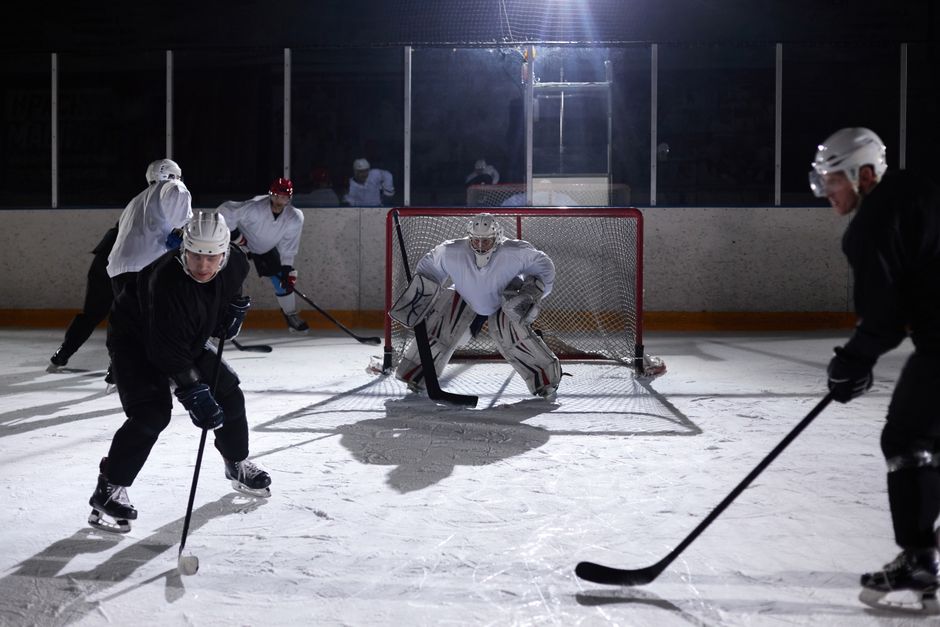
This article contains affiliate links: if you buy through them we may earn a commission, at no extra cost to you. Read our affiliate disclosure.
Ten minutes before a 6 a.m. practice, the locker room smells of wet gloves and tape. A mom kneels to check that her daughter’s neck guard sits snug under the collar, a coach hands out mouthguards, and a defenseman laces his skates a notch tighter than last week. Nobody calls it a safety routine, but that is what it is. Ice hockey injury prevention is the set of habits around a player, from the helmet and the rules to hip strength, skate fit and how checking is taught, that aim to lower the chance of getting hurt on the ice. They can lower the odds. They can’t promise anything.
Quick answer: The best-supported steps in hockey are to remove any player with concussion signs from the ice, keep body checking out of the youngest age groups, wear a certified helmet with a full face shield, a mouthguard and (for most players under 18) a neck laceration protector, and build hip and groin strength before the season. See a sports medicine doctor, physical therapist or athletic trainer if a hit to the head causes any symptoms, a groin or hip ache keeps coming back, or a joint swells or gives way.
General information, not medical advice. This page is about lowering risk. For what each injury looks like and its warning signs, see our ice hockey injuries guide.
Warm-up: what we can and can’t say
Soccer has FIFA 11+, a warm-up with trial evidence behind it. The sources reviewed for this page include no hockey-specific warm-up program with injury-rate results, so we name none and promise no minutes. Ask your coach, PT or athletic trainer to build one that gets the legs, hips and trunk moving before you step on the ice, with extra attention to the hips and groin (below). Our hockey training page covers how that fits into a week.
Concussion: recognize and remove
You can’t prevent every blow to the head, so the rule is about the response. The CDC’s HEADS UP program tells coaches and parents to recognize and remove: if a player looks dazed, moves clumsily, or reports headache, dizziness, nausea or vision problems after a hit to the head or body, take them off the ice right away. When in doubt, sit them out. They stay out for the rest of the day and until a healthcare provider clears them, and return is gradual, often a week or more. Call 911 for danger signs such as a headache that keeps getting worse, repeated vomiting, seizures, growing drowsiness, slurred speech or unequal pupils.
Youth concussion laws now exist in every US state, so check your state’s and league’s rules on removal and return.
Body checking: the rules that lower risk
Rules are prevention too, and checking is where hockey has the strongest evidence. In a study of 11- and 12-year-olds in Canada (Emery and colleagues, JAMA 2010), players in a league that allowed body checking had about three times the risk of game injuries and almost four times the risk of concussion. When Hockey Canada stopped allowing body checking at the Pee Wee level (ages 11 to 12) in 2013, a follow-up study (Black and colleagues, British Journal of Sports Medicine 2017) found a 50% lower injury rate and a 64% lower concussion rate in Pee Wee players in Alberta.
- USA Hockey: body checking is not allowed in games at 12 & under, or in any girls’ and women’s classification, and is introduced at 14U (Rule 604).
- Hockey Canada: checking is not allowed below the Bantam level and begins at U15, taught in steps, with non-checking house-league options.
- AAP: the American Academy of Pediatrics recommends keeping checking to the top competitive boys’ levels, no earlier than age 15, and the Canadian Paediatric Society says no checking in recreational hockey at any age.
Even without checking, hockey carries risk: in NCAA women’s hockey concussion was still the most common game injury (Agel and colleagues, 2007). See our youth hockey page and rules page.
Progressive training load
The 2016 International Olympic Committee (IOC) consensus statement on load and injury names poor load management as a major injury risk factor, including rapid jumps in load and crowded calendars. In hockey that looks like a first week of three practices after a quiet summer, or a school team, a club team and a weekend tournament at once. For youth players, USA Hockey’s age-by-age plan (ADM) sets ice sessions per week by age, from 2 to 3 for 8 & under up to 5 to 6 for 18 & under. The American Academy of Pediatrics warns that intense single-sport specialization and more weekly hours than your age in years are linked to more overuse injury (Jayanthi and colleagues, American Journal of Sports Medicine 2015). Our sources give no fixed weekly increase, so ask a coach or athletic trainer to plan the ramp-up.
Hip, groin and neck conditioning
Groin and hips. This is hockey’s best-studied strength target. In an NHL team study (Tyler and colleagues, American Journal of Sports Medicine 2001), preseason adductor (inner-thigh) strength was 18% lower in players who later strained a groin, and players with adductor strength under 80% of their abductor strength were 17 times more likely to get one. After a six-week strengthening program for at-risk players (Tyler, 2002), adductor strains fell from 11 in the two seasons before to 3 in the two seasons after. That was a small, team-level study, not a guarantee. In soccer, the Copenhagen adduction exercise was linked to a 41% lower risk of groin problems (Harøy and colleagues, British Journal of Sports Medicine 2019); see our soccer injuries page. A coach, PT or athletic trainer can test your strength and add adductor work before the season. Deep hip or groin pain that returns when you skate hard should be looked at (hip impingement is covered on the injuries page).
Neck and shoulders. We found no hockey study showing that neck strengthening lowers concussion risk, so we make no such claim. The shoulder does take the hit in many checks: in NCAA men’s hockey, upper-body injuries made up 42% of body-checking injuries (Boltz and colleagues, Clinical Journal of Sport Medicine 2024), and the American Academy of Orthopaedic Surgeons (AAOS) says a fall directly onto the shoulder is the most common cause of an AC separation. Well-fitted shoulder pads come first; strength work is a conversation for your PT or trainer.
Protective equipment and fit
What the rules require. These are standards and rules you can verify, so start here.
- Helmet and face: USA Hockey Rule 304 requires a helmet certified by the Hockey Equipment Certification Council (HECC) for all players except adults, plus a full facemask for every player below the adult level. Modifying a helmet can void its certification, according to USA Hockey, and the HECC sticker carries a “void after” date (retailer and association guides say about 6.5 years from manufacture).
- Full shield versus half visor: in a study of 642 college players (Benson and colleagues, JAMA 1999), those in half shields had 2.31 times the risk of facial cuts and 9.90 times the risk of dental injuries compared with full shields, with no added concussion or neck injury risk from the full shield.
- Mouthguard: USA Hockey requires a colored mouthpiece from 12 & under through 18 & under, and recommends a dentist-fitted one. A mouthguard protects teeth and lips. No mouthguard has been shown to prevent concussion, so don’t buy one for that reason.
- Neck laceration protector: required by USA Hockey since August 1, 2024 for all players in games and practices except adults, who are strongly encouraged to wear one. For 2025-29 the guard must be HECC-certified, with BNQ-certified guards still accepted through the 2026-27 season. The IIHF requires them in all its competitions. Cut-resistant socks, sleeves and base layers are recommended by USA Hockey. The rule followed a US review of catastrophic hockey lacerations that found skates caused 24 of 26 cases (DeLong and colleagues, Sports Health 2025).
- Other required items: the NFHS high school list also includes gloves, padded pants, a cup or pelvic protector, shin guards, elbow pads and shoulder pads.
What is test data and what is maker talk. Virginia Tech’s Helmet Lab published independent youth hockey helmet ratings in December 2025: 33 helmets, 10 of them five-star, tested in impacts with the facemask on. Even the lab says that any player can sustain a head injury with even the very best head protection, so a star rating is a way to compare helmets, not a promise. Package words such as “pro-level” are marketing; rely on the certification sticker and your league’s rule.
Examples that match the rules: the Bauer RE-AKT 55 helmet combo was one of the five-star helmets in the Virginia Tech youth ratings; the Bauer NLP7 is a BNQ-certified adult neck guard, so check whether your league wants HECC; and the Shock Doctor Gel Max is a mouthguard sold in youth and adult sizes. More choices are on our hockey gear page.
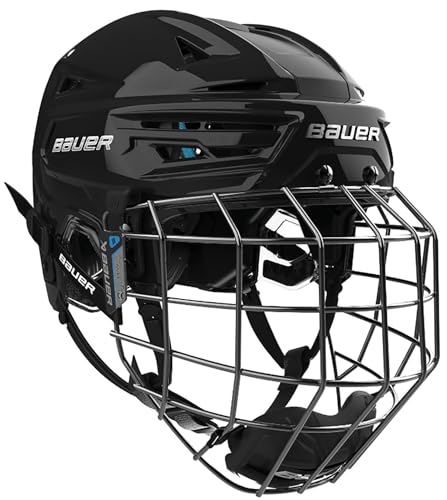
Bauer RE-AKT 55 Helmet Combo with Facemask
- Certified helmet with Bauer X facemask
- Sized S to L
- Five-star in Virginia Tech youth ratings

Bauer NLP7 Neck Guard (Adult)
- Adult, 13.5-17 in neck
- BNQ certified
- Padded, adjustable collar
$15.99 at Amazon, as of Nov 17, 2026 01:07 UTC
Check price on Amazon
Shock Doctor Gel Max Mouthguard
- Youth and adult sizes
- Gel-Fit liner
- Detachable helmet strap
$11.99 at Amazon, as of Nov 17, 2026 01:07 UTC
Check price on AmazonSkate fit. No standards body or study in our sources covers skate fit, so this is common retailer and hockey-association advice, not research: skates are usually bought snug, with the toes just brushing the front, the heel held back, and a firm but not painful fit through the ankle. Sizes differ from shoe sizes, so have a hockey shop fitter measure you.
The rink: where we stay silent
Our sources include no authoritative data on rink air quality, boards and glass, or ice conditions, so we make no claims about them. One rink point is sourced: the 2025 laceration review calls for bleeding-control kits and trained first-aiders at the rink. Ask your club where the kit is. For a bad cut, firm pressure and a 911 call.
What prevention can’t do
A full cage doesn’t stop a concussion, a neck guard doesn’t stop every cut, and a strong groin doesn’t make you immune to a strain. The studies above describe groups of players, not any one person, and several are small or old. Treat each step as one layer.
When to see a professional
- Any concussion sign after a hit, and before any return to play. Call 911 for danger signs.
- A skate cut that won’t stop bleeding: pressure and 911.
- Groin or hip pain that returns each time you skate hard, or catching in the hip.
- A shoulder that looks out of place, arm numbness, or a knee that swells fast or gives way.
A sports medicine physician diagnoses, a physical therapist guides rehab and strength work, and an athletic trainer, a licensed or regulated health care professional who works with physicians (NATA), is often at the rink for school and college teams. See the injuries page for detail.
Ice hockey injury prevention FAQs
Does a neck guard prevent skate cuts?
It covers the area of the most serious cuts, and USA Hockey and the IIHF now require one in many classifications, but it is not a guarantee. Wear it certified and as the maker intends.
At what age should kids start body checking?
USA Hockey allows it from 14U and Hockey Canada from U15. The AAP recommends no earlier than age 15 and only at the top boys’ levels. Research on 11- and 12-year-olds links checking with more injuries and concussions.
Does a visor or cage stop concussions?
No. A full shield lowers facial cuts and dental injuries compared with a half visor, but recognize and remove still applies.
Can strength work prevent groin strains in hockey?
An NHL study found weak adductors compared with abductors was a strong warning sign, and a six-week program for at-risk players coincided with far fewer strains. That is promising but small; ask a PT or athletic trainer to plan it with you.
Sources
- CDC HEADS UP, concussion signs and danger signs and what to do
- USA Hockey 2025-29 Official Rules and Casebook (Rule 304)
- USA Hockey Rule 604, body checking
- Hockey Canada, parents FAQ on checking
- Emery et al., JAMA 2010, body checking in Pee Wee hockey
- Black et al., Br J Sports Med 2017, Hockey Canada policy change
- AAP policy statement on safety in youth ice hockey (Pediatrics 2014)
- Canadian Paediatric Society, body checking in ice hockey
- Benson et al., JAMA 1999, full versus half face shields
- DeLong et al., Sports Health 2025, catastrophic hockey lacerations
- USA Hockey, neck laceration protector requirement
- USA Hockey, HECC certification and modifications
- USA Hockey, NFHS and NCAA rules comparison 2025-26
- IIHF Rulebook 2025/26
- Virginia Tech Helmet Lab, youth hockey helmet ratings
- Tyler et al., Am J Sports Med 2001, adductor strength and groin strain in the NHL
- Tyler et al., Am J Sports Med 2002, groin strain prevention program
- Harøy et al., Br J Sports Med 2019, Copenhagen adduction exercise
- Boltz et al., Clin J Sport Med 2024, NCAA men’s hockey body-checking injuries
- AAOS OrthoInfo, shoulder separation
- IOC consensus statement on load in sport and injury risk (Soligard 2016)
- Jayanthi et al., Am J Sports Med 2015, specialization and injury
- Vigh-Larsen and Mohr, Scand J Med Sci Sports 2024, physiology of ice hockey
- USA Hockey ADM chart
- NATA, about athletic training
- Hockey Monkey, when to replace a hockey helmet and skate fit guide (retailer guides, general advice)
General information for education only, not medical advice. It does not replace a visit with a doctor, physical therapist or athletic trainer. See how we write and check our pages in our editorial policy. More on this sport: ice hockey hub, recovery, game day.