This article contains affiliate links: if you buy through them we may earn a commission, at no extra cost to you. Read our affiliate disclosure.
It is the last Sunday of a tournament and a 16-year-old pitcher has thrown in four games since Friday. Her coach is checking a tally sheet that includes the bullpen warm-ups, not just the game pitches, and a parent is holding a bag of ice she has not asked for yet. Nobody is panicking. That is softball injury prevention: the unglamorous habits, from counting pitches to the mask on a fielder’s face, that aim to lower the chance of getting hurt. They can lower the odds. They cannot promise anything.
Quick answer: For windmill pitchers, the best-published guidance is the AOSSM / STOP Sports Injuries limits on pitches and rest, plus other positions, other sports and time off from pitching. For everyone, the standards that matter most are NOCSAE-approved helmets with face protection, breakaway bases, and a plan for removing a player with concussion signs. See a sports medicine doctor, physical therapist or athletic trainer if arm pain lasts a week, a joint swells or gives way, or there is any head or face blow.
General information, not medical advice. This page is about lowering risk. For what each injury looks like and what to do about it, see our softball injuries guide.
Warm up the legs and the whole chain
The American Academy of Orthopaedic Surgeons (AAOS) recommends a baseball and softball warm-up of calisthenics and light running, including running the bases, then gentle stretching of the back, hamstrings and shoulders, and stretching again after play with holds of about 30 seconds. For the knees, the evidence comes from other sports: neuromuscular warm-ups with jumping, landing and strength work lowered serious knee injuries in girls, according to a 1999 trial and a 2013 meta-analysis (Hewett et al., Myer et al.). A 2023 survey found 45.9% of responding softball coaches used prevention programs, and the top reason others did not was being unsure which program to use (Nurrenbern et al., 2023, a 1.2% response rate). Our softball training page shows how to fit this into a practice.
Windmill pitching: arm care and workload
Windmill pitching has a reputation as easy on the arm, but lab work does not back that up. Pitchers at the 1996 Olympic Games produced shoulder distraction of about 80% of body weight, similar to baseball pitchers, and they threw many more outings and pitches per week than baseball pitchers (Werner et al., 2006). The American Orthopaedic Society for Sports Medicine (AOSSM) publishes pitch and rest limits for girls: 50 pitches a game at ages 8 to 10, 65 at 10 to 12, 80 at 13 to 14 and 100 at 15 and up, with daily caps in a tournament and two days of rest, where rest means no live pitches and no batting practice. The full table is on our softball injuries page.
The catch is that these limits are recommendations. A 2025 review said that, as of 2023, no established pitch count restrictions existed in the United States or Canada (Zaremski et al., 2025), so someone on the team has to keep the count. In a study of 89 varsity outings, about a quarter went over the recommendation in game pitches alone, and 51.2% did once bullpen and warm-up pitches were counted (Kamarajugadda et al., 2025). Only 14.8% of 115 caregivers in a youth survey knew any guidelines existed (Kamarajugadda et al., 2023). A shared note on a phone, with every pitch from every team, is the simplest fix.
Other workload rules come from AOSSM too: no more than two days in a row of pitching for girls under 12 and three for those 13 and up, rotate pitchers through other positions, avoid overlapping teams and year-round pitching, and do not pitch through pain. Fatigue is measurable. In 19 pitchers around age 15, hip and shoulder-blade muscles lost close to 20% of their strength by the end of about 99 pitches (Corben et al., 2015), which is why researchers point to hip, core and shoulder-blade strength. A 2021 review found only one published prevention program for softball pitchers (Paul et al., 2021). A physical therapist who works with throwers can check range of motion and build a plan. We found no source we trust to prescribe one “correct” windmill motion, so we do not describe one.
Pain is information. In one youth study, 77% of players with arm pain had played through it (Bordelon et al., 2024). AOSSM says pain that lasts a week is a reason to see a physician, and AAOS says to take every complaint of arm pain from a young pitcher seriously.
The load across the whole season
An International Olympic Committee consensus statement describes load as more than throwing: training and competition, a crowded calendar, travel and psychological stress all count, and poor load management is a major risk factor for injury (Soligard et al., 2016). For softball, that means a tournament weekend with six games stacks load in a way a weekly schedule does not. In NCAA data from 2014 to 2019, injury rates in preseason and practice rose over the years studied, and the shoulder took the biggest share of injuries (Veillard et al., 2021).
Strength and conditioning
A review of softball injury literature points to core and lower-body strengthening, preseason conditioning and monitoring fatigue (Feeley et al., 2024). The American Academy of Pediatrics (AAP) says supervised resistance training is safe for children and adolescents, with two to three sessions a week for at least eight weeks in the studies it reviewed (Stricker et al., 2020). A physical therapist or athletic trainer can show the exercises that fit a player.
Sliding and the base paths
Sliding is the best-studied prevention story in the sport. In a recreational study, fields with breakaway bases had 2 sliding injuries in 633 games, against 45 in 627 games on fixed bases (Janda et al., 1988). In Division I softball, head-first slides produced 19.46 injuries per 1,000 slides, against 10.04 for feet-first (Hosey and Puffer, 2000). AAOS recommends breakaway bases and a double first base, practicing on a sliding mat, and not teaching sliding to players under 10. A slider kneepad can cut scrapes and bruises, though it does not make a bad slide safe. For ankles, the National Athletic Trainers’ Association (NATA) says a past sprain is the most consistent risk factor, and recommends a brace or tape for all practices and games afterward, plus a balance program of at least three months (Kaminski et al., 2013).
Helmets, masks and catcher’s gear: standards versus maker claims
Most softball head and face injuries in the emergency room are balls hitting fielders. A study of US ER visits from 2013 to 2017 found 74.3% of them came from being struck by a ball, and 83.7% of those were fielders (Strickland et al., 2019). Here is what is a verified standard and what is not:
- Batting helmets: National Federation of State High School Associations (NFHS) rules require NOCSAE-approved helmets with a face mask or guard for fastpitch batters since January 1, 2006, worn on deck, at bat and on the bases. AAOS adds that face shields can reduce facial injury risk.
- Fielders: NFHS rules allow face and head protection in the field. In lab tests with balls at about 55 mph, a metal mask held well away from the face (at least 35 mm from the upper jaw and 25 mm from the cheekbone) did best, while plastic masks bent enough for the ball to reach the face, and masks were rarely worn (Morris et al., 2019).
- Catchers: AAOS lists a mitt, helmet, face mask, throat guard, chest protector and shin guards, and NFHS requires the helmet and mask to meet the NOCSAE standard with double ear flaps.
- Chest: AAOS advises knowing where the nearest AED is, because a ball to the chest can very rarely cause commotio cordis.
Leagues differ: USA Softball, USSSA, NCAA and NFHS each set their own rules on masks, bats and cleats, so check yours before you buy. The cards below are listings we checked on Amazon; the NOCSAE and fit statements come from the makers, and we make no injury-prevention claim for any product. See our softball gear guide for bats, gloves and cleats.
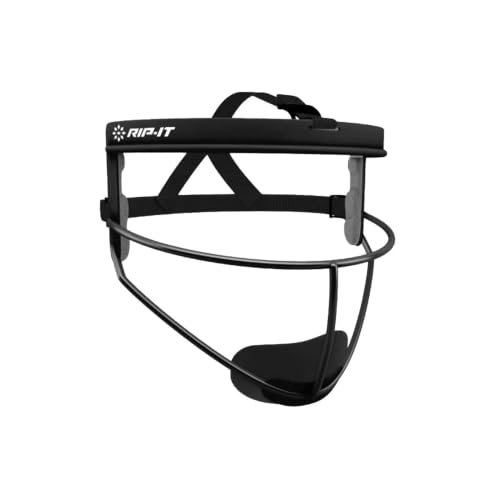
RIP-IT Defense Softball Fielder's Face Mask
- Made for fastpitch players
- Ponytail and braid friendly
- Detachable, washable padding
$39.99 at Amazon, as of Nov 17, 2026 02:07 UTC
Check price on AmazonRawlings Coolflo Batting Helmet with Facemask
- Attached face mask
- NOCSAE-certified, per maker
- Youth fit, about ages 8-14
Concussion: recognize and remove. The CDC HEADS UP program asks coaches and parents to remove any player with concussion signs or a hit to the head, and to keep her out until a healthcare provider says she can return. Call 911 for danger signs such as a worsening headache, repeated vomiting, a seizure, or slurred speech.
Heat on tournament days
The NATA position statement on exertional heat illness calls for heat acclimatization over 7 to 14 days and says exertional heat stroke is an emergency where the athlete is cooled first and transported second. The NFHS heat acclimatization statement lists risk factors, including being unfit, recently ill, or having had a previous heat illness, and says energy drinks are not appropriate for hydration. NATA’s fluid statement suggests limiting fluid loss to about 2% of body weight and not drinking so much that weight goes up. AAOS suggests delaying or canceling play in hot weather. We found no softball-specific heat-illness rates, so we give none. Our game-day page covers fluids, sun and lightning.
Youth and growing players
For younger players the sourced points are the ones already above: the AOSSM age-based pitching limits, no sliding instruction before age 10, rotating positions, and avoiding overlapping teams or year-round pitching. Divisions, leagues and bat rules for kids are on our youth softball page.
What prevention cannot do
Nothing here removes risk. AAOS notes that softball is a non-contact sport, yet most serious injuries come from contact with a ball, bat, ground, wall or another player, which gear and good habits only soften. Many studies above are observational or small, and a program that worked in one sport may not carry over.
When to see a doctor, PT or athletic trainer
- Arm or shoulder pain that lasts a week or returns every time she pitches.
- A knee that popped, swelled quickly or gives way, or an ankle that will not bear weight.
- Any blow to the head or face, any concussion sign, or a finger that stays crooked or swollen after a slide.
Athletic trainers are licensed or regulated health care professionals who work with physicians (NATA). Return to play only after a health care professional clears it. For what comes next, see our softball recovery guide and the rules page.
Softball injury prevention FAQs
Is there an official pitch count in softball?
A 2025 review said that, as of 2023, no established pitch count restrictions existed in the US or Canada. AOSSM publishes recommended maximums by age, so ask your league or coach whether they follow them.
Do bullpen and warm-up pitches count?
For the arm, yes. In a study of high school varsity outings, about half went over the recommendation once bullpen and warm-up pitches were included. AOSSM defines rest as no live pitches, including batting practice.
Should fielders wear face masks?
NFHS rules allow them, and most softball ER head and face injuries come from balls hitting fielders. Lab tests favored metal masks sitting well away from the face. Check your league rules first.
Do breakaway bases really prevent injuries?
In a recreational study they went with far fewer sliding injuries: 2 in 633 games against 45 in 627 games. AAOS recommends them on every field.
Can a neuromuscular warm-up prevent a knee injury?
Studies in girls’ sports found these warm-ups lowered serious knee injuries, but they were not softball-specific and nothing prevents every injury. A PT or athletic trainer can help set one up.
Sources
- AOSSM / STOP Sports Injuries, Softball Injury Prevention
- AAOS OrthoInfo, Baseball and Softball Injury Prevention
- Werner et al., Olympic windmill pitchers, 2006
- Zaremski et al., softball pitching and injury, Sports Health 2025
- Kamarajugadda et al., pitch counts in varsity outings, 2025
- Kamarajugadda et al., caregiver awareness of guidelines, 2023
- Corben et al., pitcher fatigue, 2015
- Paul et al., injury prevention in softball pitchers, 2021
- Bordelon et al., youth arm pain and throwing, 2024
- Soligard et al., IOC consensus on load and injury, 2016
- Veillard et al., NCAA softball injuries, 2021
- Feeley et al., softball injury review, 2024
- Nurrenbern et al., coaches and prevention programs, 2023
- Hewett et al., neuromuscular training and knee injury, 1999
- Myer et al., neuromuscular training meta-analysis, 2013
- AAP, Resistance Training for Children and Adolescents, 2020
- Janda et al., breakaway bases, 1988
- Hosey and Puffer, sliding injuries in college softball, 2000
- NATA position statement, ankle sprains
- Strickland et al., softball head and face injuries, 2019
- Morris et al., softball fielder mask testing, 2019
- NFHS, rules changes affecting risk 1982-2024
- CDC HEADS UP, concussion response
- NATA position statement, exertional heat illnesses
- NATA position statement, fluid replacement
- NFHS, heat acclimatization position statement
- NATA, about athletic training
Keep going with our injuries, training and gear pages.
General information for education only, not medical advice. It does not replace a visit with a doctor, physical therapist or athletic trainer. See how we write and check our pages in our editorial policy.