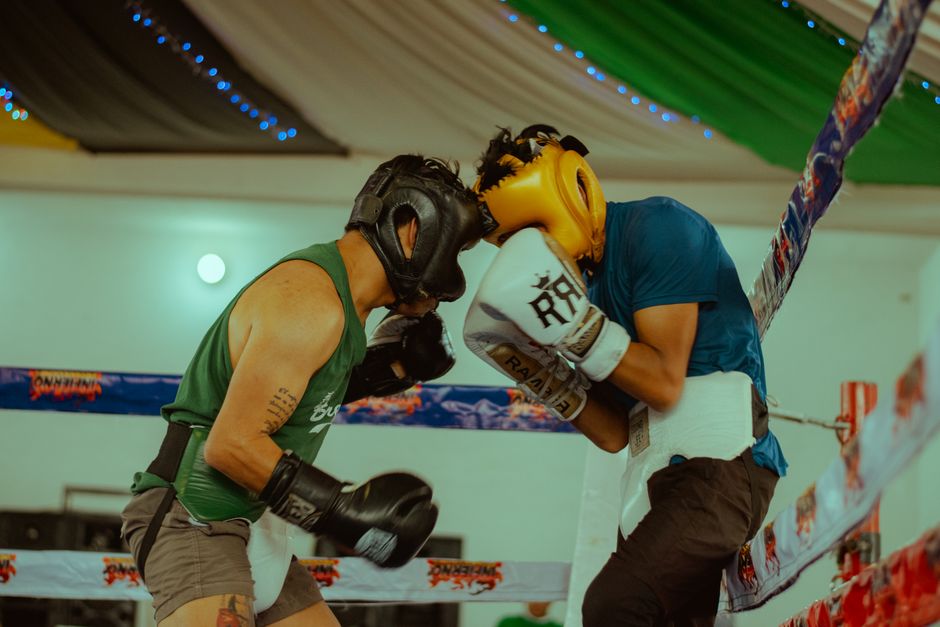
The dressing room is quiet except for the thud of gloves on pads. Ten minutes until your bout. Your hands feel heavy, your mouth is dry, and the walk to the ring suddenly seems very long. Every boxer knows this moment, from a first club show to a title card. Boxing mental training is the practice of building the skills between your ears (composure, focus, routines, bouncing back) the way you build a jab: a little, often, and under pressure. This page is about mental performance. Making weight and eating habits can affect your health, not only your boxing, so they get a separate, careful section below.
Quick answer: Build a short routine for the last hour before a bout and for the minute between rounds, and rehearse it in sparring so it is automatic. Aim your attention at the next exchange, not the crowd or the result. After a loss, review it once with your coach, take one lesson and go back to work. The research on boxers is small and none of it can promise a win. Constant worry, panic, low mood, trouble sleeping, skipping meals, fear of food or weight, or losing your love of the sport are health matters: see a doctor, a licensed mental health professional or a registered dietitian.
Why boxing puts so much on the mind
Few sports are as exposed. Nobody can sub in for you, every mistake can be seen by the whole room, and the other boxer is trying to hit you. A 2026 survey of 470 university combat sport athletes in Turkey (Duyan and colleagues, Frontiers in Psychology) found that higher scores on mental performance skills went with higher mental toughness, and higher mental toughness went with better self-rated athletic performance. It was a one-time questionnaire of combat athletes in general, so it shows an association, not cause.
Fight-day nerves
Nerves before a bout are normal and do not mean you are not ready. In a 2026 study of 20 national-level male boxers aged 18 to 21 (Bayram and colleagues, BMC Sports Science, Medicine and Rehabilitation), the stress hormone cortisol peaked after the bout, but hormone changes did not line up with how anxious or angry the boxers said they felt. In plain words: how your body reacts and how you feel are not the same thing, so a racing heart is not proof that you are about to fall apart. Small sample, one tournament.
The Exercise and Sports Science Australia (ESSA) position statement on performance under pressure (Sports Medicine, 2026) says pressure can help or hurt performance, and lists pre-performance routines, attentional strategies, psychological skills training and mindfulness-based approaches among the strategies with supporting evidence. It is not boxing-specific, so the steps below are a common coaching template, not a tested formula:
- Name it: “I’m nervous because this matters.” Naming the feeling is often easier to work with than fighting it.
- Breathe out slowly in the dressing room and again before the bell. A long exhale settles most people’s shoulders and hands.
- Pick one or two jobs for round one, such as “jab first” or “move my head.” Not a list.
Weigh-ins, food, fluids and corner rules are on our fight day page, so we do not repeat them here.
Composure under pressure
Composure is staying yourself after you get hit, after a round you lost, or when the crowd turns. A 2026 study of 20 professional kickboxers (a related sport, not boxing) found that measured pre-bout anxiety and self-confidence did not separate the winners from the beaten fighters; the winners threw more and landed more effectively (da Silva Duarte and colleagues, Frontiers in Sports and Active Living). Only 20 athletes, so it proves little. Ideas many coaches use, not boxing trial results:
- Choose a reset cue for the moment you get tagged: a breath out, a glance at your corner, then back to your guard and your feet.
- Treat the minute between rounds as a job: breathe, sip, listen to one or two instructions from your corner.
Sparring mindset
Sparring is where mental habits are built. It is also where hard head contact piles up: a 2014 study of 237 professional boxers in Maryland linked higher sparring exposure with poorer scores on tests of thinking speed and balance (Stiller and colleagues, Frontiers in Public Health), and our boxing injuries page covers head injury and the rest period USA Boxing sets after a knockout. A good sparring mindset is therefore about quality, not about winning every round:
- Give every session one purpose, such as “work the jab” or “stay calm when pressed,” and tell your coach and partner.
- Practice your pressure routine: put a few rounds a week into your fight-day order, with a timer, a corner voice and some noise.
- Stop and tell your coach if you feel dazed, dizzy or foggy. That is a safety matter, not a mindset test.
See the boxing training page for what to drill and the rules page for how bouts are scored and decided.
Confidence, motivation and goals
A 2026 survey of 489 university combat sport athletes in Turkey found that boxers and fighters who trained for their own interest and enjoyment (intrinsic motivation) reported better psychological wellbeing, partly through higher mental toughness (Duyan and colleagues, Frontiers in Psychology). It is a snapshot, not proof.
- Process goals are in your control: “double up the jab,” “return to my guard after every combination.” “Win the title” is not. Use all three kinds, but lean on process goals during the bout.
- Imagery is rehearsing in your mind: see and feel the setup, the exchange, the finish. Try a few minutes the night before, picturing one or two situations you expect, such as a taller boxer or a slow start. No boxing-specific study backs a set recipe, so keep what feels useful.
Resilience after a loss
Almost every boxer loses, and some lose a lot while they are learning. A loss feels personal because it is public and physical. A simple plan, again a common coaching approach rather than a tested protocol:
- Rest and get checked first. If you took hard shots or were stopped, the ringside doctor and the rest periods in the rules come before anything else; see the injuries page and recovery page.
- Wait a day or two before watching the bout back, ideally with your coach.
- Write down one lesson, such as a habit when tired or a plan you dropped, and one thing you did well.
- Talk to your coach, a teammate or someone at home. Losing alone is harder.
A loss that leaves you flat, hopeless or unable to sleep for weeks is no longer a mindset task. See the health section below.
Weight-cutting stress and disordered eating: a health matter
This section is separate on purpose. Making weight is a mental pressure, but when it drives food restriction, fasting, dehydration or bingeing it becomes a health matter, not a mindset problem. Please do not treat it with visualization or toughness. Much of the evidence is from combat sports in general, not boxing alone.
- A 2026 review of boxing medicine (Houser and colleagues, Current Sports Medicine Reports) calls weight management and nutrition critical yet often underappreciated for performance and safety, and says the psychological toll of training, competition and life after boxing shows the need for integrated mental health support.
- A 2025 mini review of the psychology of weight cutting in combat sports (Levy and Boyd, Frontiers in Sports and Active Living) discusses athletes’ relationship with food, body image expectations and disordered eating as risk factors.
- A 2025 survey of 256 combat sport athletes found that certain high-risk weight-loss methods were linked with more disordered eating behaviors (Barley and Harms, Translational Sports Medicine).
- The International Society of Sports Nutrition’s 2025 position stand on weight cuts for mixed martial arts and other combat sports covers safer approaches; our boxing nutrition page explains them.
- A 2025 preliminary survey of 45 current elite kickboxers (a related sport, small sample) found 57% screened positive for psychological distress and 63% for disordered eating (Bilgoe and colleagues, Discover Mental Health), using screening tools from the IOC Sport Mental Health Assessment Tool. Screening is not a diagnosis.
Warning signs include constant thoughts about food or weight, fear of eating, secret fasting or purging, binge eating after weigh-ins, missed periods, dizziness or fainting, and losing interest in training. If you notice them in yourself or a teammate, tell a coach you trust, a parent, an athletic trainer or a doctor, and ask for a sports medicine doctor or a registered dietitian. Dizziness, confusion or a racing heart before a bout is a reason to tell the ringside doctor.
Mental performance vs. mental health
Mental training is for sharpening skills in people who are otherwise well. It is not a treatment. Anxiety that stays after the bout, depression, panic, trouble sleeping or eating, burnout, worries after repeated head blows, thoughts of self-harm, or loss of enjoyment are health matters to take to a doctor, psychologist or other licensed professional. The 2026 International Olympic Committee consensus statement on mental health in elite athletes says mental health symptoms and disorders are common among elite athletes, may have sport-related causes and can affect performance. In the United States you can call or text 988 (the 988 Suicide & Crisis Lifeline) any time, free and confidential. If you are in immediate danger, call your local emergency number. A coach, trainer or ringside doctor can help you find the next step.
Competition preparation
Mental preparation sits on top of the basics: sleep, a safe weight plan, food and fluids you trust, a packed bag. Logistics for weigh-ins, rehydration, wraps and the corner are on the fight day page. The best mental use of the night before: pack, picture one situation, sleep.
Young boxers
The American Academy of Pediatrics and the Canadian Paediatric Society oppose boxing for children and adolescents because of the risk of head injury, while acknowledging benefits such as exercise, self-discipline and self-confidence (2011 policy statement, Pediatrics). Our youth boxing page covers this. We did not find a boxing-specific study of youth mental training that we could cite, so we offer no tested youth program.
Boxing mental training questions
How do I calm my nerves before a bout?
Use the same warm-up order every time, breathe out slowly, and give yourself one or two simple jobs for the first round. Nerves are normal. If anxiety feels overwhelming or constant, talk to a doctor or licensed professional.
How do I recover mentally from a loss?
Get checked if you took hard shots, wait until you have cooled off, then take one lesson from the bout with your coach and write it down. If a loss leaves you low or anxious for weeks, see a professional.
Is stress from making weight a mental performance problem?
No. Stress from cutting weight can overlap with disordered eating, which is a health matter. A doctor, athletic trainer or registered dietitian should help you, and your weight plan should follow your governing body or commission rules.
What are warning signs of disordered eating in boxers?
Constant thoughts about food or weight, secret fasting or purging, bingeing after weigh-ins, dizziness, missed periods and withdrawing from teammates. These deserve a doctor’s visit. They are not a sign of weakness.
Sources
- Duyan M et al. Mental performance skills and athletic performance in combat athletes: the mediating role of mental toughness. Frontiers in Psychology, 2026. PMID 42403619
- Duyan M et al. The relationship between intrinsic motivation and psychological wellbeing in combat sport athletes: the mediating role of mental toughness. Frontiers in Psychology, 2026. PMID 42058302
- Bayram B et al. Temporal dissociation between endocrine and psychological responses across an official boxing bout in national-level male boxers. BMC Sports Science, Medicine and Rehabilitation, 2026. PMID 42728620
- Schweickle MJ et al. Performance Under Pressure in Sport: A Position Statement from Exercise and Sports Science Australia. Sports Medicine, 2026. PMID 42271117
- da Silva Duarte JDR et al. Pre-competitive anxiety, self-confidence, and technical-tactical performance in professional kickboxing athletes. Frontiers in Sports and Active Living, 2026. PMID 42807216
- Stiller JW et al. Sparring and neurological function in professional boxers. Frontiers in Public Health, 2014. PMID 25101253
- Houser A et al. Boxing Medicine Beyond the Ringside. Current Sports Medicine Reports, 2026. PMID 43007324
- Levy JJ, Boyd C. Getting small to feel big: the psychology of weight cutting in combat sports. Frontiers in Sports and Active Living, 2025. PMID 39911474
- Barley OR, Harms CA. Rapid Weight Loss Across Combat Sports and the Relationships Between Methods and Magnitude. Translational Sports Medicine, 2025. PMID 40177332
- International Society of Sports Nutrition position stand: nutrition and weight cut strategies for mixed martial arts and other combat sports. J Int Soc Sports Nutr, 2025. PMID 40059405
- Bilgoe S et al. Prevalence of mental health symptoms in current and former elite kickboxers. Discover Mental Health, 2025. PMID 41264054
- Reardon CL et al. Mental health in elite athletes: International Olympic Committee consensus statement (2026). British Journal of Sports Medicine. PMID 42580854
- American Academy of Pediatrics and Canadian Paediatric Society. Boxing participation by children and adolescents. Pediatrics, 2011. PMID 21873697
- 988 Suicide & Crisis Lifeline
General information for education only, not medical advice. It does not replace a doctor, psychologist, registered dietitian or other qualified professional. See how we work in our editorial policy. Back to the boxing hub.