This article contains affiliate links: if you buy through them we may earn a commission, at no extra cost to you. Read our affiliate disclosure.
It is a bluebird Saturday and a rider is strapped in at the top of the first run, goggles down, helmet buckled, wrist guards already under her gloves. She does a few squats in her stance, rolls her ankles, and points the board down an easy groomer before she even thinks about the park. Nobody is watching, and it will never be a highlight. It is snowboarding injury prevention: the habits and gear around a rider, from lessons and a warm first run to a helmet, wrist guards and knowing when to stop, that aim to lower the chance of getting hurt. They can lower the odds. They cannot promise a day without a fall.
Quick answer: The best-supported steps for riders are a lesson that teaches you how to fall, wrist guards, a snow-sport helmet that fits, a short warm-up before the first run, and calling it a day when you are tired. Wrist guards and helmets lower injury risk but do not make a rider injury-proof, and no helmet is proven to prevent concussion. See a sports medicine doctor, physical therapist or athletic trainer (or ski patrol on the mountain) for a suspected concussion, a swollen wrist, or an ankle “sprain” that is not improving.
General information, not medical advice. This page is about lowering risk. For what each injury looks like, see our snowboarding injuries guide; for building fitness, see snowboarding training.
Warm up before the first run
We found no snowboarding-specific warm-up program, such as the FIFA 11+ in soccer, in the sources we use, so we do not name one. What the American Academy of Orthopaedic Surgeons (AAOS) says in its skiing injury prevention guidance is simple: be in good physical condition, warm up for 3 to 5 minutes with jumping jacks or light cardio, then take a couple of slow, easy runs before you push. Leg swings and squats at the lift line are common practice, not a published protocol. For competitive riders, the International Ski and Snowboard Federation (FIS) consensus statement of 2025 calls training and testing the most important strategies for improving performance, building resilience and preventing injuries.
Lessons, learning to fall and technique
Lessons are the least glamorous and best-supported tool on this page. AAOS says learning how to fall correctly and safely can reduce the risk of injury and urges lessons for new and experienced riders. A 2024 meta-analysis of 15 studies in ice and snow sports (Fan et al.) found injury-prevention programs cut injuries by about half overall (relative risk 0.50), and educational training on its own also came in at 0.50. Beginners carry the highest risk: a Vermont study of 18 seasons found the highest injury rate among young, inexperienced riders, and a randomized trial of 5,029 snowboarders (Rønning et al., 2001) found beginners in their first five days and riders on rented equipment had more injuries.
What to expect in a lesson: instructors commonly teach riders to keep their arms in, sit down on a heelside fall, and stay low on the board. We have not confirmed that against a PSIA-AASI document.
Build up your riding gradually
We found no published rule of thumb for how fast a rider should add days, terrain or tricks, so we do not give a number. The Rønning trial (more injuries in the first days) and AAOS’s advice to avoid difficult runs when tired both suggest risk is not spread evenly. Many riders add one new thing at a time and save steeper terrain for fresh legs; that is common practice, not a study result. Kids and teens need rest as well: the American Academy of Pediatrics (AAP) recommends at least one to two days off a week from organized sport.
Strength, balance and conditioning
Riding is hours of half-squatting on a moving board with constant small balance corrections. The National Athletic Trainers’ Association (NATA) position statement on ankle sprains recommends a balance and neuromuscular program of at least three months, so the work belongs in the fall rather than the week before a trip. Exercises and a sample week are on our training page. We found no study showing that one exercise prevents a particular snowboarding injury, so treat strength work as general preparation.
Terrain park rules and habits
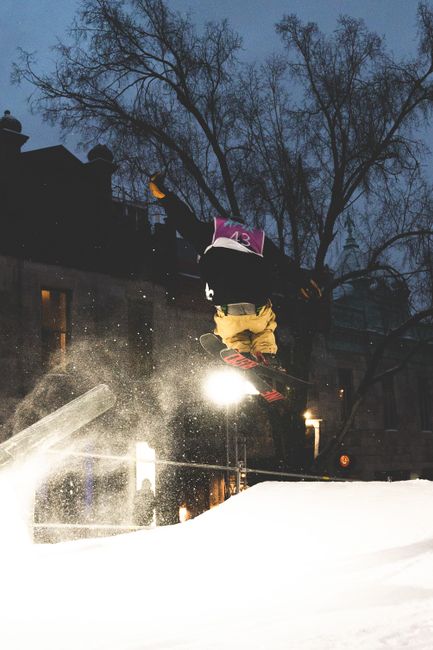
Jumps, rails and boxes are where much of modern snowboarding happens. In the Vermont study, 21.8% of snowboarding injuries happened in the terrain park, against 6.5% of ski injuries, though the researchers did not find park riders overrepresented among the injured. A decade of data from 28 western Canadian resorts counted 12,602 terrain-park injuries, 73.0% of them in snowboarders and 86.5% in riders under 25.
The park-safety program the ski industry promotes is Park Smart, from the National Ski Areas Association (NSAA) with Burton, PSIA-AASI and the National Ski Patrol. It has five points: start small, make a plan, always look, respect, and take it easy, with the tagline “Don’t go if you don’t know.” Burton’s beginner terrain park guide adds that features come in sizes from XS to XL, and suggests starting on XS or S and wearing a helmet, wrist guards, impact shorts and knee pads. Our rules and etiquette page has the Your Responsibility Code that applies on every run.
Cold, fatigue and snow conditions
- Tired legs. AAOS advises avoiding difficult runs when you are tired, such as at the end of the day. We found no study that measures injury rates by time of day, so treat that as expert advice, not a statistic.
- Cold. The CDC says frostbite signs run from redness or pain to white or grayish-yellow, firm or waxy, numb skin, and that body temperature below 95 °F (35 °C) is an emergency. The American College of Sports Medicine (ACSM) expert consensus on cold-weather exercise says frostbite on exposed skin can occur in 30 minutes or less when the wind chill is below -27 °C (-17 °F). Dress in layers and cover your nose, ears, cheeks, chin, fingers and toes.
- Altitude. The CDC Yellow Book lists headache, dizziness, fatigue and nausea among the signs of altitude illness and advises mild exercise only for the first 48 hours at high elevation. See our snow day page for food, water and layering.
- Deep snow and tree wells. A 2010 medical review counted more than 70 deaths from non-avalanche snow immersion in two decades, with death probably within 15 to 30 minutes, and resorts advise riding with a partner you can see. Details are on our injuries page.
Helmets, wrist guards and concussion
Wrist guards. A systematic review of six studies (Russell, Hagel and Francescutti, 2007), including randomized trials, found snowboarders wearing wrist guards had a relative risk of 0.23 for wrist injury, 0.29 for wrist fracture and 0.17 for wrist sprain, about three-quarters fewer wrist injuries. A later review found a likely protective effect but no consensus on the best design. That matters because wrist injuries were 27.6% of snowboarding injuries but only 2.8% of ski injuries in the Vermont study. Pick a pair that fits with your gloves.
Helmets. A meta-analysis of 12 studies (Russell, Christie and Hagel, 2010) found helmets were linked with 35% lower odds of head injury (odds ratio 0.65), and 0.41 in studies of children under 13, without more neck injuries. A trauma-surgeons’ evidence review recommends helmets for all recreational skiers and snowboarders, and the AAP says the evidence is strong for snow sports.
Standards versus maker claims. The verified part: the US Consumer Product Safety Commission (CPSC) lists ASTM F2040 as the snow-sport helmet standard, tells riders to choose a helmet that fits, and says no helmet has been proven to prevent concussions. AAOS says not to wear a bike helmet on the slopes. The maker part: listings for the Smith Mission MIPS state ASTM F2040, CE EN 1077 and Mips, but how much Mips adds is the maker’s claim, and we found no independent figure to quote. Burton advises replacing a helmet after an impact.
Concussion. The CDC’s HEADS UP program says to stop riding for the day when a concussion is suspected and not return until a health care provider clears you. Signs include looking dazed, headache, dizziness, nausea and blurry vision. Call 911 or get ski patrol for danger signs such as one pupil larger than the other, a headache that gets worse, repeated vomiting, slurred speech, seizures or loss of consciousness.
Back and tailbone. Padded impact shorts are popular for tailbone falls, but we found no study showing they prevent tailbone fractures. A 2025 Swiss trauma-center study found back protectors did not prevent spinal injuries, so treat padding as comfort and bruise protection, not spine protection. See snowboard gear for how to choose each piece.

Smith Mission MIPS Snow Helmet
- ASTM F2040 and CE EN 1077 listed
- Mips liner
- Dial fit, 14 vents

Pro-Tec Undercover Snow Wrist Guards
- Removable top and bottom splints
- Worn under gloves
- Sizes XS to XL
$33.99 at Amazon, as of Nov 17, 2026 01:07 UTC
Check price on Amazon
Triple Eight Bumsaver Padded Shorts
- 10 mm removable EVA pads
- Hips, thighs and tailbone
- Sizes XS to XL
$79.99 at Amazon, as of Nov 17, 2026 01:07 UTC
Check price on AmazonYounger riders
The AAP advises a qualified instructor in a program designed for children, helmets for all young riders (enforced by parents), equipment that fits, and gloves with built-in wrist guards for snowboarders. Young riders get injured more: a US emergency department study of 2000 to 2019 found snowboarding made up 57.0% of snow-sport injuries in patients under 18. More on starting a child in the sport is on our youth page.
What prevention cannot do
Even with every step here, riders fall, and a board that catches an edge does not care how well you prepared. Wrist guards cannot stop a collarbone fracture or a snowboarder’s ankle injury, and a helmet cannot be promised to prevent concussion. The aim is fewer avoidable injuries, caught earlier.
When to see a professional
- Right away (ski patrol or 911): any concussion danger sign, a possible broken bone, a joint that looks out of place, neck or back pain with numbness or weakness, or signs of hypothermia.
- Same day or next: a swollen wrist or one too painful to grip, a suspected concussion, or a shoulder you cannot lift.
- Soon: an “ankle sprain” from riding that is not improving after a week or so (ask the doctor about a lateral talar process fracture), tailbone pain that lasts for weeks, or pain that keeps coming back.
A sports medicine physician diagnoses and decides on X-rays or CT; a physical therapist guides rehab and your return to riding. For the injuries themselves, see our snowboarding injuries page, and for the days after, our recovery page.
Snowboarding injury prevention: FAQs
Do wrist guards really prevent snowboarding injuries?
They lower the risk. A systematic review of six studies found about three-quarters fewer wrist injuries in riders who wore them. They do not protect the shoulder, collarbone or ankle, and no single design has been shown best.
Does a helmet prevent concussion on the slopes?
Helmets lower the odds of head injury, but the CPSC says no helmet has been proven to prevent concussions. Wear a snow-sport helmet that fits, and stop riding after any hit that causes concussion signs.
Is a lesson worth it if I already ride?
AAOS recommends lessons for new and experienced riders, and education programs cut injuries by about half in a 2024 meta-analysis of snow and ice sports. Lessons are especially valuable for learning to fall and for a first time in the park.
How do I stay safer in the terrain park?
Follow the Park Smart points: start small, make a plan, always look, respect others and take it easy. Begin on small features, wear a helmet and wrist guards, and skip the park when you are tired.
Should I stop riding when I am tired?
AAOS advises avoiding difficult runs when you are tired. A common-sense version is to take an easy run back to the lodge instead of one more hard one.
Sources
- AAOS OrthoInfo, skiing injury prevention
- FIS consensus statement on training and testing, 2025
- Fan et al., injury prevention in ice and snow sports, 2024
- Kim et al., snowboarding injuries compared with skiing, 2012
- Rønning et al., randomized trial of wrist guards, 2001
- Russell et al., wrist guards among snowboarders, 2007
- Kim and Lee, snowboard wrist guards review, 2011
- Russell et al., helmets in skiing and snowboarding, CMAJ 2010
- Haider et al., EAST helmet recommendation, 2012
- AAP policy statement on helmets, 2022
- CPSC, Which Helmet for Which Activity?
- NSAA Park Smart
- Burton, terrain park guide for beginners
- Burton, on-hill safety tips
- Dickson, terrain park injuries in western Canada, 2024
- Tinner et al., back protectors and spinal injuries, 2025
- Van Tilburg, non-avalanche snow immersion deaths, 2010
- ACSM expert consensus on cold-weather exercise, 2021
- CDC, winter weather prevention
- CDC Yellow Book, high-altitude travel
- CDC HEADS UP, signs and symptoms
- NATA position statement on ankle sprains, 2013
- AAP, sports specialization and intensive training in young athletes, 2016
- AAOS OrthoInfo, winter sports injury prevention
- AAP HealthyChildren, winter safety
- US emergency department snow-sport injuries in youth, 2000 to 2019
Keep going with our gear, best wearables and leagues and associations pages, or return to the snowboarding hub.
General information for education only, not medical advice. It does not replace a visit with a doctor, physical therapist or athletic trainer. See how we write and check our pages in our editorial policy.