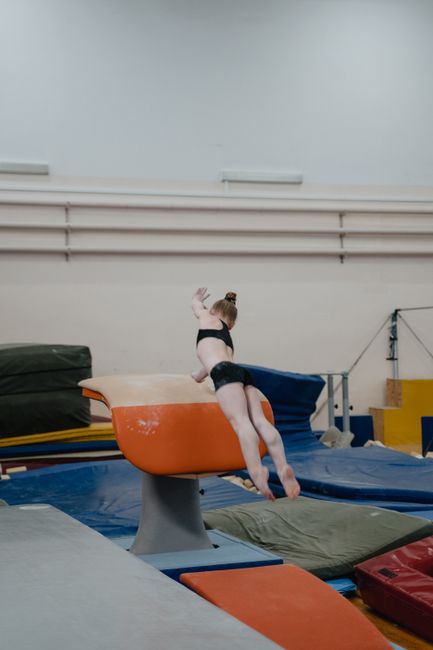
It is a Saturday morning before a meet, and a team is spread across the floor in the warm-up gym. Some are running through handstand holds, a few are rolling out their wrists on the mat, and a coach is walking the beam lines checking that every spotter has a clear view. Nobody has tried a routine yet. That quiet stretch is the heart of gymnastics injury prevention: the habits around a gymnast, such as warm-up, careful skill progressions, sensible training hours, strong landings, safe equipment and enough fuel, that aim to lower the chance of getting hurt. They can lower the odds. They cannot promise anything.
Quick answer: A 2026 review of the research on gymnastics found the same themes again and again: progressive, individual training, watching workload, enough recovery, and spotting pain and fatigue early. In practice that means gradual increases in hours and skills, qualified coaching on proper mats, rest days and time off each year, and enough food for the training. See a sports medicine doctor, physical therapist or athletic trainer if wrist pain keeps coming back, if back pain lasts or hurts with arching, or if a gymnast is eating too little or losing weight. Call 911 for any suspected neck injury or head injury danger sign.
General information, not medical advice. This page is about lowering risk. For what each gymnastics injury looks like and when to get it checked, see our gymnastics injuries guide.
Know where the risk sits
Prevention works best when it aims at the real problem, and in gymnastics the problems are repetition, impact and growth. A 2026 systematic review of adolescent artistic gymnasts found a pooled wrist pain prevalence of about 53%, linked to ages 10 to 14, training intensity, years in the sport and weekly hours (Orthopaedic Journal of Sports Medicine, 2026). A 2026 review put low back pain in competitive gymnasts at 25% to 50%, rising with age and weekly training volume (BMC Sports Science, Medicine and Rehabilitation). So most prevention advice starts with the wrists, the lower back and the landing.
Warm up before the first skill
Unlike soccer’s FIFA 11+, gymnastics has no widely tested named warm-up program, so be wary of anyone who says there is one. What coaches commonly use, based on practice rather than a published trial, is an order like this: easy running or jumping to raise the heart rate, shoulder, hip and ankle movement, wrist circles and gentle weight-bearing on the hands before handstands and tumbling, light core and balance work, then skills built from easy to hard. A 2026 narrative review listed physical preparation among its main themes (Healthcare) but did not name one best routine.
Wrist: load it gradually, listen to it early
Gymnasts put their body weight through the hands more than almost any other athletes. Children’s Mercy Kansas City describes gymnast’s wrist (distal radial epiphysitis) as an overuse injury of the growth plate at the end of the radius, with pain on the thumb side of the wrist that gets worse with impact or weight bearing. Growth plates are the softer areas near the ends of a child’s bones, and the American Academy of Orthopaedic Surgeons (AAOS) lists gymnastics among the sports where repeated stress can injure them. The practical points are modest: build up hand-support skills slowly, and get pain that returns session after session looked at rather than taping over it.
Wrist supports are popular, but they are not a proven prevention tool. A 2023 study of 23 young gymnasts found that supports, including Tiger Paws, increased the bending load on the wrist in the first landing phase, and the authors suggested thinking about injury history and how long supports are worn (American Journal of Sports Medicine). Ask a physical therapist or athletic trainer whether a support makes sense for a particular gymnast.
Back: arching, landings and strong trunk muscles
Back walkovers, arches and hard landings bend the lower spine backward again and again. AAOS names gymnastics among the sports with repeated stress on the lower back and describes spondylolysis, a stress fracture in a small part of a vertebra, as pain that can feel like a muscle strain, may spread to the buttocks and thighs, and worsens with activity. In the 2026 low back pain review, 8 to 12 weeks of core stability training reduced pain in competitive gymnasts (BMC Sports Science, Medicine and Rehabilitation), which is why trunk strength is a common part of gymnastics conditioning. That finding is about treating existing pain; it does not prove that core work prevents a stress fracture. A classic 1976 X-ray study of 100 young female gymnasts concluded that low back pain in a young gymnast should be a warning sign, and that advice still stands: get it checked.
Growing bodies and growth-plate stress
A 2026 systematic review of 65 studies on adolescent aesthetic and acrobatic athletes (Sports Medicine) found that gymnastics training supports bone health in prepubertal athletes at weight-bearing sites, but that the risk of bone-related injury rises around puberty, possibly because of later menarche, lower bone age and nutritional deficiencies. It also named hypermobility, shorter stature and flexibility and strength imbalances among the factors that may influence injury risk. In plain words: a growth spurt is a time for extra attention to pain, fatigue and training volume, not for pushing through.
Skill progressions and spotting
Skills are built in steps, and progressions often move from an easier surface to a harder one. USA Gymnastics requires its professional members to hold a safety and risk management certification and to complete coaching courses, concussion education, U.S. Center for SafeSport training and background screening. We could not find a published trial proving that any particular spotting method lowers injuries, so we do not claim one. What families can fairly look for is a coach who teaches skills in clear stages, who does not rush a gymnast into a new skill to meet a competition date, and who stops a skill when a gymnast is afraid or hurt.
The USA Gymnastics Safe Sport Policy also treats painful stances or positions as a form of physical misconduct, and discourages coaches from laying or sitting on top of an athlete during stretching.
Landing surfaces and equipment safety
Landings are where the surface matters. A 2025 laboratory study of 11 skilled female gymnasts and 11 untrained young women dropped them onto a competition-certified (FIG-certified) mat, a gymnastics carpet and three experimental mats. The certified mat produced the lowest peak forces and the longest time to peak, the carpet produced the highest peaks, and stiffer constructions transmitted higher loads (Scientific Reports). It was a small drop-landing study, not a report of injuries, but it supports a simple rule: land on the mats the skill was designed for.
For equipment in general, check that mats, beams, bars and trampolines are in good repair, set up for the skill being taught and not used past their limits. The American Academy of Pediatrics (AAP) policy on trampolines says most injuries happen with more than one jumper at a time, that neck injuries can result from falls and flips, and that home trampoline use is strongly discouraged. New skills and flips belong in a gym with trained coaches, not on a folding mat at home. Our gymnastics gear guide covers grips, wrist supports and mats, and separates what the maker says from what has been tested.
Training load and early specialization
Gymnastics has the highest number of participation hours of all youth sports, and early specialization is the norm, according to a 2022 review of overuse elbow injuries in youth gymnasts (American Journal of Sports Medicine). The AAP’s 2016 clinical report on sport specialization and its 2024 report on overtraining recommend one to two days off a week and two to three months a year away from the main sport, in blocks of about a month, and a 2015 study of young athletes found that training more hours per week than one’s age in years roughly doubled the odds of a serious overuse injury (Jayanthi et al.). A 2023 study of young gymnasts found weekly hours of about 11 for ages 6 to 9, 16.5 for ages 10 to 13 and 15 for ages 14 to 17, so the two youngest groups were above that age-in-hours rule of thumb (Children, 2023). The AAP also says such thresholds still need to be validated, so they are guides, not guarantees.
For increases in training, the USA Gymnastics Safe Sport Policy sets a “10 percent rule”: no more than a 10% increase per week in training time, distance or weight. Sleep matters too; see our gymnastics recovery and training pages. For the youth side, see our youth gymnastics guide.
Energy availability: eating enough for the training
The 2023 International Olympic Committee consensus statement on Relative Energy Deficiency in Sport (REDs) describes a syndrome in female and male athletes that do not eat enough for their training, with effects that include bone stress injuries and hormonal changes. The AAP’s 2024 overtraining report lists REDs, bone stress injuries and menstrual disruption as concerns for young athletes, and the 2026 growth-and-maturation review found that inadequate energy intake may contribute to bone stress and overuse injuries. A small 2026 study of 30 non-elite gymnasts aged 11 to 14 found no clear signs of low energy availability in season (Nutrients), so it is not every gymnast’s problem, but it is one to watch.
Prevention here is about gym culture as much as meals: coaches and parents should not comment on weight or body shape, and any gymnast who is skipping meals, losing weight, missing periods or having repeated bone injuries should see a doctor or sports dietitian. Our gymnastics nutrition page has more.
What prevention cannot do
Even the best habits cannot make gymnastics risk-free. In a 2025 trial of an injury prevention program in rhythmic gymnastics clubs, injury prevalence did not differ between groups, and the authors pointed to load management and planning instead (Scandinavian Journal of Medicine & Science in Sports). A gymnast can do everything right and still be injured, so never treat these tips as a reason to ignore pain.
When to see a professional
- Right away (emergency): a fall with neck pain, numbness or weakness, any concussion danger sign, a joint that looks out of place, or a possible broken bone.
- Soon: wrist pain that returns every practice, low back pain that hurts with arching or lasts more than a couple of weeks, heel or Achilles pain, pain at night or at rest, a limp, or a child who is skipping meals or losing weight.
A sports medicine doctor, physical therapist or certified athletic trainer can check a gymnast, guide a gradual return to skills and advise on training. The person treating an injury, not the coach, decides on return.
Gymnastics injury prevention: FAQs
Can wrist supports prevent gymnast’s wrist?
There is no good evidence that they do. A 2023 study found supports changed the load on the wrist in landings, and its authors suggested limiting how long young gymnasts wear them. Persistent wrist pain needs a medical check.
How many hours a week is too many for a young gymnast?
No single number is proven. A 2015 study found that training more hours per week than a child’s age in years roughly doubled the odds of serious overuse injury, and the AAP recommends one to two days off a week. The AAP also says thresholds need validation, so ask your child’s doctor.
Is back pain in a gymnast normal?
It is common but should not be ignored. Pain with arching can be a sign of a spine stress fracture (spondylolysis), which only a doctor can diagnose.
Do thicker mats make skills safer?
Not automatically. A 2025 lab study found that a competition-certified mat gave lower peak landing forces than a carpet surface, but that mat structure matters, not just thickness. Use the mats the coach chose for each skill, and do not add flips at home.
Sources
- Focused narrative review on gymnastics training optimization, athlete health and injury prevention, Healthcare, 2026
- Growth and maturation in adolescent aesthetic and acrobatic athletes, systematic review, Sports Medicine, 2026
- Wrist pain in adolescent artistic gymnasts, systematic review, Orthop J Sports Med, 2026
- Low back pain in competitive gymnasts, BMC Sports Sci Med Rehabil, 2026
- Children’s Mercy Kansas City, Gymnast Wrist
- Hart et al., wrist guards and supports in gymnastics, Am J Sports Med, 2023
- AAOS OrthoInfo, Spondylolysis and Spondylolisthesis
- Jackson et al., spondylolysis in the female gymnast, 1976
- AAOS OrthoInfo, Growth Plate Fractures
- Landing mat properties and lower limb biomechanics in gymnasts, Scientific Reports, 2025
- AAP policy statement on trampoline safety, 2012
- Bonazza et al., overuse elbow injuries in youth gymnasts, Am J Sports Med, 2022
- AAP clinical report, sport specialization, Brenner 2016
- AAP clinical report, overtraining in young athletes, Brenner and Watson 2024
- Jayanthi et al., specialization and overuse injury, 2015
- Williams et al., injury pathology in young gymnasts, Children, 2023
- Gram et al., injury prevention program in rhythmic gymnastics, Scand J Med Sci Sports, 2025
- IOC consensus statement on Relative Energy Deficiency in Sport (REDs), 2023
- Energy availability in adolescent artistic gymnasts, Nutrients, 2026
- USA Gymnastics Safe Sport Policy (approved 12.15.21)
- USA Gymnastics, professional member requirements
General information for education only, not medical advice. It does not replace a visit with a doctor, physical therapist or athletic trainer. See how we write and check our pages in our editorial policy.