This article contains affiliate links: if you buy through them we may earn a commission, at no extra cost to you. Read our affiliate disclosure.
It is the third match in three days, and a right back has felt a dull ache in her throwing shoulder since Friday. Her coach has the team do the same ten-minute warm-up before every practice, so she does it again without thinking. Handball injury prevention is the set of habits players and teams use to lower the chance of getting hurt: a structured warm-up, sensible workload, strength and landing work, good shoes, and the right protection. It cannot remove the risk of a fast, physical contact sport, but some of these habits have been tested in real teams.
Quick answer: The best-studied habits for handball are a neuromuscular warm-up (running, cutting and landing technique, balance, strength) and a shoulder routine built into the warm-up, done every week and not just once. Raise workload gradually, keep shoes and gear in good shape, and take every head knock seriously. See a sports medicine doctor, physical therapist or athletic trainer if pain lingers, a joint gives way or swells, or you hit your head.
General information, not medical advice. What each injury looks like is covered on our handball injuries page; this page is about lowering the odds.
Warm-up: what the published programs include
Handball’s best evidence comes from Norway. In a randomized trial of 120 clubs and 1,837 players aged 15 to 17 (Olsen and colleagues, BMJ 2005), teams used a warm-up that trained running and cutting technique, landing, balance and strength. Teams using it had about half as many players with acute knee or ankle injuries (4.8% vs 8.6%). A German study of 23 adolescent teams (Achenbach and colleagues, 2018) found severe knee injuries were rarer in teams that did regular neuromuscular exercises (0.04 vs 0.33 per 1,000 hours). A Norwegian women’s program (Myklebust and colleagues, 2003) used 15 minutes of balance, planting and landing exercises; across all divisions the drop in ACL tears was not statistically clear, but elite-division players who completed it had far fewer ACL injuries than those who did not.
For throwers, the OSTRC Shoulder Injury Prevention Programme is the one to know. In a trial of 660 elite players on 45 teams (Andersson and colleagues, 2017), doing it three times a week as part of the warm-up, about ten minutes of shoulder mobility, external-rotation and shoulder-blade strength, and upper-back work, lowered the risk of shoulder problems by 28%. The picture is not perfectly clean: a 2025 meta-analysis of three shoulder trials did not find a statistically significant overall drop, and a follow-up study (Fredriksen and colleagues, 2020) found the program did not change rotation strength or motion, so researchers think the benefit comes from the routine as a whole. How to fit these into a training week is on our handball training page.
Technique: landings, cuts and the throw
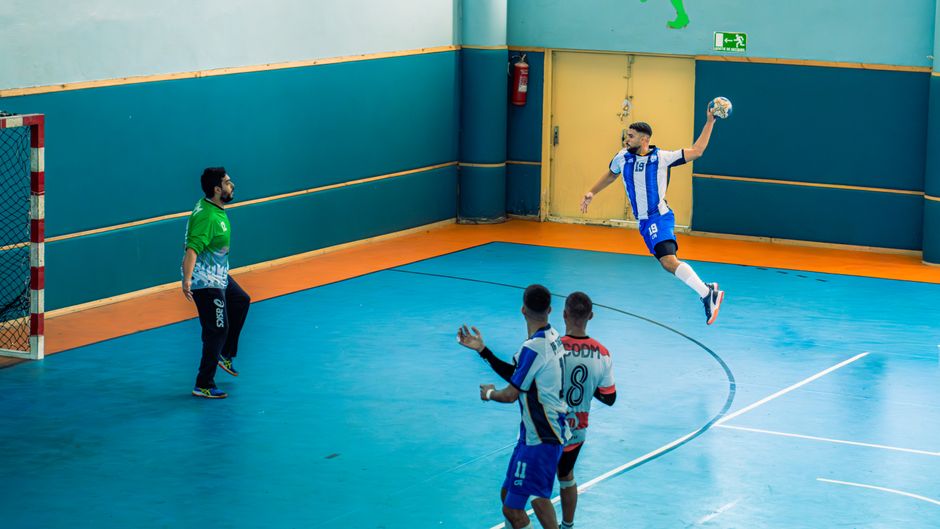
Most ACL tears in Norway’s top divisions happened without contact, in the plant-and-cut moves players make all game, and video work (Koga and colleagues, 2010) shows the knee collapsing inward within about 40 milliseconds of landing. That is why the prevention programs above coach landing technique rather than only strength: landing softly, keeping the knee tracking over the foot, and practicing jump shots and fakes with that in mind. It is worth asking a coach or physical therapist to watch your landings, because it is hard to feel your own knee position.
For the throw, handball shots take the arm into a large amount of external rotation before a fast forward whip (a 2019 scoping review of throwing mechanics). Nothing in our sources gives a “safe” throwing technique, so this page leaves the details to your coach and PT.
Training load: watch the jumps in hours
Among 679 elite youth players in Denmark (Møller and colleagues, 2017), a week in which handball hours jumped by more than 60% over the previous four weeks went with almost twice the shoulder injury rate, higher still in players with weak external rotators or poor shoulder-blade control. That is a research finding, not a rule for your team, but it supports the IOC consensus statement on load and injury, which links sudden workload changes to injury risk. A 2025 study of one German first-league team found weekly load varied more between players in congested weeks and that backcourt players and wings differed, so coaches should consider extra training or rest by role. For rest days, the American Academy of Pediatrics suggests 1 to 2 days off per week and about 3 months a year away from a single sport in blocks of at least a month for young athletes.
Strength and conditioning
Handball asks for running, jumping, throwing and contact in one match. A 2015 study of elite players found women covered about 4,700 meters and men about 3,900 per match, and men took on average 34.5 tackles in offense. Strength and plyometric work does build jumping power (a 2024 meta-analysis of 20 studies, 563 players), but those studies measured performance, not injuries, so do not assume the extra power equals protection. The AAP says supervised resistance training is safe for children and adolescents. One more honest note: an eight-week study of 92 youth players found two band exercises three times a week did not raise external-rotation strength (2021), so a single band routine may not be enough by itself. Your PT can tailor it.
Shoes, floors and the court
Handball is played on an indoor court in sports shoes, with sudden stops and cuts. The American Academy of Orthopaedic Surgeons (AAOS) advises shopping for athletic shoes late in the day, wearing the socks you play in, leaving about half an inch of toe room, checking that the heel is held, and lacing fully; choose a shoe made for court sports. We do not name a model because models change each year, and no source we found shows a particular shoe lowers injury rates.
Many players use resin to grip the ball. The IHF guidelines on Rule 4:9 allow glue on the shoes but not on the hands or wrist, since glue might come into the eyes or face. Resin on the floor is a separate matter we could not find research on, so this page makes no claim about it: if the floor feels slippery or sticky, tell the coach or facility before playing. The same goes for a damp spot, a loose board or a hall that is too warm.
Protective equipment and fit
Standards (the IHF’s equipment regulations): ankle braces with straps are allowed if they have no hard components, and braces and tape must match the sock color; knee protectors of soft thin material are allowed, but not with uncovered hard parts; elbow protection must be soft; mouthguards must be transparent or single-colored; masks and head protection are not allowed. National federations may apply different rules in lower-level club play, so check with your league. The National Athletic Trainers’ Association (NATA) says the most consistent risk factor for an ankle sprain is a previous sprain and recommends that athletes who have sprained an ankle tape or brace it for all practices and games.
Maker claims: products are sold with their own descriptions, and none of our sources show that any pad, brace or tape prevents injuries in handball specifically. Ask your athletic trainer what suits you. Many players keep a light resistance band set such as the THERABAND Resistance Bands for their shoulder routine and athletic tape such as Mueller MTape for taping a jammed finger. More about fit and rules is on our handball gear page.

THERABAND Resistance Bands Set
- 3 latex bands, 5 ft each
- Yellow, red, green
$11.99 at Amazon, as of Nov 17, 2026 02:07 UTC
Check price on Amazon
Mueller MTape Athletic Tape
- 1.5 in x 15 yd, 2 rolls
- Zinc oxide adhesive
- Tears by hand
Youth players
Both the Norwegian youth trial (ages 15 to 17) and the German adolescent study (average age about 15) enrolled teenagers, so those warm-ups are the best-supported starting point for youth teams. For younger players, the IHF sets smaller balls by age and shorter match halves; our youth handball page covers that. We found no prevention trial for children under 14 in handball, so be cautious about claims that say otherwise.
What prevention cannot do
No program removes the risk. The Norwegian trials lowered injury rates, not to zero, and programs only work when teams do them: only 29% of coaches in the shoulder trial used it as often as recommended, and 67% called it too time-consuming. In a video study of 59 injuries at an Olympic handball tournament, 86% came from contact, which warm-ups cannot stop. Concussion is a good example: among 945 Danish players aged 11 to 17, almost half kept playing after the hit, mostly by their own decision. The CDC HEADS UP guidance is to remove a player with a suspected concussion from play and keep them out until a health care provider clears them.
When to see a professional
- A head knock with confusion, headache, vomiting or any danger sign (the CDC says call 911 for the serious ones).
- A knee that pops, gives way or swells, or an ankle you cannot stand on.
- Shoulder pain that returns every time you throw, a drop in shot speed, or pain at night.
- A finger that looks crooked, cannot straighten at the tip, or stays swollen.
For what these injuries are and how they are usually handled, see our handball injuries page, and for rest and rebuilding see handball recovery. For match-day routines, see handball game day.
Handball injury prevention: FAQs
How long should a handball warm-up take?
The published programs are short: about 15 minutes in the Norwegian women’s ACL program and about 10 minutes for the shoulder program. We found no source that sets one required length for all teams.
Do prevention programs really work?
For the knee and ankle, trials in teen players found fewer injuries, and the shoulder program cut risk by 28% in one big trial, though a later meta-analysis was not statistically clear. They work best when done regularly.
Should I wear an ankle brace in matches?
NATA recommends taping or bracing for all practices and games after an ankle sprain. The IHF allows strap braces without hard components, in sock color. Ask your athletic trainer which fits you.
Does resin affect injury risk?
We found no study on this. What we can say is the IHF allows glue on shoes only, not on hands or wrists, because it might reach the eyes or face.
Can I add training hours quickly before a tournament?
Sudden jumps are risky. In Danish elite youth players, a rise of more than 60% in weekly handball hours compared with the previous four weeks went with almost twice the shoulder injury rate. Build up gradually, and ask your coach.
Sources
- Olsen et al., BMJ 2005, youth handball warm-up trial
- Myklebust et al., Clin J Sport Med 2003, ACL program
- Achenbach et al., 2018, adolescent knee program
- Andersson et al., Br J Sports Med 2017, OSTRC shoulder program
- Shoulder prevention meta-analysis, BMJ Open Sport Exerc Med 2025
- Fredriksen et al., 2020, shoulder program and strength
- Møller et al., Br J Sports Med 2017, workload and shoulder injuries
- IOC consensus statement on load and injury (2016)
- Koga et al., Am J Sports Med 2010, ACL mechanism
- Coach and captain survey, Scand J Med Sci Sports 2019
- Injuries in Olympic handball tournaments: video analysis (2004)
- Concussion in youth handball, JOSPT 2025
- Weekly training load in a German first-league team, 2025
- Michalsik and Aagaard, 2015, physical demands
- Plyometric training in handball players, 2024
- Shoulder external-rotation training in youth handball, JOSPT 2021
- Throwing mechanics scoping review, 2019
- AAP, Resistance Training for Children and Adolescents
- AAP, sports specialization and rest days (Brenner 2016)
- NATA position statement on ankle sprains
- AAOS OrthoInfo, Athletic Shoes
- IHF Regulations on Protective Equipment and Accessories
- IHF Rules of the Game, Indoor Handball (Rule 4:9 guidelines)
- CDC HEADS UP: response to a suspected concussion
General information for education only, not medical advice. If you are hurt or worried, see a sports medicine doctor, physical therapist or athletic trainer. How we work: editorial policy.