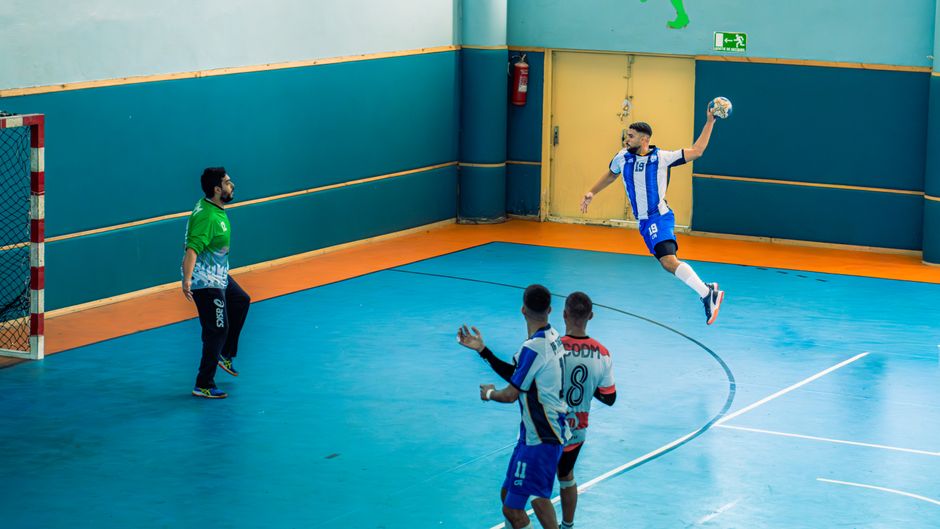
Ten seconds left, one goal down, and the referee points to the 7-meter line. The hall is loud, the goalkeeper is crouched in the middle of the goal, and everyone on the bench has stopped talking. Handball players know this moment from school gyms to national-league halls. Handball mental training means practicing the skills between your ears (focus, confidence, routines, quick decisions, bouncing back after a miss, talking with teammates) the way you practice a jump shot. This page is about mental performance, which is different from mental health; there is a clear section on that difference below.
Quick answer: Mental skills are trainable habits: one fixed routine for every 7-meter throw, a quick reset after a miss, simple imagery, small goals you control, and short clear calls with teammates. Research on these tools in handball is small and early, and none of them guarantees a better result. If worry, low mood, or trouble eating or sleeping lasts more than a couple of weeks or gets in the way of daily life, see a doctor, licensed psychologist or other qualified professional, and in a crisis call or text 988 (US).
Confidence and motivation
Confidence in sport psychology means your belief that you can do a specific thing, like beat the keeper from nine meters. It grows from repetition and from honest feedback, not from hype. A habit many coaches suggest: after each match, write down two things you did well, even in a loss.
Motivation has been studied in young players. In a 2026 experimental study of 36 cadet female handball players (Saket and colleagues, Frontiers in Psychology), an 8-week program of progressive muscle relaxation plus mental imagery, three sessions a week on top of normal training, was followed by bigger gains in several kinds of self-determined motivation than in a control group that only trained as usual. It was a small, non-randomized study, so treat it as promising, not proof.
Goals and focus
A common way to organize goals is to split them into three kinds: outcome (win the match), performance (score 4 of 5 in shooting practice) and process (use my routine every time, call my defender’s name). Process goals are fully in your control, so they hold up on a night when the shots don’t fall. This split is standard coaching practice rather than a result of one study.
Handball is fast and tiring, and a tired mind can feel like a tired body. In a 2026 randomized crossover study of 16 elite collegiate handball players (Kim and colleagues, Sports), mentally tiring tasks (a Stroop task or social media use) did not impair decision accuracy, although visual reaction time was slower after social media. The authors read this as strong attention control in elite players. It is one small study, so treat it as a curiosity, not advice.
The 7-meter throw: pressure in its purest form
A 7-meter throw is you against the goalkeeper with nothing in between, and everyone is watching. Researchers analyzed play-by-play data from 2,978 matches in the top Danish men’s and women’s leagues, 2017 to 2024 (Gümüş and colleagues, Frontiers in Psychology, 2026). Success rates stayed in a narrow band of roughly 73% to 78% across seasons, with no significant difference between men and women, and results in the last five minutes of close matches were close to the rest of the match. The authors suggest this reflects good psychological self-regulation and recommend adding attentional-focus and stress-regulation skills to penalty practice. It covers professional leagues in one country and recorded events, so it cannot tell us what any player was thinking.
Another analysis of 10,593 7-meter throws from the Icelandic elite division (Laxdal and colleagues, Journal of Human Kinetics, 2026) tested two beliefs: that the fouled player should not take the throw, and that you should swap the shooter after a miss. It found no sign that either one hurt results, so the authors say coaches can let their best 7-meter shooter take any throw. A missed penalty is not a verdict on the next one.
- Build a routine you can finish in the time you have. For example: pick your corner, one breath, look at the keeper, throw. Keep it the same in practice, scrimmages and matches. The 2026 position statement from Exercise and Sports Science Australia on performance under pressure (Schweickle and colleagues, Sports Medicine) lists pre-performance routines among its evidence-based strategies. It covers sport in general, not handball.
- Aim at a target, not at “don’t miss”. A corner is a job; a fear is a distraction.
- Practice with stakes. End practice with a 7-meter competition, with the team watching, loser does the cleanup. Keep it fun and fair so it builds readiness rather than dread.
- Expect to concede. In the Danish data above, 7-meter throws scored roughly three times in four, so conceding is normal. Do not judge your game by one penalty.
- Pick one focus cue for each throw (for example “watch the arm”) and practice it until it is automatic.
- Reset in one breath after a goal and be back in position before the next attack.
- Talk to your defense. The keeper sees the whole play; short calls can organize the wall.
- Try 3 to 5 minutes before bed or on the bus: see yourself, through your own eyes, doing your penalty routine and your first defensive step.
- Rehearse the hard version too: a loud hall, a one-goal game, you staying steady.
- Keep it short and regular. If it feels like a chore it won’t last.
- Agree on short calls for defense switches and set plays, and use them every practice.
- Encourage after errors. A hand slap or a “next one” helps the player who missed get back into play.
- Use team time-outs well. Handball teams get time-outs per game (see our handball game day guide); they are a moment to breathe, name one fix and go.
- Schweickle MJ et al. Performance Under Pressure in Sport: A Position Statement from Exercise and Sports Science Australia. Sports Medicine, 2026. PMID 42271117
- Reardon CL et al. Mental health in elite athletes: International Olympic Committee consensus statement (2026). British Journal of Sports Medicine. PMID 42580854
- Li L et al. Psychological interventions and competitive anxiety: Bayesian network meta-analysis. Sports Medicine – Open, 2026. PMID 41866642
- Gümüş H et al. Temporal and situational analysis of 7-m shots in elite handball: a multi-season study. Frontiers in Psychology, 2026. PMID 42052056
- Laxdal A et al. Fact or Fiction? Examining the Veracity of Common Myths Related to 7-meter Throws in Handball. Journal of Human Kinetics, 2026. PMID 42211803
- Jedziniak W et al. Differences in Gaze Behavior Between Male and Female Elite Handball Goalkeepers During Penalty Throws. Brain Sciences, 2025. PMID 40149833
- Kim J, Yook D, Han S. The Impact of Mental Fatigue on Decision-Making Abilities, Visual Search Strategies, and Simple Reaction Time in Handball Players. Sports, 2026. PMID 42043060
- Saket I et al. Effects of an 8-week mental preparation program combining progressive muscle relaxation and mental imagery in youth female handball players. Frontiers in Psychology, 2026. PMID 42638822
- Tannoubi A et al. Pre-session video observational modeling, emotional intelligence and 9 m shooting in U14 male handball players. Children, 2026. PMID 42194181
- Adiloğulları İ et al. Coach behaviours, team resilience, support perception and collective efficacy in young team athletes. BMC Sports Science, Medicine and Rehabilitation, 2025. PMID 40775348
- Przybylski J et al. Noise Cancelling Program: a psychoeducational mental skills program for young athletes. Current Issues in Personality Psychology, 2026. PMID 42959888
- 988 Suicide & Crisis Lifeline
Goalkeeper mindset
The goalkeeper faces the same pressure from the other side, with less time to think. In a 2025 study of 40 elite handball goalkeepers (Jedziniak and colleagues, Brain Sciences), 20 women and 20 men wore eye-tracking glasses while saving five penalty throws each. On saves, their “quiet eye” (a steady final fixation before the throw) was longer than on goals against. Men tended to watch the throwing arm and ball, while women tended to watch the torso and head. This is a study of where keepers look, not proof that training your eyes changes your save rate.
Suggestions, not tested rules:
Decision-making at pace
A handball attack can go from fast break to set play to a one-on-one in a few seconds, and the choice (pass, shoot, break through, go to the pivot) has to be made while a defender is on you. We did not find a handball study that shows one mental technique makes this decision faster, so this section stays practical. Coaches commonly build decisions into drills: small-sided games with rules that force a read (“score only after one extra pass”) and video review with the question “what did you see?”
One related finding: in a 2026 randomized trial of 33 U14 boys (Tannoubi and colleagues, Children), watching a 3 to 5 minute video of the 9-meter shooting technique before each session for six weeks went along with better emotional intelligence scores and 9-meter shooting than in a control group. The study was small and the link between the two is an association, not proof of cause.
Visualization and imagery
Imagery means rehearsing a skill in your mind with as many senses as you can: the run-up, the hall noise, the ball leaving your hand. The cadet handball study above combined imagery with muscle relaxation, so we cannot say which part helped. A 2026 six-month mental skills program for 92 young athletes aged 12 to 19 (Przybylski and colleagues, Current Issues in Personality Psychology), not handball-specific, reported more imagery use and mental skills afterwards. Imagery adds to real reps and never replaces them.
Teamwork and communication
Handball defenses work as a line and attacks as a unit, so teammates need clear shared language. A 2025 study of 285 young athletes in football, basketball, volleyball and handball (Adiloğulları and colleagues, BMC Sports Science, Medicine and Rehabilitation) found that athletes who felt supported by their coaches and teammates reported more team resilience and stronger belief in their team’s ability to cope with demanding conditions (collective efficacy). The data came from questionnaires at one point in time and mixed four sports, so it shows a link, not a cause, and it is not specific to handball.
Resets after a miss or a goal against
Handball produces a lot of goals, so errors are followed quickly by the next attack. Many coaches teach a short reset: acknowledge it (a breath), take one lesson (“I telegraphed my pass”), then move to the next job (get back in defense). Pick one cue, such as a hand clap or the word “next”, and use it after good plays and bad ones so it becomes a habit. This is common coaching practice, and we did not find a handball study that tested it.
On pressure in general, the ESSA statement says it can help or hurt performance and that adding some pressure in training can help prepare athletes. A 2026 network meta-analysis of competitive-anxiety interventions across 46 trials (Li and colleagues, Sports Medicine – Open) reported substantial uncertainty, so no single technique can be called the best.
Preparing for competition
Plan one or two imagery sessions, a 7-meter routine practiced under mild pressure, one or two process goals and an agreed team reset cue. Tournament-day logistics (meals, fluids, rest between games, warm-ups) are in the handball game day guide. Physical preparation is in the handball training guide, and sleep and bounce-back in the recovery guide. If an injury is part of why you feel anxious about playing, see our handball injuries guide and talk to a sports medicine doctor, physical therapist or athletic trainer before returning.
Young players
Keep it light for kids: fun routines, effort goals and praise for trying. Studies of mental skills in youth handball players are small (the trials above), and the 2026 IOC consensus statement lists adolescents among groups where research is thinner, so adults should watch for signs of struggle. See our youth handball guide for age-based guidance.
Mental performance is not mental health care
Routines, imagery and resets are performance tools. Anxiety disorders, depression, disordered eating and burnout are health matters, and they need a qualified professional such as a doctor, licensed psychologist or counselor. The 2026 International Olympic Committee consensus statement on mental health in elite athletes (Reardon and colleagues, British Journal of Sports Medicine) says mental health symptoms and disorders are common in elite athletes, can affect performance, and can be treated, and that with support many athletes keep training and competing. Signs worth raising with a professional: weeks of low mood, constant dread, changes in eating, sleep or weight, pulling away from teammates, or losing interest in a sport you love.
If you or someone you know is thinking about self-harm, call or text 988 or chat at 988lifeline.org (US, free, 24/7, confidential). In immediate danger, call 911. Outside the US, use your local emergency number or crisis line. College players can also ask their athletics department about campus counseling and sports medicine staff.
FAQs
How do I stay calm taking a 7-meter throw?
Use the same short routine you use in practice, aim at a corner, and practice it under mild pressure. Routines are one of the strategies the 2026 ESSA position statement lists as evidence-based, though nothing guarantees a goal.
How can a goalkeeper get better at penalties mentally?
Accept that most penalties are goals, pick one focus cue, and reset quickly. Eye-tracking research found a longer quiet eye on saves than on goals, but that does not show that training your gaze improves saves.
Does visualization help handball players?
A small 2026 study of cadet female players found gains in motivation after a program combining imagery and relaxation. Evidence is limited, and imagery works best next to real practice.
Is pre-match anxiety normal?
Some nerves are common and can even help, according to the ESSA statement. If worry is constant, causes panic, or disrupts sleep or eating, talk to a doctor or licensed mental health professional.
Sources
General information for education only, not medical advice. It does not replace a doctor, psychologist or other qualified professional. See how we work in our editorial policy. Back to the handball hub.