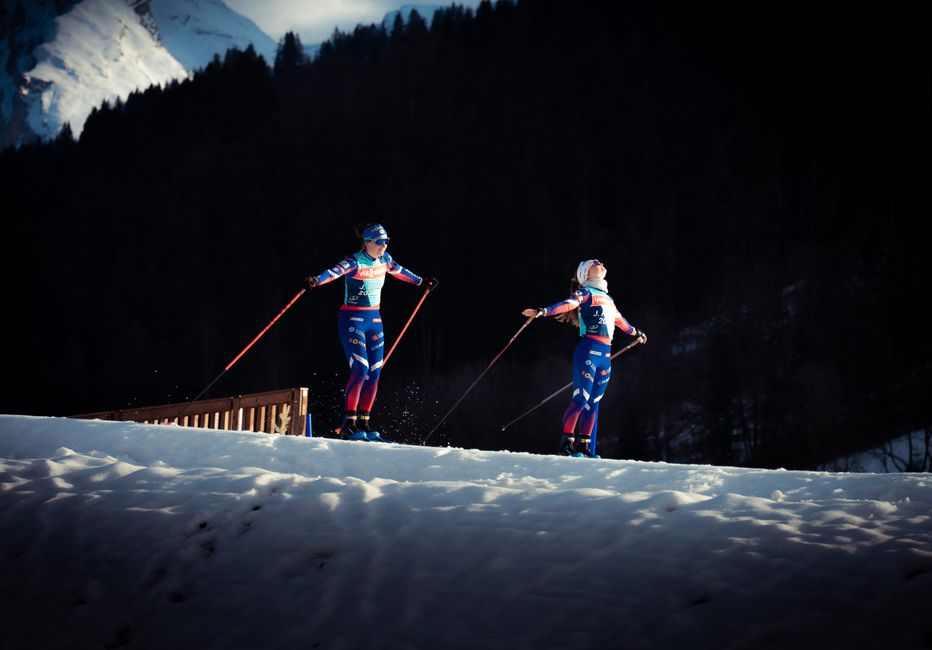
You are two-thirds of the way round a 15 km race, climbing the long hill for the third time. Your arms are heavy, your breath is loud inside your buff, and a skier you have chased since the start is pulling away on the flat. Every racer knows some version of that moment. Cross-country ski mental training means practicing the skills between your ears (pacing, focus, handling hurt, a calm routine at the start line) the way you practice your double pole. This page is for skiers, parents and coaches. It is about mental performance, which is different from mental health; there is a clear section on that difference below.
Quick answer: Mental skills are trainable habits: a race plan you have rehearsed, a start that is not too fast, one or two focus cues for the climbs and the flats, a simple routine before the start, and a plan for what you do after a bad race. Published research on pacing in skiers is fairly strong; research on imagery, routines and mindfulness in skiers is thin, and none of it shows a guaranteed faster time. If worry, low mood, or trouble eating or sleeping lasts more than a couple of weeks or gets in the way of daily life, see a doctor, licensed psychologist or other qualified professional, and in a crisis call or text 988 (US).
Pacing: the mental side of a long, hilly race
Ski courses go up and down, so effort is never steady. A 2024 review of pacing in Nordic skiing (Losnegard, Kocbach and Sandbakk, International Journal of Sports Physiology and Performance) says the stop-start pattern of climbs, flats and descents means skiers must continuously regulate effort, and that heart rate, lactate and speed readings should supplement, not replace, perceived effort for setting intensity on rolling terrain. Its authors add that the ability to self-regulate effort should be developed in young skiers. In plain words: learning to feel your effort is a skill, and it can be practiced.
The clearest evidence is about starting too fast. In a 2022 study of 34 teenage skiers (about 17 years old) on a 7.5 km course (Losnegard and colleagues, same journal), the half who started fastest were told on day two to slow their opening pace. They started about 8% slower, felt less strained at the start (effort rating 5 down to 4 out of 10), and finished faster overall (about 1.9%), while the other half, who changed nothing, did not improve. A 2023 study of 38 highly trained biathletes found a similar result on roller skis. These are short time trials, not a 50 km marathon, and the skiers were told what to do, but they back a simple rule many coaches teach: the first lap should feel easier than you think it should.
Mass starts add a second mental job. In a 2022 study of a 21.8 km skating mass start with 57 men (Seeberg and colleagues, Frontiers in Sports and Active Living), skiers were in one big pack for the first 2.3 km, with an “accordion effect” that caused extra braking and surging and a higher risk of incidents for skiers at the back; 31% reported incidents, none among the top ten. The authors list a good start position, avoiding the accordion, tolerating changes in intensity and holding speed on the uphills as key factors. A calm head in the pack, not panic, is part of the plan. How a mass start works is on our rules page.
Discomfort tolerance: what the hurt is made of
Skiing hurts in more than one way, and knowing which hurt you are in helps. A 2024 review of “intermittent endurance events” (Falk Neto, Faulhaber and Kennedy, Sports) describes cross-country skiing as repeated moderate surges of roughly 30 seconds to 2 minutes, often above the pace you could hold steadily, so a long race is many short hills strung together. A 2024 study of ten competitive skiers on roller skis (Gløersen and colleagues, European Journal of Applied Physiology) found that skiers went deeper into the red during each hard stretch of a 3.5-minute effort than of a 15-minute one, which suggests skiers change how hard they push as the race gets longer.
What does the research say about toughness itself? A 2026 narrative review of pacing in Olympic winter endurance sports (Edholm and colleagues, Scandinavian Journal of Medicine and Science in Sports) describes pacing as a mix of the body (the “engine”) and the mind (the “operator”: self-regulation, expectations and how effort is read), and calls for training that develops both in realistic conditions. We found no skiing study that shows a way to “toughen up” and finish faster. Practical habits are more modest: practice race effort on the same hills in training, break a long course into sections with a cue for each, and use a process goal such as “long glide, quick pole” for when the numbers look ugly. Rehearsal, not slogans, makes the hurt familiar.
Staying focused through long sessions
A skier’s weeks are full of long, slow sessions. In a study of the training of Olympic and World champions (Tønnessen and colleagues, 2014, PLoS One), about 90% of their endurance training was at low intensity. That is a lot of hours with your thoughts. Mental drift on a three-hour ski or roller-ski is normal. Many coaches use one technique cue per section (hips forward, tall on the kick) and return to it whenever attention wanders. The training itself is covered on our training page.
One small skiing study touches on attention and breathing. In a 2007 study of 13 well-trained skiers roller-skiing on a treadmill (Fabre and colleagues, International Journal of Sports Physiology and Performance), deliberately timing the out-breath with the poles did not change oxygen use but gave a lower rating of perceived effort. It was a short lab study, not a race, so treat it as an idea to try, not a promise.
Confidence, motivation and goals
Confidence grows from evidence you can point to: a hard interval session completed, a race-pace loop you held, a personal best on a favorite trail. Split goals into three kinds: outcome (a podium, a qualifying place), performance (a time on a known course) and process (a calm first kilometre, a sharp kick every stride). Process goals stay in your control when waxing, weather or a crowded start spoil the day. We found no skiing study that tests goal-setting, so this is common coaching practice.
Imagery and race routines
Imagery means rehearsing a race in your mind with as many senses as you can: the cold on your face, the start gun, the rhythm of the climb. A 2023 systematic review and meta-analysis of psychological interventions across sports (Reinebo and colleagues, Sports Medicine) found moderate effects for imagery, multimodal psychological skills training and mindfulness-based approaches compared with controls, but the effects were not stable: they were no longer significant once non-randomized trials and subjective outcomes were removed. We found no skiing-only imagery trial, so treat it as an add-on to real skiing.
A 2026 position statement from Exercise and Sports Science Australia on performance under pressure (Schweickle and colleagues, Sports Medicine) lists pre-performance routines among evidence-based strategies, along with psychological skills training and mindfulness-based approaches, and says pressure can help as well as harm. For a skier, a routine can be as simple as the same order every race: check skis, same warm-up loop, a few starts, the same breathing, one cue word. A short, specific warm-up can work well for sprints: in a 2020 study of 14 national-level skiers (Solli and colleagues, International Journal of Sports Physiology and Performance), eight 100 m build-up runs gave the same sprint time as a long 35-minute warm-up. That is a small study at one level, so ask your coach. Wax, food, layers and start-line logistics are on our ski day and race day page; keep them in the routine so the morning has no surprises.
After a bad race
Every skier has a bad day: skis that would not grip, a fall on the downhill, an opening kilometre that cost the finish, a result that does not match the work. The useful skill is how quickly you come back. Many coaches teach three steps: acknowledge it (one slow breath), learn one thing (“I went out too hard” or “my kick wax was wrong”), and move to the next job (the cool-down, the next race, the next training week). Talk to yourself the way you would to a training partner. Review splits for lessons, not blame. We found no skiing study on recovering from a bad race, so this is common coaching practice, not a proven method. A bad race can also be a sign that you are tired from training, so see cross-country ski recovery and injuries.
Mental performance is not the same as mental health
Everything above is about performance skills. Anxiety disorders, depression, disordered eating and burnout are health matters, not mindset problems, and they are not fixed by a better race plan. The 2026 International Olympic Committee consensus statement on mental health in elite athletes (Reardon and colleagues, British Journal of Sports Medicine) treats them as medical and psychological care issues. Signs to take seriously include worry or low mood lasting weeks, dread of racing, withdrawing from the ski team, or big changes in eating or sleep.
Start with your doctor, a licensed psychologist or other qualified mental health professional. In the US, you can call or text 988 (Suicide & Crisis Lifeline) at any time. For eating and weight worries, a clinician should lead care; basics are in our nutrition and supplements guide.
Frequently asked questions
How do I stop going out too fast in a ski race?
Rehearse a slower first lap in training and judge it by effort, not by the skiers around you. In a 2022 study of teenage skiers, those who started fast and were told to slow down finished faster. Test it with your coach, because a race is not a controlled trial.
How do I handle the pain on the last climb?
Practice it. Ski race-pace efforts on hills like it, give the climb one technique cue, and keep a process goal for when your mind starts to bargain. We found no skiing study that proves a pain-tolerance method.
How do I stay focused on a three-hour ski?
Pick a cue for each section, return to it when your mind drifts, and accept that drifting is normal. Long, easy volume is the core of elite skiers’ training, so it is worth making it purposeful.
How do I recover mentally from a bad race?
Take one slow breath, pick one lesson, and turn to the next job. If low mood or worry lasts for weeks, see a doctor or a licensed mental health professional.
Should my young skier see a sport psychologist?
Most juniors need fun, supportive coaching, not a specialist. If a child shows lasting distress, start with their pediatrician or a licensed mental health professional. Youth ski basics are on our youth page.
Sources
- Losnegard T, Kocbach J, Sandbakk Ø. Pacing Demands in Competitive Nordic Skiing. Int J Sports Physiol Perform, 2024. PMID 39231491
- Losnegard T et al. Cross-Country Skiers With a Fast-Start Pacing Pattern Increase Time-Trial Performance by Use of a More Even Pacing Strategy. Int J Sports Physiol Perform, 2022. PMID 35193112
- Losnegard T et al. Highly Trained Biathletes With a Fast-Start Pacing Pattern Improve Time-Trial Skiing Performance by Pacing More Evenly. Int J Sports Physiol Perform, 2023. PMID 37758254
- Seeberg TM et al. Race development and performance-determining factors in a mass-start cross-country skiing competition. Front Sports Act Living, 2023. PMID 36704262
- Falk Neto JH, Faulhaber M, Kennedy MD. The Characteristics of Endurance Events with a Variable Pacing Profile. Sports, 2024. PMID 38921858
- Gløersen Ø et al. The influence of race duration on oxygen demand, uptake and deficit in competitive cross-country skiers. Eur J Appl Physiol, 2024. PMID 38918220
- Edholm P et al. Mind-Muscle-Environment Interactions: Psychophysiological Determinants of Optimal Pacing in Olympic Winter Endurance Sports. Scand J Med Sci Sports, 2026. PMID 41665741
- Tønnessen E et al. The road to gold: training and peaking characteristics in the year prior to a gold medal endurance performance. PLoS One, 2014. PMID 25019608
- Fabre N et al. Paced breathing in roller-ski skating: effects on metabolic rate and poling forces. Int J Sports Physiol Perform, 2007. PMID 19255454
- Solli GS et al. The Effects of a Short Specific Versus a Long Traditional Warm-Up on Time-Trial Performance in Cross-Country Skiing Sprint. Int J Sports Physiol Perform, 2020. PMID 32182587
- Reinebo G et al. Psychological interventions to enhance athletic performance: a systematic review and meta-analysis. Sports Medicine, 2023. PMID 37812334
- Schweickle MJ et al. Performance Under Pressure in Sport: A Position Statement from Exercise and Sports Science Australia. Sports Medicine, 2026. PMID 42271117
- Reardon CL et al. Mental health in elite athletes: International Olympic Committee consensus statement (2026). Br J Sports Med. PMID 42580854
- 988 Suicide & Crisis Lifeline
General information for education only, not medical advice. It does not replace a doctor, psychologist or other qualified professional. See how we work in our editorial policy. Back to the cross-country skiing hub.