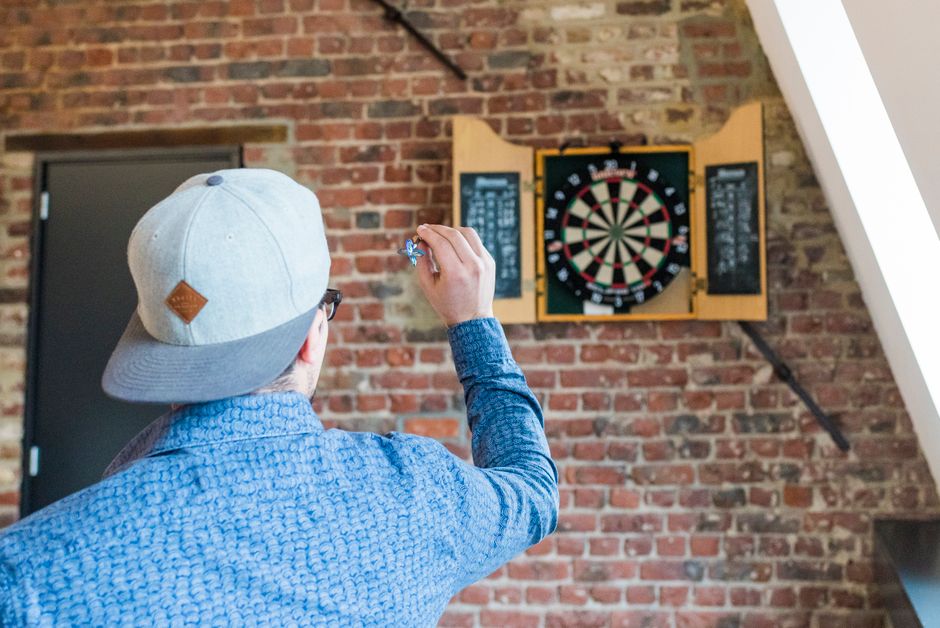
You are one leg from the match. You have 40 left, the double 20 is waiting, and the room has gone quiet enough that you can hear the glasses. The first dart drifts just outside the wire. Your arm feels slightly different than it did an hour ago. What you do over the next ten seconds is a skill, and it can be practiced. Mental training for darts players is the deliberate use of routines, attention, self-talk and preparation to throw your own darts under pressure, from a pub league to a floor tournament. It supports good throwing; it cannot promise a checkout.
Quick answer: Studies of dart players suggest a few useful habits: a steady final look at the target before each throw, a short self-talk cue, and practice that includes noise, tiredness and stakes. None of these guarantees a result. See a doctor if your hand will not release the dart or throws feel involuntary, and a licensed mental health professional if worry, low mood, disordered eating or exhaustion are affecting daily life.
General information for players. Back to the darts hub. Practice routines, stance and the basic mental findings are on our darts training page, and food, drink and the long wait on the day are on the match night and tournament day page. This page goes deeper on the thinking side and avoids repeating those.
Build a pre-throw routine you can repeat
A routine is the same short sequence before every visit: feet set, breath, pick the exact spot, look, throw. Its job is to make the throw feel automatic when the match is not. The best-supported ingredient is the look. In a randomized study of 30 novice dart players (Norouzi and colleagues, Motor Control, 2019), quiet eye training, a steady final look at the target before throwing, and “quiet mind” training both cut errors more than normal practice, including when players were put under stress. These were novices, so treat it as a promising habit, not a proven recipe for professionals.
Keep the routine short enough to do on every dart, including the third one. Many players find a routine that changes with the score is a routine that disappears when it matters most. Practice it on a normal Tuesday so it is already there on a Saturday final.
Focus and self-talk
In a 2025 study of 43 novice players (Geng and colleagues, PLoS One), a self-talk group kept attention and performance steadier than others when mentally tired and distracted by noise. A broader meta-analysis of 32 studies (Hatzigeorgiadis and colleagues, Perspectives on Psychological Science, 2011) found self-talk helped more on fine, precise tasks than on strength or endurance tasks, which is a fair description of darts. Pick a short cue you believe, such as “smooth” or “through”, rather than a speech.
What to focus on is less clear. A 2026 systematic review of 19 studies (Feng and colleagues, Frontiers in Psychology) found no consistent advantage for focusing on the target over focusing on your arm movement; it depended on the player and the task. So choose what keeps your throw automatic, and be wary of advice that says there is only one right place to put your attention.
Finishing under pressure: doubles
Doubles are where nerves show up, because the next dart can end the leg. Two findings are worth knowing. An analysis of 32,274 throws by professionals (Ötting and colleagues, PLoS One, 2020) found no evidence that they choke, or excel, under pressure on average. Another study of 26,724 professional performances (Greve and colleagues, Scientific Reports, 2023) found real crowds lowered checkout percentage slightly. The effects were small. The practical reading for the rest of us is that pressure is real but manageable, and preparation tends to matter more than the room.
Some ways to apply it, offered as common practice rather than proven methods for darts:
- Throw at one double at a time. Decide your outs before you step up, so the thinking is done and only the throw is left.
- Give practice doubles a score. A friend, a forfeit or a streak counter makes the dart matter.
- Run the same routine on dart one and dart three. A rushed last dart is a different throw.
- Judge the habit, not the dart. A missed double thrown with your full routine was still a good visit.
When the throw itself goes wrong: dartitis
“Dartitis” is the name players use when the hand will not let go of the dart at the right moment, or the throw stalls. We did not find a darts-specific study in the medical literature, so we cannot say how common it is or what fixes it. Closely related work is on the “yips” in golf putting. A study of 15 golfers with yips (Stinear and colleagues, Medicine and Science in Sports and Exercise, 2006) found they could be sorted into two groups: one with mainly movement-related symptoms, linked to impaired movement initiation and execution, and one with mainly anxiety-related symptoms, linked to performance anxiety. That is a different sport and a small study, so it is a way of thinking about the problem, not a diagnosis for dart players.
What follows from that is simple. If the trouble is mostly nerves, a calmer routine, shorter sessions and stakes-free practice may help, and a sport psychology consultant can work with you. If it is a physical, involuntary problem, or it spreads beyond darts, see a doctor first. Do not try to force your way through it by throwing more.
Handling a bad leg
Every player loses a leg badly. One study of 80 professional matches (Stins and colleagues, Frontiers in Psychology, 2018) found accuracy at treble 20 declined over the course of a match, so a dip late on is normal and not a sign that something is broken. Some habits that fit the evidence on routine and self-talk:
- Reset in the walk to the board. One slow breath out, back to the first part of your routine. Slow breathing is linked to calmer, more alert states in a review of the research (Zaccaro and colleagues, Frontiers in Human Neuroscience, 2018).
- Throw the next visit, not the last one. A leg is over when it is over.
- Use the cue word. Say it, then throw.
- Talk about it after the match, not between legs. Looking at your averages the next day is more useful than replaying it in your head.
Goals, confidence and motivation
Goals you control keep you steadier than goals you do not. “Run my full routine on every dart” is in your hands; “win the league” is not. Track your three-dart average and checkout percentage over weeks, as our training page suggests, and let the trend, not one night, build your confidence. We found no darts-specific study on goal setting or motivation, so this is general coaching practice, not a research result.
Tournament nerves
Nerves before a big event are normal and, on average, they do not wreck professional performance (see Ötting and colleagues above). The practical work is to rehearse the unfamiliar: throw at a new board in a noisy room, practice a long format so late-match concentration is familiar, and arrive early enough to find the practice area without rushing. For eating, drinking, caffeine, alcohol rules and drug-testing notes, see match night and tournament day; we will not repeat them here. If you are a younger player, our youth darts page covers the rules and safety side.
If you like to see imagery in your preparation, picturing the full routine and the dart landing is common practice among athletes in many sports. We did not find a darts-specific study on it, so use it only as a calming extra, not a substitute for throwing.
Mental performance is not the same as mental health
Routines and self-talk are performance skills. Anxiety, depression, disordered eating, heavy drinking or burnout are health matters, and a coach or a book cannot replace a qualified professional. The IOC consensus statement on mental health in elite athletes (Reardon and colleagues, British Journal of Sports Medicine, 2019) treats them as health concerns that need assessment and care. If these are affecting your sleep, work, relationships or enjoyment of the game, talk to a doctor or a licensed mental health professional. In the United States, you can call or text 988 to reach the 988 Suicide and Crisis Lifeline at any time. The Association for Applied Sport Psychology lists resources for finding a qualified sport psychology consultant.
Darts mental training: FAQs
What is dartitis?
It is the players’ name for a hand that will not release the dart normally. We did not find a darts-specific medical study. Research on the golf yips describes movement-related and anxiety-related types, so see a doctor if it persists.
Do professional darts players choke under pressure?
An analysis of 32,274 professional throws found no evidence of choking or excelling under pressure on average. Another study found real crowds lowered checkout percentage slightly.
What is quiet eye in darts?
It is a steady final look at the target before the throw. In a randomized study of 30 novices, training it reduced errors more than normal practice.
How do I recover after losing a leg badly?
Reset with one slow breath, return to your routine, use your cue word and throw the next visit. Late dips are normal across a match, according to a study of 80 professional matches.
Does self-talk help darts?
In a 2025 study of 43 novices, a self-talk group stayed steadier when tired and distracted. Keep the cue short, and remember that it will not guarantee a score.
Sources
- Norouzi E et al. Effect of quiet eye and quiet mind training on motor learning among novice dart players. Motor Control 2019 (PMID 31553944)
- Geng et al. Self-talk and dart performance under ego depletion and noise. PLoS One 2025 (PMID 40112017)
- Feng, Shangguan and Zhu. Internal and external attentional focus on dart-throwing performance: a systematic review. Front Psychol 2026 (PMID 42755506)
- Ötting M et al. Performance under pressure in skill tasks: an analysis of professional darts. PLoS One 2020 (PMID 32084161)
- Greve et al. Crowd effects in professional darts. Sci Rep 2023 (PMID 37524747)
- Stins JF et al. Performance over a match in elite darts. Front Psychol 2018 (PMID 29755389)
- Stinear CM et al. The yips in golf: multimodal evidence for two subtypes. Med Sci Sports Exerc 2006 (PMID 17095933)
- Hatzigeorgiadis A et al. Self-talk and sports performance: a meta-analysis. Perspect Psychol Sci 2011 (PMID 26167788)
- Zaccaro A et al. How breath-control can change your life: slow breathing review. Front Hum Neurosci 2018 (PMID 30245619)
- Reardon CL et al. Mental health in elite athletes: IOC consensus statement (2019). Br J Sports Med 2019 (doi, PMID 31097450)
- 988 Suicide and Crisis Lifeline (988lifeline.org)
- Association for Applied Sport Psychology resources (appliedsportpsych.org)
General information for education only, not medical advice. It does not replace a doctor, licensed mental health professional or qualified coach. See our editorial policy for how we research and write.