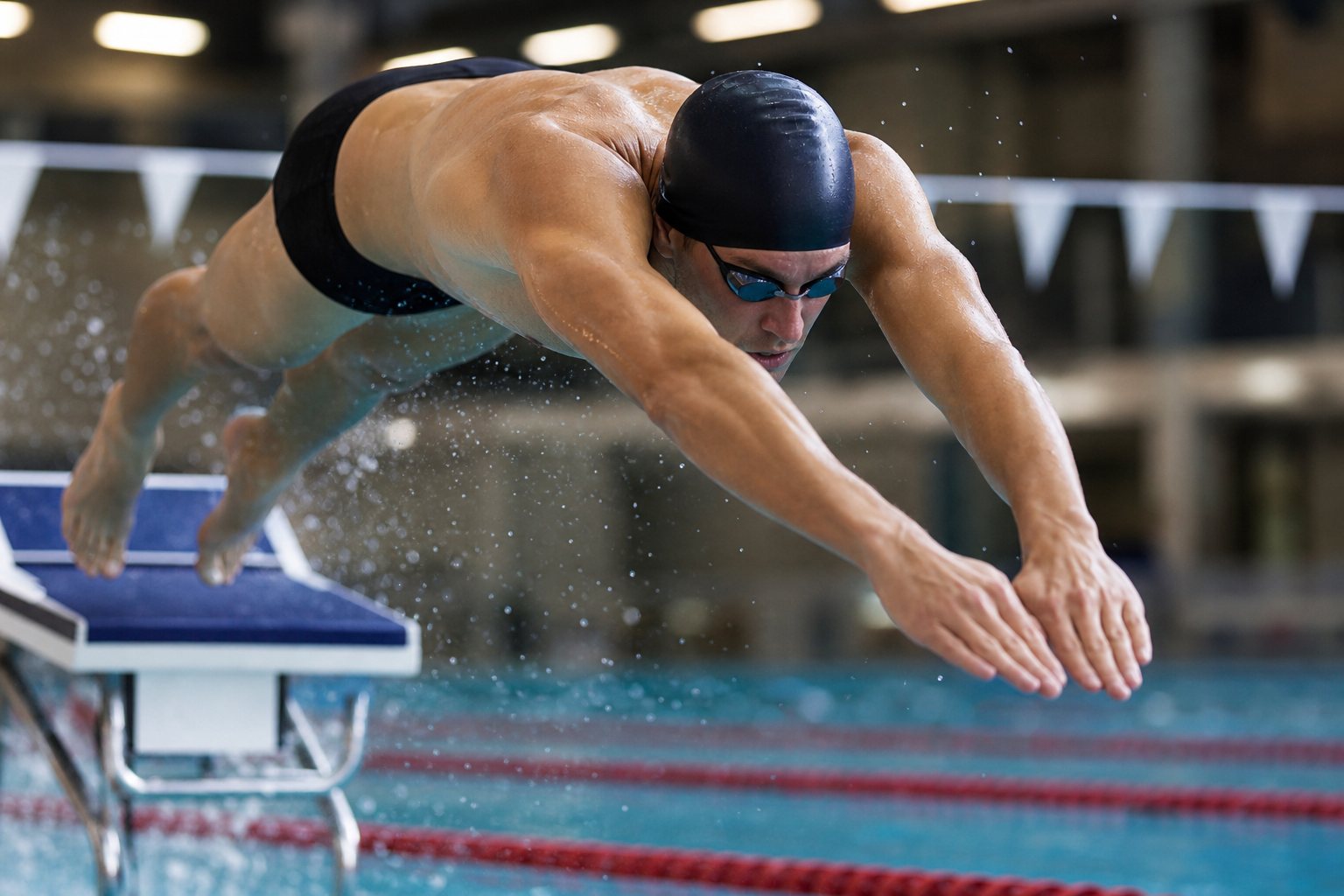
The swimmer’s shoulder aches at the top of the stroke, the diver’s wrist is sore after a week of hand-first entries, and the water polo player has a fat lip and a headache after taking a ball to the face. Aquatic injuries cover what typically goes wrong in swimming, diving, water polo and artistic swimming: mostly overuse of the shoulder, plus knees, back and wrists, with contact and head injuries in water polo and board or platform impacts in diving. This page names the patterns and the numbers behind them. It does not diagnose anything.
Quick answer: Across the aquatic sports, the shoulder is the most commonly reported problem, mostly from overuse. Water polo adds head, face and finger injuries from contact; diving adds head and impact injuries. Do not train through pain that stays or sharpens. See a sports medicine doctor, physical therapist or athletic trainer, and call emergency services for danger signs after a head or neck injury.
The big picture: injuries across aquatic sports
At the 2015 FINA World Championships, injuries and illnesses affected 12.9 per 100 athletes. The most common injuries were shoulder sprains and low-back muscle cramps (5.7% each); the most common illnesses were respiratory (33.9%) and gastrointestinal (23.5%). Injury incidence was highest in high diving, water polo and diving, and the authors recommended focusing on out-of-competition overuse injuries (Mountjoy et al., PMID 27313172). A study of 2019 Gwangju championships clinic visits found elite athletes visited at 15.0% against 8.6% for amateurs, and the most frequent elite injury was overuse of the shoulder joints (Bom et al., PMID 36794242). One caveat applies to all these numbers: they come from different groups and different ways of counting, so compare them with care.
Swimmers: shoulder first
- Shoulder. AAOS says shoulder pain from repetitive motion is the most common swimming injury. In a study of 80 elite swimmers aged 13 to 25, 91% reported shoulder pain, and hours swum and weekly mileage were linked with tendon problems (Sein et al., PMID 18463295). In US high school data (2008 to 2019), 563 swimming and diving injuries were recorded, and in swimmers the shoulder accounted for 48.6% (PMID 36715985). NCAA data from 2009-10 to 2013-14 also found the shoulder the most injured area, mostly strains and overuse (Kerr et al., PMID 25633831).
- Knee. A survey of 391 athletes found knee pain in 73% of breaststroke specialists against 48% of other swimmers (Rovere and Nichols 1987, PMID 3812862). A 1980 study of breaststrokers with knee pain found onset usually within three years of starting breaststroke (PMID 7377447).
- Back. A 2021 review of swimming-injury epidemiology reported high prevalence of shoulder, knee and lower-back problems from overuse (PMID 33010194).
Divers, water polo players and artistic swimmers
- Divers. In a four-season study of 63 Australian national-program divers, 70% to 85% had an injury each year, most in training (79.3%) rather than competition (Currie et al., PMID 39277492). In US high school data, injuries in divers were mostly to the head and face (36.6%), and 68.3% involved contact with the playing surface (PMID 36715985).
- Water polo. World Aquatics’ own rules call water polo a contact sport whose incidence of traumatic injuries is the highest of its sports. A systematic review of 41 articles found head, fingers and shoulders the most common sites, with training injuries mainly in the shoulder (PMID 34150321). In Pac-12 collegiate data (2016-2021), shoulder injuries were 20.6% and head and face 18.8%; concussion was the most common single diagnosis at 11.4%, mostly outside competition (PMID 35898203).
- Artistic swimming. A 2025 review of 11 studies pointed to shoulders, back and knees, and noted methodology limits (Rincon et al., PMID 40070964). We found no reliable rates per 1,000 hours, so we give none. See artistic swimming injuries.
Concussion
Concussion matters in water polo and diving, and anywhere a swimmer hits a wall, a lane rope or another person. The CDC HEADS UP message is to recognize and remove: an athlete who may have a concussion leaves the water for the day and sees a healthcare provider, who decides when they return. Call 911 for danger signs such as repeated vomiting or a seizure, or if the person cannot be woken. The 2023 Amsterdam consensus describes a short period of relative rest followed by a stepwise return, but timing is an individual decision for a clinician.
Ears, eyes and skin
Water-related problems are common and usually minor. The CDC says swimmer’s ear needs a provider if there is ear pain or drainage, and chloramines can irritate eyes and the airways at poorly ventilated indoor pools; tell the pool operator about a strong chemical smell. Eye or skin irritation that does not settle is a reason to ask a doctor. Prevention steps are on the injury prevention page.
Rehabilitation principles
Rehab is the job of a clinician, so this is background, not a plan. Return to sport is described in the research as a continuum rather than a single moment, and a decision shared between athlete, clinician and coach (Ardern et al., PMID 27226389). For a swimmer, rehab often means keeping what is safe going, such as kicking or an alternative activity, while an injured area settles; that is general rehabilitation practice, not a quotation. Strengthening of the shoulder girdle is common, which is why trials of shoulder programs exist (PMID 40077099). We do not give recovery times or clear anyone to return, because they vary by person and by injury.
When to see a professional
- Pain that lasts more than a couple of weeks, returns every session or wakes you at night.
- Pain that changes how you swim, take off, throw or land.
- Numbness, tingling, weakness, a locked or giving-way joint, or visible swelling.
- Any head blow with symptoms, any suspected neck injury after a dive, and any ear pain or drainage.
Related: swimming injuries, diving injuries, water polo injuries, aquatic recovery.
Frequently asked questions
What is the most common aquatic injury?
The shoulder. AAOS calls shoulder pain from repetitive motion the most common swimming injury, and the 2015 World Championships data listed shoulder sprains among the most common injuries.
What is swimmer’s shoulder?
It is the common name for shoulder pain in swimmers, often linked with tendon irritation from repeated strokes. A clinician can say what is happening in a specific shoulder.
Can I keep swimming with shoulder pain?
That is a question for a clinician. AAOS and most coaches advise not training through pain, and kicking or another activity may be an option while you get checked.
Do divers get concussions?
Yes. In US high school data, divers’ injuries were mostly to the head and face. Follow the CDC HEADS UP steps.
Is water polo dangerous?
World Aquatics’ rules call it a contact sport with the highest rate of traumatic injuries among its sports. Rules, ear guards, referees and coaching reduce risk; they do not remove it.
Sources
- Mountjoy et al., injury and illness at FINA World Championships 2015
- Bom et al., Gwangju 2019 clinic visits
- Sein et al., shoulder pain in elite swimmers
- High school swimming and diving injuries (HS RIO), Clin J Sport Med 2023
- Kerr et al., NCAA swimming injuries, 2015
- Rovere and Nichols, breaststroker’s knee
- Stulberg et al., breaststroker’s knee, 1980
- Epidemiology of swimming injuries, PM&R 2021
- Currie et al., diver injuries 2024
- Water polo injuries: systematic review, 2021
- Collegiate water polo injuries, Pac-12
- Rincon et al., artistic swimming injuries review 2025
- Ardern et al., return to sport consensus 2016
- CDC HEADS UP
- AAOS OrthoInfo: swimming injury prevention
- World Aquatics water polo rules (Part Six, 2023)
General information for education only, not medical advice. It does not replace a visit with a doctor, physical therapist or athletic trainer. See how we write and check our pages in our editorial policy.