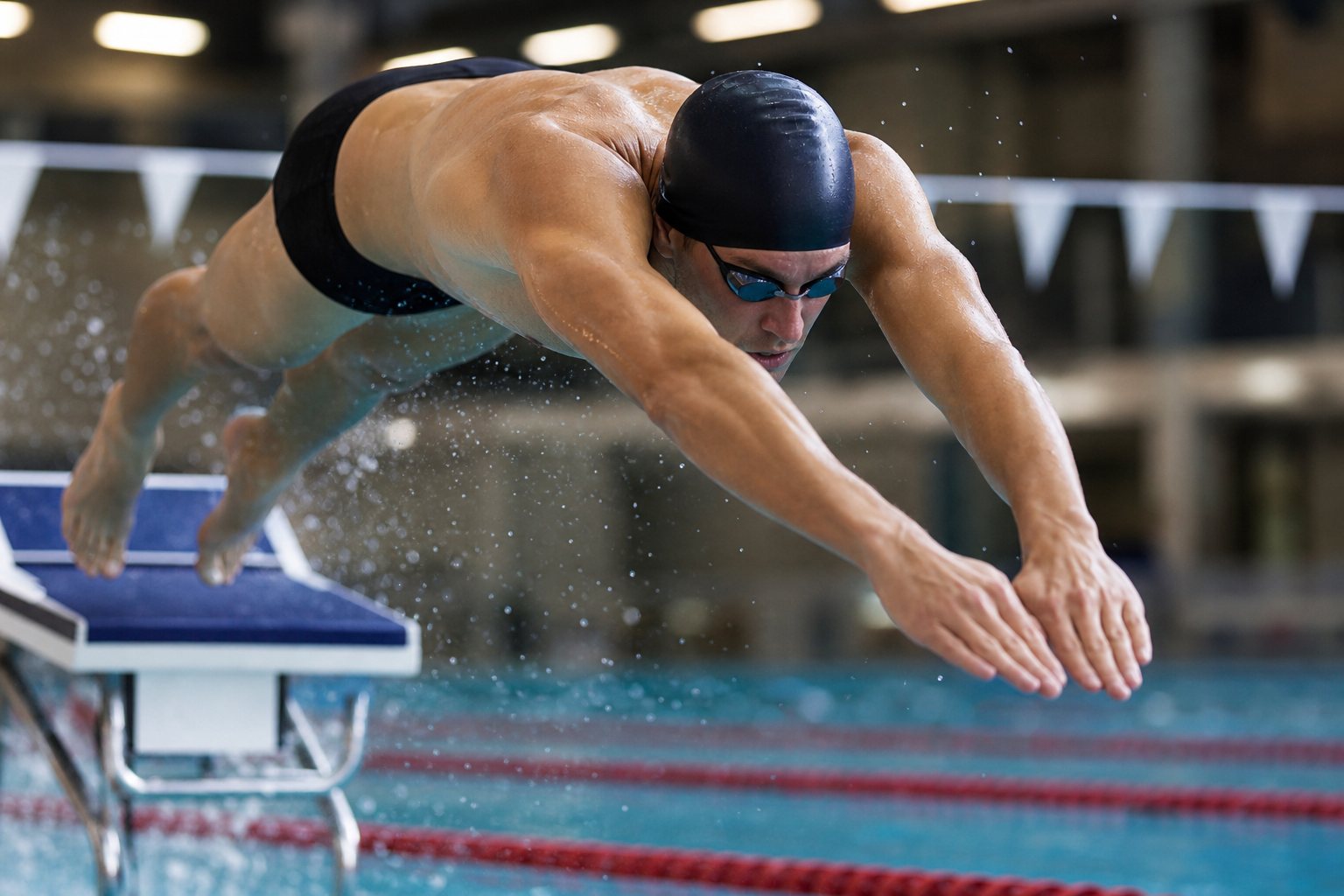
The pool is quiet at 5:45 a.m. A swimmer is on lane two, a diver is stretching on the deck, and a water polo goalie is doing shoulder circles with a band. Four sports, one building, and one shared question: how much should I train, and how? Aquatic training here means the in-water and dryland work that swimmers, divers, water polo players and artistic swimmers have in common. Each sport has its own training page; this one covers the shared ground.
Quick answer: Aquatic athletes usually mix pool sessions with dryland strength, mobility and rest. Evidence for exact numbers is thin outside elite swimming, so build volume gradually, take at least one or two days off a week (as the American Academy of Pediatrics advises for young athletes), and let a coach set the plan. See a sports medicine doctor, physical therapist or athletic trainer for pain that stays.
What the water asks of the body
Swimming is mostly aerobic work with sprint events at one end. Diving is short bursts of power, flexibility and body awareness. Water polo mixes repeated sprints, treading water with the eggbeater kick, overhead throwing and contact. Artistic swimming combines breath control, flexibility and strength while holding positions upside down or high out of the water. Open water swimming adds pacing and cold. The water supports body weight, which makes it feel gentle, yet the shoulders in particular take large repetitive loads. These descriptions come from our sport pages and federation event pages; they are general, not measurements.
A sensible weekly shape (general coaching practice)
No source gives one correct week for every aquatic athlete, so treat the pattern below as a shape, not a prescription. It is the kind of structure many clubs use, and a coach should adjust it to age, sport and season.
- Pool sessions: several per week, with skill work first, harder sets on some days and easy days between them.
- Dryland strength: two or three short sessions with legs, trunk, shoulder blades and upper back; supervised for young athletes.
- Mobility and body awareness: short daily work on shoulders, hips and ankles; divers and artistic swimmers lean on it more.
- Rest: at least one full day off; sleep protected before early practices.
The few numbers that are sourced
- A 1997 study of five elite female swimmers measured 17.5 km a day over two sessions totaling 5 to 6 hours (Trappe et al., PMID 9243495). That describes elite training, not a target for anyone else.
- The AAP clinical report on overuse injuries advises 1 to 2 days off a week and about 3 months off per year from a given sport, in 1-month blocks (Brenner 2016, PMID 27573090). A 2015 study found that training more hours a week than your age in years was linked with higher odds of serious overuse injury (Jayanthi et al., PMID 25646361).
- In 80 elite swimmers aged 13 to 25, hours swum per week and weekly mileage were linked with shoulder tendon problems (Sein et al. 2010, PMID 18463295).
- A 2021 systematic review of elite swimmers found sprinters tended toward polarized and threshold training, middle-distance swimmers toward threshold and pyramidal, and long-distance swimmers mainly pyramidal, with wave-like periodization in most studies (PMID 33952709).
Dryland: what the research supports
A 2019 review found that swim start performance was strongly related (r above 0.90) to jump height and that plyometric training improved starts (PMID 31493205). That matters most for swimmers and for the explosive takeoffs of divers and water polo players, but the review was about swimming starts. For shoulders, a 2025 randomized trial of 16- to 35-year-old competitive swimmers found that twice-weekly, 12-week programs of five exercises with weights or elastic bands left swimmers with less rotator imbalance than a sham program (PMID 40077099). Frontiers in Physiology reported in 2023 that internal rotators tend to get stronger than external rotators with repetitive strokes, and an 8-week band program showed improvements that were not statistically significant (PMID 38028779). For young athletes, the AAP advises supervised strength training 2 to 3 times a week, 20 to 30 minutes, 2 to 3 sets of 8 to 15 reps, starting without weights and avoiding maximal lifts before skeletal maturity.
Periodization in plain words
Periodization means planning harder and easier blocks across a season: build, sharpen, race, rest. In swimming research, many elite programs use wave-like cycles of load. For divers and artistic swimmers, a season usually adds more skill repetition and routine rehearsal, which we describe as coaching practice rather than evidence. Early-season athletes need time to adjust; a rapid jump in load is the thing to avoid. Our recovery page covers how to absorb the load.
Cross-training and shared habits
- Swimmers and divers can borrow each other’s sessions: kick sets and lung-capacity work for divers; flexibility and vertical jumps for swimmers (coaching practice).
- Keep a log: sessions, sleep, mood, pain. Patterns show up on paper first.
- Use other sports: the AAP encourages varied activity for young athletes.
For sport detail, see swimming training, diving training, water polo training and artistic swimming training.
Frequently asked questions
How many days a week should an aquatic athlete train?
There is no single number. The AAP advises 1 to 2 days off a week for young athletes. Beyond that, a coach sets the plan from age, sport and season.
Do swimmers need to lift weights?
Dryland strength work is common, and research shows links between jump strength and swim starts and between shoulder band or weight programs and rotator balance. Young athletes should lift under supervision.
Is swimming enough exercise on its own?
Swimming builds aerobic fitness and uses many muscles, but it is not weight-bearing. Many coaches add dryland work for strength and bone loading; talk to a coach or doctor about your needs.
How fast can I increase my yardage or training time?
No source gives a universal rate. Rapid jumps in load are linked with injury in the IOC load consensus, so increase gradually and listen to a coach and your body.
Should divers and artistic swimmers train differently from swimmers?
Yes. Their pool time is more skill-based, with more time on land for strength, flexibility and rehearsal. Use the sport pages for specifics.
Sources
- Trappe et al., energy expenditure of swimmers, 1997
- Brenner (AAP), overuse injuries and burnout, 2016
- Jayanthi et al., specialization and overuse injury, 2015
- Sein et al., shoulder pain in elite swimmers, 2010
- Training intensity distribution in elite swimmers: systematic review, 2021
- Dry-land resistance training and swim start performance, 2019
- Shoulder-strengthening RCT in swimmers, 2025
- Rotator strength imbalance and band program, Frontiers in Physiology 2023
- AAP HealthyChildren: strength training
- Soligard et al., IOC consensus on load and injury, 2016
General information for education only, not medical advice. It does not replace a visit with a doctor, physical therapist or athletic trainer. See how we write and check our pages in our editorial policy.