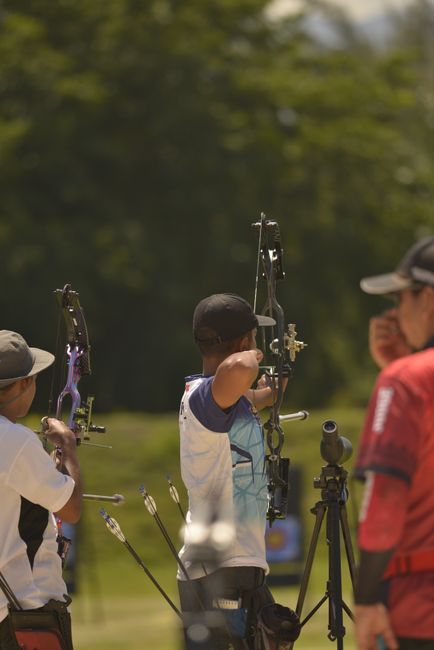
You are one arrow from the end of a long qualification round. The last two went low and left, the archer on the next lane is celebrating a ten, and your pin is drifting in a way it hasn’t all day. Nothing about your equipment has changed in the last five minutes. What you do with the next thirty seconds is a skill, and it can be practiced. Mental training for archers is the deliberate use of routines, attention, self-talk, goals and imagery to shoot your own shot under pressure, from a school range to a ranking event. It supports good shooting; it cannot promise a score.
Quick answer: Research on archers points to a few useful habits: a repeatable shot routine, a way to reset after a poor arrow, goals about process rather than score, and practice that includes pressure. None of these guarantees a result. See a doctor or a licensed mental health professional, not only a coach, if worry, low mood, disordered eating or exhaustion are affecting daily life.
General information for archers. Back to the archery hub. The physical side, including breathing and a basic shot routine, is on our archery training page, and food, sun and range signals for the day itself are on the tournament day page. This page goes deeper on the thinking side and avoids repeating those.
Why the mind matters in a sport with no opponent in your lane
An archer shoots alone, on a clock, with every result visible. That makes attention the main thing you manage. In a 2026 crossover trial of 15 well-trained compound archers, a 30-minute mentally tiring computer task before shooting made accuracy significantly worse, while heart rate did not change (Soylu and colleagues, Brain Sciences). The practical lesson many coaches draw is to protect your mental energy before a round: avoid long screen sessions, arguments and last-minute equipment tinkering. That is an interpretation of one small study, not a rule.
Confidence from evidence
In interviews with 65 South Korean archers who had shot a perfect ten (the X-ring), confidence and a positive mindset were the leading themes in how they described their preparation (Lee and Hwang, Frontiers in Psychology 2024). Confidence tends to hold up better when it is tied to proof: scores you shot in practice, rounds you finished, the form checks you passed. Many archers keep a short training log and reread it the week before a tournament. That is common practice rather than a tested method.
Focus: one arrow at a time
Attention in archery is narrow and repeated. Between arrows it can wander to the score, the wind or the person beside you; at full draw it needs to sit on one or two form cues. A few approaches coaches use:
- Choose one process cue per arrow, such as back tension or a smooth follow-through, instead of several. Fewer cues are easier to hold when the clock is running.
- Keep self-talk short and instructional. A 2011 meta-analysis of 32 studies by Hatzigeorgiadis and colleagues found self-talk helped most on fine or novel tasks, which suits the precision of a release. Words like “smooth” or “through” are examples, not a prescription.
- Separate “doing” from “judging.” Score after the end, not during the shot.
Goals that you control
A goal of “score 650” depends on wind, rivals and luck. A goal of “run my full routine on every arrow” is yours alone. An expert statement for Exercise and Sports Science Australia on goal setting (Swann and colleagues, Sports Medicine 2026) is a good place to read about setting goals well. For a practical ladder, many coaches use three levels: a process goal you control, a performance goal such as an average per end, and an outcome goal such as a placing. Hold the outcome goal loosely. For young archers, a 2025 article in the British Journal of Sports Medicine raised the question of whether goal setting in youth sport can unintentionally contribute to dropout, so keep goals playful and flexible for children.
Motivation across a long season
Archery improvement is slow and often invisible week to week. Archers who stay with it tend to find small, concrete signs of progress: a tighter group at a set distance, a cleaner release on video, a better score on the same round. Record those. Shooting with a partner or club group, trying a different round or format occasionally, and taking a planned easier week all help keep the sport enjoyable, which is what keeps you shooting. This is general coaching practice, not a study result.
Imagery and visualization
Imagery means rehearsing a shot in your mind: the stance, draw, anchor, release and the arrow arriving, with the feel of it rather than only the picture. A 2026 scoping review (Zhao, Wang and Anuar, Frontiers in Psychology) mapped how athletes use mental imagery to manage stress, which shows researchers take it seriously, but we are not aware of an archery-specific study we can cite for a size of benefit. A simple use: two minutes of imagery the evening before, running through your routine at the venue, and a few seconds before you step up to the line. Keep it to what you can control and stop if it makes you more tense.
A pre-shot routine you can trust
A routine is a fixed sequence that begins before you nock and ends after the arrow lands. Its job is to make the shot automatic and to give a nervous mind something to do. A workable structure:
- Before the line: a slow breath and a single intention for the end.
- On the line: your physical sequence, then your cue, then the release.
- After the arrow: hold your follow-through, then a one-word note (good, low, left) and let it go.
- Let down if it is wrong. Coming down and restarting is part of the routine, not a failure. The time limits under World Archery rules are listed on the archery rules page; practice with a timer so a restart is never a surprise.
For the breathing part, a review of slow breathing (Zaccaro and colleagues, Frontiers in Human Neuroscience 2018) linked breathing under about ten breaths a minute with higher heart rate variability and feeling calmer and more alert. That supports a slow breath as part of a routine; it does not prove it improves scores.
Handling pressure
Pressure is physical as well as mental. Among eight elite league archers followed over 184 matches, heart rate rose from about 97 beats per minute before matches to about 111 during them, while a measure of heart rate variability linked to calm stayed steady, and the pattern was similar in higher and lower scoring matches (Yuan and Chang, Perceptual and Motor Skills 2026). A fair reading is that feeling revved up is normal and does not by itself mean a bad day. Ways to practice with it:
- Score training ends and write the number down, so the feeling of being counted is familiar.
- Create small stakes: shoot a last end against a friend, or “you must hit the gold to go home.”
- Practice shoot-offs and the alternating-arrow timing used in matches.
- Name the feeling as readiness, then return to the routine.
You may hear that some people use medication to steady their hands. Beta-blockers are prohibited in archery under the WADA list, and alcohol is banned in World Archery competition, so neither is a nerves strategy; details are on our archery nutrition page. If you take a prescribed medicine, talk to your doctor before changing anything.
After a bad arrow or a bad round
Researchers studying elite archers found performance dropped after two consecutive missed bullseyes, described as a “cold hand” effect (Li and Zhao, Frontiers in Psychology 2024). The finding is a reason to plan a reset rather than a reason to worry. A reset can be as small as one breath, a cue word and a return to the first step of the routine. After a poor round, give yourself a short, specific review: one thing that went well, one thing to practice, then move on. Avoid replaying the score all evening.
Decisions and teamwork
Archery decisions are small but real: whether to let down, when to adjust a sight mark in changing wind, whether to shoot early or late in the time window. Settle these rules in practice rather than on the line. In team rounds, archers usually agree beforehand on signals and who adjusts for wind. We could not find archery-specific studies to cite on these points, so treat them as common coaching practice.
Getting ready for a tournament
Mentally, preparation is mostly about removing surprises. Visit or look up the venue, know your target lane and timing, rehearse your routine with your own equipment, and decide beforehand what you will do if the wind changes or a rival shoots a perfect end. Logistics such as packing, food, sun and range signals are covered on the archery tournament day page, so we will not repeat them. Check the rules page for formats and the leagues and associations page for how to find events.
Young archers
Most young archers start in school or club programs (see youth archery). For children, the most useful mental skills are simple: a short routine, a calm adult who praises effort and safe habits rather than scores, and goals that can change. We have not cited archery-specific research on age-appropriate mental skills, so this follows the general caution above about goal setting in youth sport.
Mental performance is not mental health
Routines, imagery and self-talk are performance skills. Anxiety that will not settle, low mood, loss of interest, disordered eating, constant exhaustion or burnout are health matters, not weaknesses of technique. The International Olympic Committee consensus statement on mental health in elite athletes (Reardon and colleagues, British Journal of Sports Medicine 2019) treats them as health concerns that need appropriate assessment and care. If these are affecting your sleep, school, work or relationships, talk to a doctor or a licensed mental health professional. In the United States, you can call or text 988 (the 988 Suicide and Crisis Lifeline) at any time if you or someone you know is in distress. The Association for Applied Sport Psychology lists resources on finding a sport psychology professional. If you are outside the US, contact your national emergency or crisis service.
Archery mental training: FAQs
How do I stop shaking at full draw when I’m nervous?
Some shake comes from fatigue and some from nerves. Work on strength and holding endurance (see archery training), use a routine and slow breath, and let down if it does not settle. Do not use medication to steady your hands: beta-blockers are prohibited in archery. If tremor is frequent, mention it to a doctor.
What should I think about while shooting?
Most coaches suggest one or two simple process cues rather than the score or the result. Meta-analytic evidence suggests short, instructional self-talk helps most on precise tasks, though results vary between people.
How do I recover after shooting a bad end?
Plan a reset: one slow breath, a cue word, and back to the first step of your routine. Elite archers’ scores have been observed to dip after two missed tens in a row, so a practiced reset is worth building before you need it.
Does visualization improve archery scores?
Many archers use it for rehearsal and for settling nerves, and researchers study imagery in athletes broadly. We have not found an archery study we can cite that shows how much it helps, so treat it as one tool among several.
When is nervousness a health problem?
Pre-round nerves are common. If worry, low mood or avoidance are frequent, last more than a short time or interfere with daily life, speak to a doctor or licensed mental health professional. In the US, 988 is available by call or text.
Sources
- Soylu Y et al. Mental fatigue and compound archery accuracy. Brain Sci 2026 (PMID 42192772)
- Lee and Hwang. Preparation themes of archers with X-ring experience. Front Psychol 2024 (PMID 39944706)
- Yuan and Chang. Heart rate and heart rate variability in elite archers in league matches. Percept Mot Skills 2026 (PMID 42773550)
- Li and Zhao. Consecutive misses (“cold hand”) in elite archers. Front Psychol 2024 (PMID 39377056)
- Hatzigeorgiadis A et al. Self-talk and sports performance: a meta-analysis. Perspect Psychol Sci 2011 (PMID 26167788)
- Zaccaro A et al. How breath-control can change your life: slow breathing review. Front Hum Neurosci 2018 (PMID 30245619)
- Swann C et al. Goal setting in exercise and physical activity: an expert statement for Exercise and Sports Science Australia. Sports Med 2026 (doi)
- Goddard SG et al. Goal setting in youth sport: are we unintentionally contributing to dropout? Br J Sports Med 2025 (doi)
- Zhao L, Wang Y, Anuar N. Mapping the use of mental imagery for stress management in athletes: a scoping review. Front Psychol 2026 (doi)
- Reardon CL et al. Mental health in elite athletes: IOC consensus statement (2019). Br J Sports Med 2019 (doi, PMID 31097450)
- World Archery rule books 2026 (Book 3)
- 988 Suicide and Crisis Lifeline (988lifeline.org)
- Association for Applied Sport Psychology resources (appliedsportpsych.org)
General information for education only, not medical advice. It does not replace a doctor, licensed mental health professional or qualified coach. See our editorial policy for how we research and write.