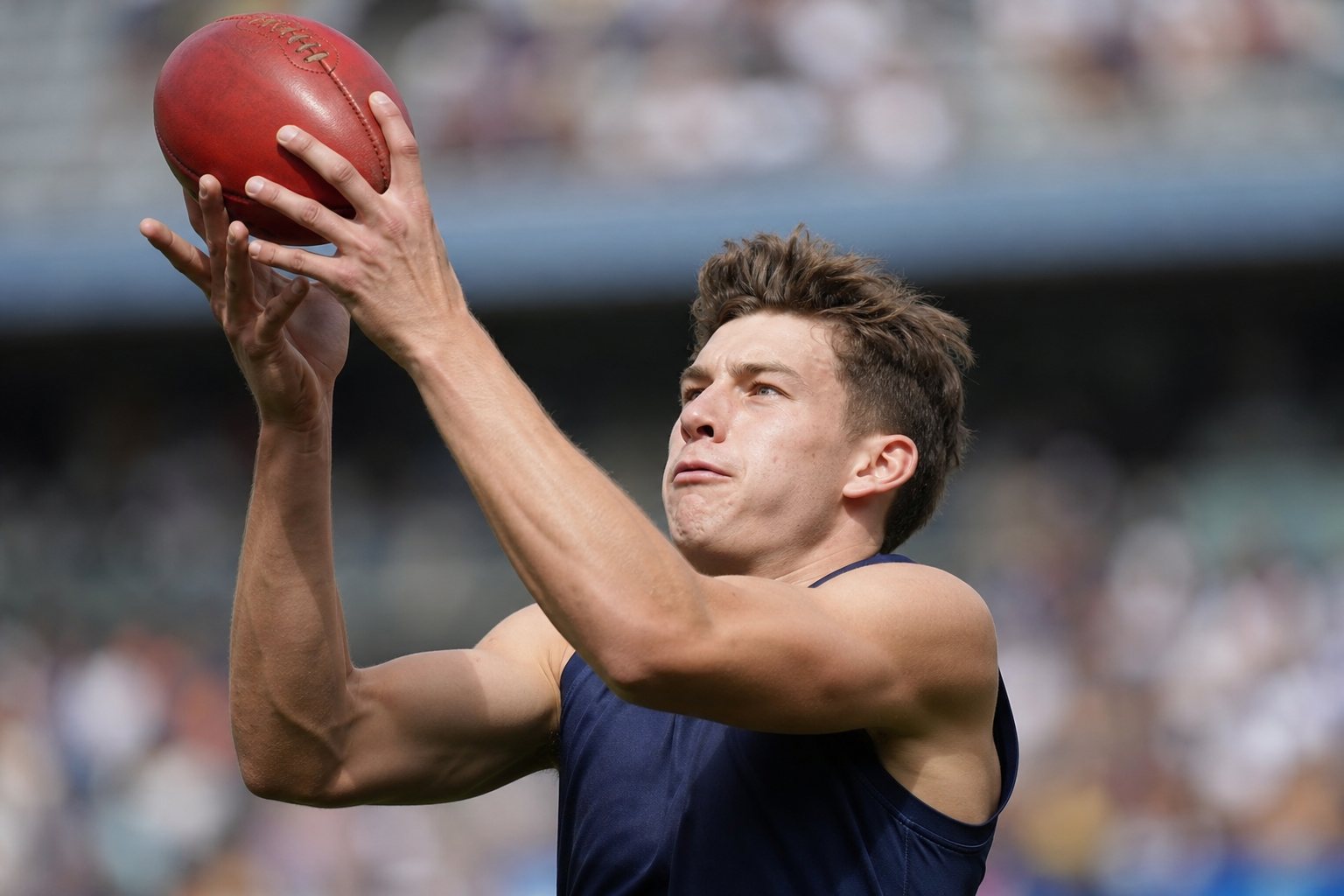
Tuesday night at a suburban oval: two laps at an easy jog, then a set of 20-metre sprints, then kicking drills until the light goes. Match day will ask the same body to run for most of 80 minutes of playing time, change direction, jump for a mark and tackle. Australian rules football training is the practice of building that body in a sensible weekly pattern, and this page explains what the sport demands and how players commonly organise a week. It is general information, not a personal plan.
Quick answer: Footy mixes steady running, repeated sprints, jumping, kicking and tackling, so a week usually blends running, strength work, ball skills and rest. Keep sudden jumps in running volume or sprint distance small: in a study of 299 elite men, higher weekly high-speed running and bigger weekly changes in running load were linked with more hamstring strains. A coach, physical therapist or athletic trainer can tailor numbers to your age, level and history.
Rules and how to start are on the rules page. How to lower injury risk is on the injury prevention page, and rest is on the recovery page. The sport overview is on the hub.
What the game asks of the body
A 2018 review of Australian football injury and demand research describes the sport as a mix of tackling, kicking, jumping and high-speed running, with more high-speed running than other football codes. A systematic review of running performance found that elite men covered about twice the total distance of elite women, mostly because men’s quarters are longer, and that men did at least 50% more high-speed running (above 14.4 km/h) relative to time played. A study of 17 women in the AFLW (the professional women’s league) measured 6,712 metres per match, with bursts of very high-intensity running. A later study of one AFLW club saw total distance rise by 344 metres and then 971 metres across consecutive seasons, a reminder that the demands change as leagues develop.
Those are elite numbers from GPS units. A community or junior player will usually do less, but the pattern is the same: long periods of moderate running broken by sprints, jumps and contact. A 2022 systematic review of 48 studies found that physical demands are well documented, while how technical skill and tactics affect movement is much less understood.
A sensible weekly shape
One study of 42 professional men across two weekly match cycles shows how a week can be organised. Total distance was about 13 kilometres on game day, about 8 km two days before, about 7 km four days before, about 3.5 km the day before and none three days before. In plain terms, the heaviest running sat early and midweek and the lightest came just before the match. The authors also reported low carbohydrate intake relative to the work, which we cover on the nutrition page. A community player will not train like this, but the idea of a light day before the game and a harder session earlier in the week is the useful part.
An illustration for a recreational adult with a Saturday game (a general example, not from a study and not a prescription):
- Monday: rest or an easy walk or jog.
- Tuesday: strength session for legs, hips, trunk and shoulders.
- Wednesday: team training with running, kicking and handball.
- Thursday: shorter speed or agility work with full recovery between sprints, plus kicking practice.
- Friday: light activity or rest before the match.
- Saturday: match.
- Sunday: easy movement and sleep.
Running: the base and the sprints
Footy running has two layers. The first is aerobic fitness so you can keep going and recover between efforts, built with easy running and, for those who are ready, interval work. The second is repeated sprinting and changes of direction, built in short sessions with full rest between efforts. The hamstring study mentioned above (Breed and colleagues, 2025) followed 299 elite players over two pre-seasons and two seasons. There were 67 hamstring strains across 408 player-seasons (16.4%), and weekly high-speed running distance (odds ratio 1.7), weekly change in total distance (1.5) and weekly change in high-speed running (1.6) differed between the injured and uninjured groups. That is an association in elite men, not a rule for everyone, but it supports building speed work gradually and avoiding a sudden jump after a break.
Strength and conditioning
Strong legs help with kicking, landing and sprinting, and strong shoulders and trunk help with tackling and marking. The hamstring study found that strength and muscle architecture measures together explained only 12% of the variation in hamstring risk, so strength is one piece of the picture, not a guarantee. A 2024 study of 223 female players found that running vertical jump height, hip abduction strength and 6-metre hop speed were related to kicking accuracy once playing experience was taken into account.
- Legs and hips: squats or lunges, hip hinges, calf raises and single-leg work to suit your level.
- Hamstrings: Nordic and bridge-type exercises are common; a 2021 reappraisal of the evidence found their injury-prevention effect inconclusive, so use them as part of a program, not as a promise.
- Trunk and shoulders: planks, rows and pushing work to prepare for contact.
- Landing and cutting: practice soft, balanced landings and changes of direction with a coach.
For children and teens, the 2014 international consensus statement on youth resistance training says that appropriately designed and supervised programs can be safe and effective. Ask a qualified coach before young players start lifting.
Kicking load
Kicking is repeated thousands of times. A 2026 study of 35 professional women found they averaged 37.2 kicks per training session, 95.9% of them on the preferred leg. Build kicking volume slowly after a break, because every kick is repeated stress on the hip and leg. For beginners, short sessions of 10 to 20 kicks with good technique are a common starting point in coaching, not a figure from a study.
Pre-season and in-season basics
Periodisation simply means changing the focus across the year. In most programs the pre-season builds fitness and strength, the in-season keeps fitness while managing fatigue and contact, and the off-season gives the body a break. We did not find a community-level study that tests a specific plan for amateur footy, so treat the structure as general practice. In the USAFL, club seasons start in spring, regionals run June to July and Nationals are in October, so US players may plan their peak around those dates.
If you are returning to play after a break or an injury, do not jump straight back to full training. A study of gastrocnemius (calf) strains in the AFL found that a recent change in loading before the injury was linked with longer recovery. Increase load gradually, and talk to a sports medicine doctor or physical therapist about the pace.
Australian rules football training FAQs
How fit do I need to be to start?
Not very fit. The USAFL runs a non-contact Rec program for all skill levels. Build up with walking and easy jogging, and let the club’s sessions do the rest.
How many days a week should I train?
Many community players train two or three times a week and play once, with strength work on one of the training days. The right number depends on your age, fitness and recovery, so ask a coach.
Do I need to lift weights?
It helps. Stronger legs, hips and trunk support kicking, landing and contact, but strength training is not a guarantee against injury. Young players need qualified supervision.
How do I avoid a hamstring strain when I start sprinting?
Build sprint volume gradually and avoid sudden jumps in weekly running load, as the 2025 elite study suggests. If you feel sharp pain in the back of the thigh, stop and see a professional.
Is training the same for women and men?
The principles are the same. Studies show elite men run farther per match than women mainly because of longer quarters, and women’s match demands have been changing, so your coach should work from your own match demands.
Sources
- Injuries in Australian Rules Football overview, Sports Health 2018
- Running performance of male versus female players in Australian football (2021)
- Comparison of AFLW match-day energy and nutrient intake and match volume (2024)
- Evolution of athlete match demands across 3 AFLW seasons (2025)
- Physical, technical and tactical analysis in the AFL: systematic review (2022)
- Training load and carbohydrate periodization of elite male Australian football players (2020)
- Running load, strength, muscle architecture and hamstring strain injury (2025)
- Fitness, technical skill and injury in female Australian football players (2024)
- Why methods matter in a meta-analysis: Nordic hamstring exercise (2021)
- Kicking loads in professional female Australian football (2026)
- Gastrocnemius strain injury characteristics in elite Australian football (2025)
- International consensus on youth resistance training (2014)
- USAFL (Aussie Rules USA)
General information for education only, not medical advice. It cannot replace a sports medicine doctor, physical therapist or athletic trainer who knows you. See how we research and write in our editorial policy.